Meta Cracks the Claude Wall in Arena, While Usage Still Chases Cheap Tokens

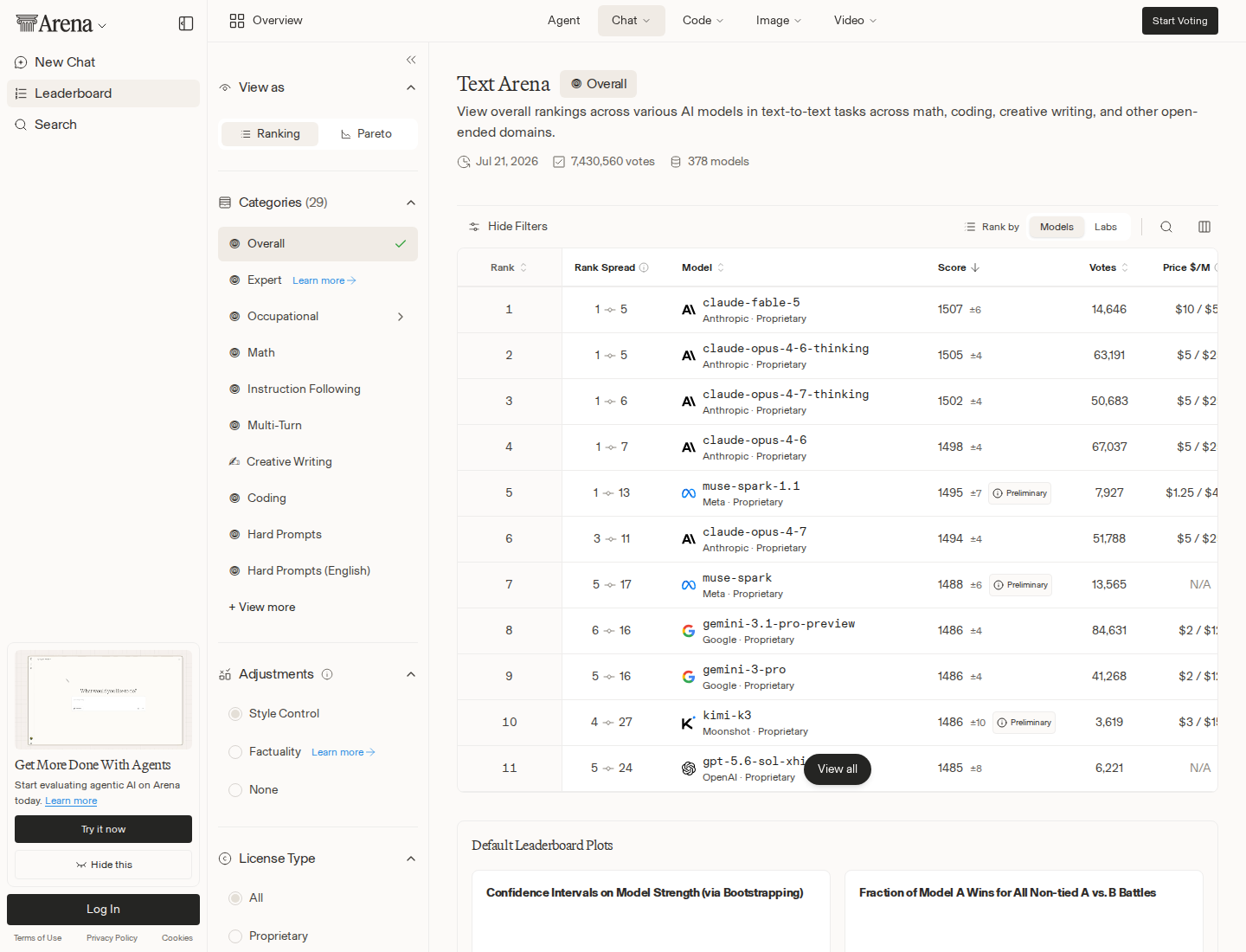
The most useful leaderboard story today is not that Anthropic is losing. It is not. Claude still owns the top of Arena AI's text leaderboard so thoroughly that the first four slots read like an internal product lineup: Claude Fable 5, Claude Opus 4.6 Thinking, Claude Opus 4.7 Thinking, and Claude Opus 4.6.
The interesting part is what happened immediately below that wall. Meta's Muse Spark 1.1 moved from #6 to #5, pushing Claude Opus 4.7 down to #6. That is a small movement on paper and a useful signal in practice: the frontier preference tier is still Claude-led, but it is no longer cleanly Claude-only at the edge where teams start building their eval shortlists.
That distinction matters. Leaderboards are terrible when treated as procurement systems and useful when treated as smoke alarms. A one-rank move should not trigger a migration plan. But when a non-Anthropic model moves into the top five while Meta also holds #7 with Muse Spark, the correct engineering response is not fanfare. It is adding the model to the next eval run and seeing whether the public ranking translates into your private workload.
Meta did not take the crown. It earned a meeting.
Arena's visible top 20 now has Muse Spark 1.1 at #5 and Muse Spark at #7. Between them sits Claude Opus 4.7 at #6, newly down one slot. Below that, Moonshot's Kimi K3 rose from #9 to #8, OpenAI's GPT-5.6 Sol XHigh rose from #10 to #9, and Google's Gemini 3 Pro fell two places from #8 to #10.
That cluster is where the real vendor fight is happening for most practitioners. The #1 model matters for hard calls, executive demos, and the rare workflow where marginal reasoning quality beats every other constraint. But the #8 to #15 band often determines what gets shipped: models that are good enough, cheaper enough, faster enough, or simply easier to route through existing infrastructure.
The movement is also a reminder that model selection has become a portfolio problem. Teams should stop asking which model is best and start asking which failure modes they are willing to buy. Claude's current Arena dominance suggests it remains the strongest default for high-judgment language tasks. Muse Spark 1.1 moving up suggests Meta deserves fresh attention where teams need a second frontier-class candidate. Kimi K3 and GPT-5.6 Sol XHigh moving upward while Gemini 3 Pro falls suggests the middle of the top 10 is too fluid for hard-coded vendor loyalty.
For engineers, the action item is blunt: if your model routing table has not changed in the last month, it is probably stale. Add Muse Spark 1.1 to your eval harness next to the strongest Claude candidate. Keep Kimi K3 and GPT-5.6 Sol XHigh in the candidate set for coding-heavy and agentic tasks. Re-test Gemini 3 Pro instead of assuming its prior rank still describes its current behavior.
Usage is telling a different story than preference
OpenRouter's ranking adds the necessary cold water. Its visible weekly-usage table is not led by the premium models that dominate public preference boards. It is led by accessible, high-volume options: Hy3 (free) at 11.8T weekly tokens, MiMo-V2.5 at 9.37T, and DeepSeek V4 Flash at 5.34T. GLM 5.2 moved ahead of MiniMax M3 for #4, with 3.57T tokens versus 3.46T.
That is not a contradiction. It is the market behaving like the market. Preference leaderboards reward quality as measured by side-by-side prompts. Usage leaderboards reward distribution, price, defaults, speed, community momentum, and the willingness of developers to burn tokens without asking finance for forgiveness.
The weekly growth numbers make the picture more interesting. Hy3 rose from 11.5T to 11.8T tokens, but its week-over-week growth cooled from 88% to 58%. MiMo-V2.5 rose from 9.23T to 9.37T while cooling from 55% to 43%. Nemotron 3 Ultra fell from 3.08T to 2.92T and cooled from 51% to 22%. The winners are still large, but the acceleration is easing.
That cooling matters because it separates adoption from novelty. A model can spike because people are curious, because a provider is subsidizing usage, because a router promotes it, or because it genuinely solves a cost-performance problem. Sustained token volume after the first burst is the more interesting signal. Hy3 and MiMo-V2.5 are still enormous by OpenRouter volume, but the next few snapshots will tell us whether they are becoming durable infrastructure or just winning the current free-token popularity contest.
Practitioners should read OpenRouter popularity as an operational clue, not a quality verdict. High volume can mean the model is easy to integrate and cheap enough for experiments. It can also mean users are using it for workloads that tolerate errors. If you are building customer-facing automation, do not promote a model because it is popular. Promote it because it passes your evals at your target latency, cost, and incident budget.
The caveat is part of the story
Today's Arena table exposed category ranks rather than the Elo and vote fields that make leaderboard movement easier to interpret statistically. The visible columns included Overall, Expert, Hard Prompts, Coding, Math, Creative Writing, Instruction Following, and Longer Query. OpenRouter's scraper exposed only ten visible rows after attempting to expand the list.
That means the right confidence level is directional, not absolute. Muse Spark 1.1 passing Claude Opus 4.7 is worth noticing. It is not proof that Muse is better than Claude for your support agent, code reviewer, search assistant, or long-context analyst. Gemini 3 Pro falling two slots is worth watching. It is not an obituary. The numbers tell us where to look; they do not remove the need to test.
This is where many teams still get model evaluation wrong. They treat public leaderboards as either gospel or noise. Both positions are lazy. Public leaderboards are external monitoring. They catch broad changes in capability and demand before your internal process would, but they cannot know your prompts, your retrieval quality, your tool schemas, your latency requirements, or your users' tolerance for weird answers.
The healthier pattern is simple. Maintain a small internal benchmark suite built from real tasks: successful tickets, failed tickets, known adversarial prompts, representative code changes, and cases where the current model needed human rescue. Run the top public movers through that suite weekly. Track quality, latency, cost, refusal behavior, tool-call correctness, and recovery from bad intermediate state. Then route by workload instead of replacing one default model with another every time a public table twitches.
That is especially important for agentic systems, where token usage can explode. A cheaper model that handles planning poorly may cost more once retries, tool mistakes, and human review are counted. A premium model that succeeds in fewer steps may be cheaper per completed task. OpenRouter's token rankings are useful because they show what developers are willing to try at scale, but completed-work economics still have to be measured inside your own product.
The practical read
My read: Anthropic remains the benchmark baseline, Meta just made the short list harder to ignore, and OpenRouter is showing that production demand is still governed by access and economics as much as raw capability. That is exactly the split builders should expect. The model that wins a preference board is not automatically the model that wins your workload, and the model that wins token volume is not automatically the model you should trust.
The move this week is not to crown Muse Spark 1.1 or punish Gemini 3 Pro. It is to refresh the eval matrix. Put Claude Fable and the Opus variants in the high-confidence lane. Add Muse Spark 1.1 as a serious challenger. Keep Kimi K3 and GPT-5.6 Sol XHigh in the coding and agentic candidate pool. Use Hy3, MiMo-V2.5, GLM 5.2, and DeepSeek V4 Flash when cost and throughput dominate, but make them earn production traffic with measured outcomes.
The broader story is that the leaderboard era is maturing. The interesting signal is no longer just who is #1. It is where public preference, practical usage, pricing, and developer workflow start to diverge. That divergence is not a problem to smooth over. It is the map.
Sources: Arena AI leaderboard, OpenRouter rankings, Meta Muse Spark announcement, Poolside models, Laguna M.1 model card