Azure Content Understanding Is Becoming the Document Intake Layer for Agents

Most agent failures start before the agent does anything clever. The document was flattened badly. The table lost its headers. The embedded image never made it into context. The email thread arrived without attachments. A scanned PDF became a bag of words. Then the agent, sitting downstream from a broken intake pipeline, produces confident nonsense and everyone blames “the model.”
Microsoft’s Build update for Azure Content Understanding is worth reading through that lens. This is not just another OCR service with fresher model branding. Microsoft is positioning Content Understanding as the intake layer for agent systems: the place where documents, images, audio, and video become structured fields, layout-aware Markdown, extracted figures, and analyzable content before a model starts reasoning over them.
The update brings Content Understanding deeper into Foundry, adds support for the GPT-5 family starting with GPT-5.2, expands native file handling, and integrates with Microsoft Agent Framework, Foundry IQ, LangChain, and MarkItDown. That set of integrations tells the real story. Microsoft wants enterprise content ingestion to become composable inside agent workflows, not a preprocessing script duct-taped to the side of RAG.
The parser is now part of the agent runtime
Content Understanding combines traditional Azure Document Intelligence techniques with LLM-based content reasoning for structured and unstructured extraction. That hybrid matters because enterprise documents are rarely clean. A support packet may contain email, spreadsheets, screenshots, PDFs, scanned signatures, embedded charts, and enough formatting weirdness to make a model hallucinate structure just to feel useful. If the extraction layer cannot preserve the right evidence, the downstream agent is already compromised.
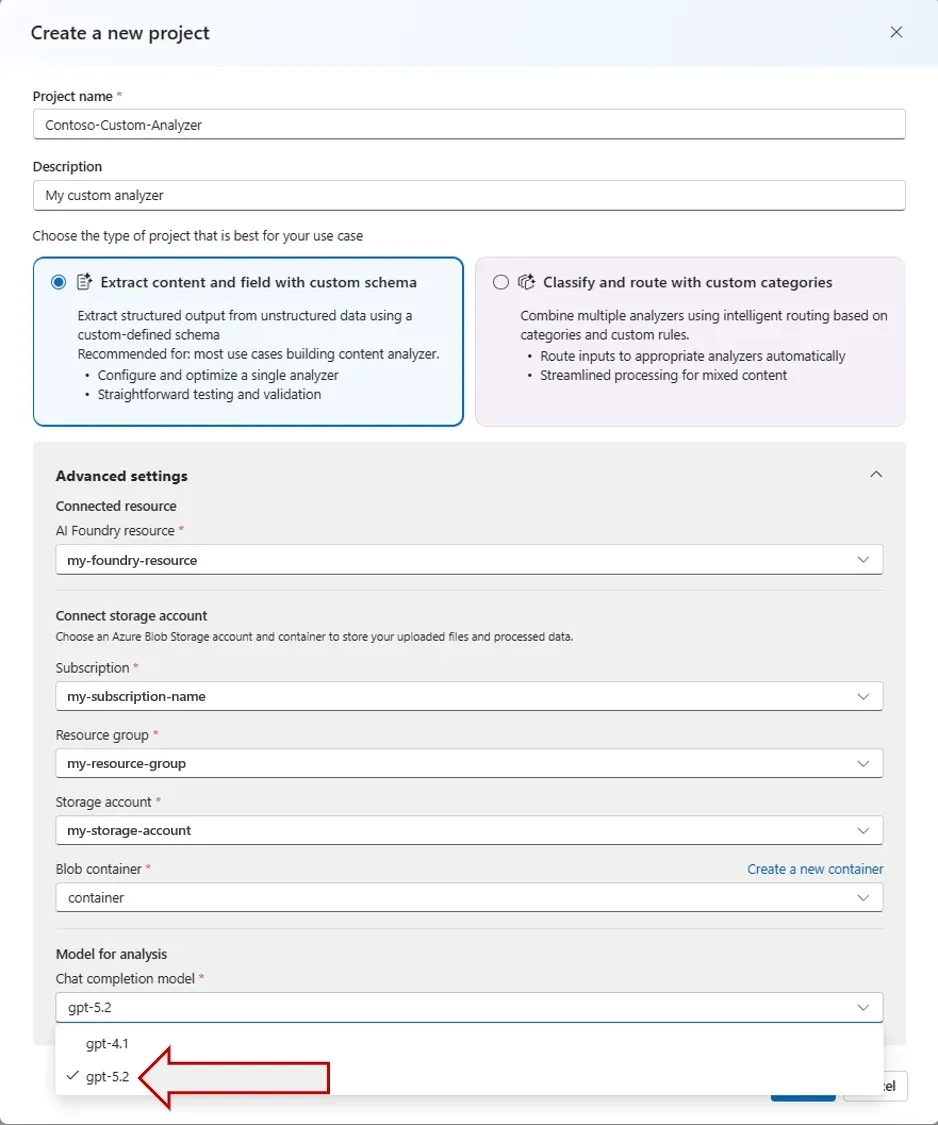
The new GPT-5.2 analyzer support will get attention because model numbers always do. Microsoft says the upgrade path is usually a two-step process: deploy GPT-5.2 in Foundry, then create new custom analyzers with that deployment in Content Understanding Studio. The more important line is Microsoft’s migration warning: run side-by-side evaluation before production because confidence scores, latency, and output accuracy can shift with a new model.
That warning should be printed on every enterprise AI dashboard. A stronger extraction model is not automatically a safer production parser. It may extract more fields, rename or reshape output, alter confidence distributions, cost more, run slower, or improve one document class while regressing another. Teams migrating from GPT-4.1 analyzers should build an eval corpus from real documents, compare field-level accuracy, inspect false positives, test multilingual and mixed-layout cases, and measure downstream retrieval quality. The metric is not “newer model looks smarter.” The metric is “fewer humans correct fewer fields without more invented structure.”
Markdown is not cosmetic when models are the reader
The MarkItDown integration is one of the more practical pieces. Microsoft’s MarkItDown is designed for LLM and text-analysis pipelines, not pixel-perfect human document conversion. Adding Azure Content Understanding as a backend means developers can route harder inputs — scanned documents, audio, video, multimodal files, and documents that need structured extraction — through a cloud analyzer and receive output that is friendlier to chunking, retrieval, and reasoning.
That distinction matters. Markdown is not merely a convenient export format. It preserves headings, tables, links, lists, and enough hierarchy to keep retrieval from becoming confetti. In RAG systems, bad conversion quietly taxes everything downstream: chunks split in the wrong place, tables lose relationships, figures disappear, citations become vague, and retrieval returns text that looks relevant but lacks the evidence a human would need. Layout-aware Markdown is a governance feature disguised as formatting.
Content Understanding now supports additional direct file types including .eml, .msg, legacy Office formats like .doc, .xls, and .ppt, plus OpenDocument formats such as .odt, .ods, and .odp. That file coverage is not trivia. A lot of enterprise knowledge is trapped in boring formats, old formats, and inbox-shaped workflows. If an agent pipeline only handles modern PDFs and clean DOCX files, it is not ready for the business documents people actually have.
The embedded-figure extraction is similarly concrete. Microsoft says customers can extract figures from Office documents such as .docx, .pptx, and .xlsx, then retrieve each figure through an analyzer-results endpoint. That can matter for technical reports, incident decks, financial presentations, medical packets, and engineering documents where the “important detail” is not in paragraph text. If your RAG pipeline drops the chart, the agent did not read the document. It read the parts your converter failed to ruin.
Mid-turn document analysis is powerful, and easy to abuse
The Microsoft Agent Framework integration is where Content Understanding becomes operationally interesting. An agent can hand off a PDF or image mid-turn and receive structured fields or layout-aware Markdown through ContentUnderstandingContextProvider. That is a cleaner developer experience than forcing every team to write its own upload, parse, normalize, chunk, and attach path.
It also changes the threat model. Document analysis becomes an active tool call. That means it needs the same governance as other agent tools: approval rules, file-size and page limits, data-residency policy, audit logs, source-to-output traceability, and prompt-injection defenses for content inside the document. A malicious document can include instructions to the model, misleading tables, hidden text, poisoned figures, or content designed to steer downstream reasoning. The extraction layer should not just produce text. It should produce evidence and metadata that downstream systems can inspect.
This is where many RAG and agent projects are still too casual. Teams spend weeks debating vector databases and model choices, then treat ingestion as plumbing. That is backwards. Retrieval quality is bounded by intake quality. Agent reliability is bounded by the evidence it receives. If the parser loses section hierarchy, strips footnotes, misreads a table, or fails to flag low-confidence fields, no amount of prompt polish will restore the missing facts.
Content Understanding’s Foundry portal integration may help here because it gives teams a playground for uploading documents and inspecting structured output side by side. That is useful not because playgrounds are production, but because they make extraction errors visible before they become model behavior. The right practice is to turn those inspections into tests: keep a corpus, version analyzers, compare outputs across model upgrades, and fail releases when extraction drift breaks downstream tasks.
API versioning is not admin trivia
Microsoft’s “what’s new” notes say Content Understanding is generally available on the 2025-11-01 API version, while preview API versions 2024-12-01-preview and 2025-05-01-preview retire by July 15, 2026. SDKs for Python, .NET, Java, and JavaScript/TypeScript target the GA API. This is the kind of detail teams ignore until a production ingestion job breaks during renewal week.
Agent pipelines need dependency discipline. Pin API versions. Track preview retirement. Keep analyzer configs in source control. Tag datasets by analyzer version. Log which analyzer produced which fields. If a model answer cites extracted content, the system should be able to reconstruct the path from source file to analyzer result to retrieval chunk to final response. That sounds heavy until legal, compliance, or a customer asks why an agent made a claim it could not support.
The July roadmap adds more to watch: synchronous Read/Layout results, agentic understanding mode for complex documents, data-zone and global-zone processing, improved training for custom analyzers, and no longer storing labeled training data in Content Understanding. The synchronous work should improve application UX. The data-zone work matters for residency. The “agentic understanding” phrase deserves adult supervision. Deeper reasoning over complex documents may be valuable for contracts, audits, tax packets, medical forms, and technical dossiers. It will also cost more, take longer, and may be harder to make deterministic. Use it where complexity earns the bill, not where a prebuilt invoice analyzer already works.
For practitioners, the action item is clear: treat document intake as an engineering subsystem, not a helper function. Classify document types by risk and complexity. Use cheap/simple conversion where it is enough. Use Content Understanding where layout, multimodal content, structured fields, or evidence quality matter. Build eval sets from real documents. Measure field accuracy, grounding, latency, cost, and downstream task success. Put prompt-injection defenses at the ingestion boundary. And do not let agents reason over content unless the system can show how that content was extracted.
The best agent in the world still fails if the document pipeline feeds it garbage. Azure Content Understanding is Microsoft’s attempt to make that boundary structured, governable, and model-friendly. That is less exciting than a new chatbot. It is also much closer to where enterprise AI systems actually break.
Sources: Microsoft Foundry Blog, Microsoft Learn, Azure Content Understanding release notes, MarkItDown on GitHub