Cheap Models Are Winning the Traffic War—But Tokens Are Not a Benchmark

The most useful thing about this week’s model rankings is also the easiest thing to misread. OpenRouter’s chart is not telling us which model is smartest. It is showing where developers are spending tokens when price, latency, availability, launch promotions, and “good enough” quality all collide. That makes it less like a benchmark and more like production telemetry—with several large asterisks attached.
The headline movement is Tencent’s Hy3 climbing to second place with 5.36 trillion weekly tokens, passing Xiaomi’s MiMo-V2.5 at 5.22 trillion. DeepSeek V4 Flash 0423 remains first at 6.6 trillion, while DeepSeek V4 Flash 0731 sits fourth with 4.71 trillion. Add those four models together and the top of the chart represents 21.89 trillion displayed tokens, all from Chinese providers.
That concentration is more consequential than a one-place shuffle. It suggests that the center of gravity for high-volume inference is moving toward models designed around aggressive deployment economics. Premium frontier models still matter for the hardest tasks, but raw traffic increasingly belongs to systems that can process extraction, classification, summarization, retrieval synthesis, and agent substeps without charging frontier-model prices for every call.
Hy3’s 21 billion active parameters explain the appeal
Tencent describes Hy3 as a hybrid fast- and slow-thinking mixture-of-experts model with 295 billion total parameters but only 21 billion active for a given token. It supports a 256,000-token context window, and its weights are available under Apache 2.0. Tencent says daily token consumption grew twenty-fold after its April preview, while active selection inside its WorkBuddy product increased sixfold.
The architecture matters because total parameter count is a poor proxy for serving cost in a sparse model. Activating 21 billion parameters at inference time can produce a very different throughput profile from running a dense 295-billion-parameter network. It does not make Hy3 trivial to self-host—the memory footprint, expert routing, interconnect requirements, batching behavior, and operational burden remain serious—but it creates a plausible path for organizations that want both strong capability and an exit from permanent dependence on a hosted API.
There is a second-order effect here. An Apache-licensed model does not merely compete on today’s hosted price; it puts a ceiling on tomorrow’s switching cost. Teams can start behind an API, collect task traces and eval data, then decide whether sufficient volume justifies managed or self-hosted deployment. That option value is difficult to represent on a leaderboard, but procurement teams and platform engineers should include it when comparing models.
Community enthusiasm is encouraging but not yet evidence of reliability. A recent r/opencodeCLI thread praising Hy3’s ability to spot adjacent weaknesses during debugging received 75 votes and 16 comments. That is a useful qualitative clue: the model may do more than patch the line directly in front of it. It is not a substitute for longitudinal data on regressions, tool-use failures, schema adherence, or behavior across a team’s actual repositories.
Gemini 3.6 Flash arrives selling fewer tokens, not more
Google’s Gemini 3.6 Flash entered OpenRouter’s top 20 at number 14 with 1.16 trillion tokens and a displayed 263% weekly increase. The more interesting claim is not the growth rate, which is heavily affected by launch timing. Google prices the model at $1.50 per million input tokens and $7.50 per million output tokens, compared with $9 per million output tokens for Gemini 3.5 Flash, and says it uses 17% fewer output tokens on the Artificial Analysis Index.
That last metric points toward the right unit of competition. A cheaper token is useful; avoiding an unnecessary token is better. Agentic workflows often amplify small inefficiencies because one verbose response triggers another tool call, another retrieval, or another attempt to repair malformed output. If Gemini can complete the same accepted workflow with fewer generated tokens and fewer loops, the effective saving may exceed the difference on the price card. If it needs more retries, the advertised discount can disappear immediately.
Google’s model card gives developers reasons to test by workload rather than crown a universal winner. Gemini 3.6 Flash scores 58.7% on SWE-Bench Pro, up from 55.1% for 3.5 Flash; 49% versus 37% on DeepSWE; 63.9% versus 49.7% on MLE-Bench; and 83.0% versus 78.4% on OSWorld-Verified. Against GPT-5.6 Luna, however, the pattern splits. Luna leads on SWE-Bench Pro, 62.7% to 58.7%, on DeepSWE, 67% to 49%, and on Terminal-bench 2.1, 84.7% to 78.0%. Gemini leads on MLE-Bench, 63.9% to 47.6%, and OSWorld, 83.0% to 72.6%.
Those are vendor-reported numbers and deserve reproduction on internal tasks. Still, the shape is believable: coding agents, ML engineering, and computer-use automation are related but distinct workloads. The practical conclusion is not to select whichever row has the most bold numbers. It is to route by task family and preserve an escalation path when the inexpensive model fails.
Gemini 3.6 Flash offers a one-million-token input window and 64,000-token output limit, but long context should not be mistaken for free context. Large prompts increase latency, cost, and the chance that important instructions are diluted by irrelevant material. Google also acknowledges hallucinations, occasional slowness or timeouts, and an uneven knowledge cutoff—March 2026 in some domains and January 2025 in others. Production systems need retrieval, validation, and timeout handling even when the context-window number looks comfortably oversized.
The leaderboard is a shortlist generator, not a purchasing decision
OpenRouter calculates its ranking from prompt tokens plus completion tokens. Its documentation explicitly warns that upstream providers supply their own token counts, and tokenizers are not directly comparable. One model can split the same text into more tokens than another and appear busier without doing more useful work. Free endpoints, discounts, and temporary promotions also influence selection: GPT-5.6 Luna remains fifth at 3.54 trillion tokens with an eye-catching 848% weekly change while OpenRouter is promoting a limited 50% discount.
Nor is OpenRouter share equivalent to market share. The chart excludes enormous first-party workloads and reflects the preferences of one routing ecosystem. It can reveal which models developers are curious enough to try and cheap enough to run at scale, but it cannot tell us how many tasks succeeded, whether users were satisfied, or whether the traffic will remain after a subsidy ends.
Engineering teams should treat this week’s movers as candidates for a controlled bake-off. Send a 5–10% shadow or canary slice through Hy3 and Gemini 3.6 Flash using fixed prompts and explicit acceptance checks. Measure cost per accepted result, p50 and p95 latency, retry rate, invalid structured-output rate, tool-call count, fallback frequency, and human correction time. Segment those metrics by task type; averages routinely hide the one workflow where a cheaper model creates expensive cleanup.
Also test the failure path, not just the happy path. Force malformed tool responses, unavailable dependencies, ambiguous instructions, and context near the window limit. A model that is slightly weaker on a public coding benchmark can still be the better production choice if it fails predictably, follows schemas, and escalates uncertainty. Conversely, a spectacular demo model that silently invents fields will eventually invoice the team through incident response.
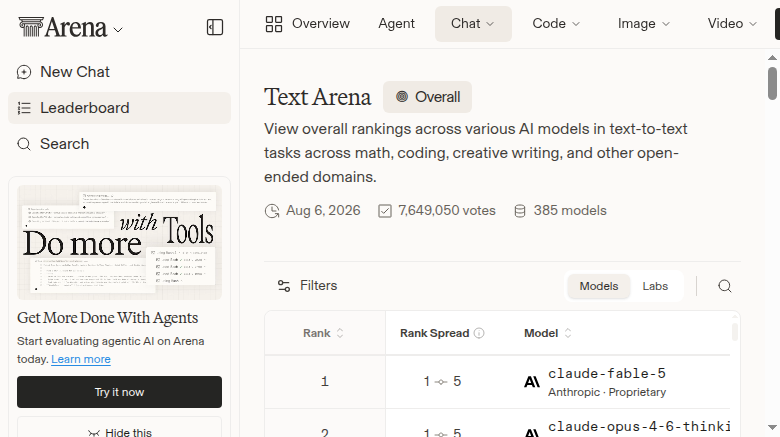
The Arena AI text leaderboard was static in the latest capture, with Anthropic models occupying much of the top tier, but that does not contradict OpenRouter’s traffic story. Preference tests and usage charts answer different questions. One measures what evaluators choose in controlled comparisons; the other records what routed workloads consume under real economic constraints. Mature model stacks will use both signals and obey neither blindly.
The shift worth watching is from “best model” to “best economics per completed job.” Cheap, efficient models are winning substantial traffic because most production calls do not require the maximum reasoning available at any price. The winning architecture will not bet everything on this week’s number one. It will make models replaceable, measure outcomes instead of tokens, and reserve expensive intelligence for the requests that can prove they need it.
Sources: OpenRouter Rankings, OpenRouter rankings dataset documentation, Tencent Hy3 announcement, Google Gemini 3.6 Flash announcement, Gemini 3.6 Flash model card, Arena AI leaderboard