Claude Code Memory That Loads but Does Not Steer Tools Is Just Expensive Wallpaper

Agent memory has a marketing problem because the word “memory” sounds stronger than the mechanism usually is. Developers hear “remember this” and mentally file it under configuration. Most agent systems file it under context. That gap is where a lot of disappointment lives.
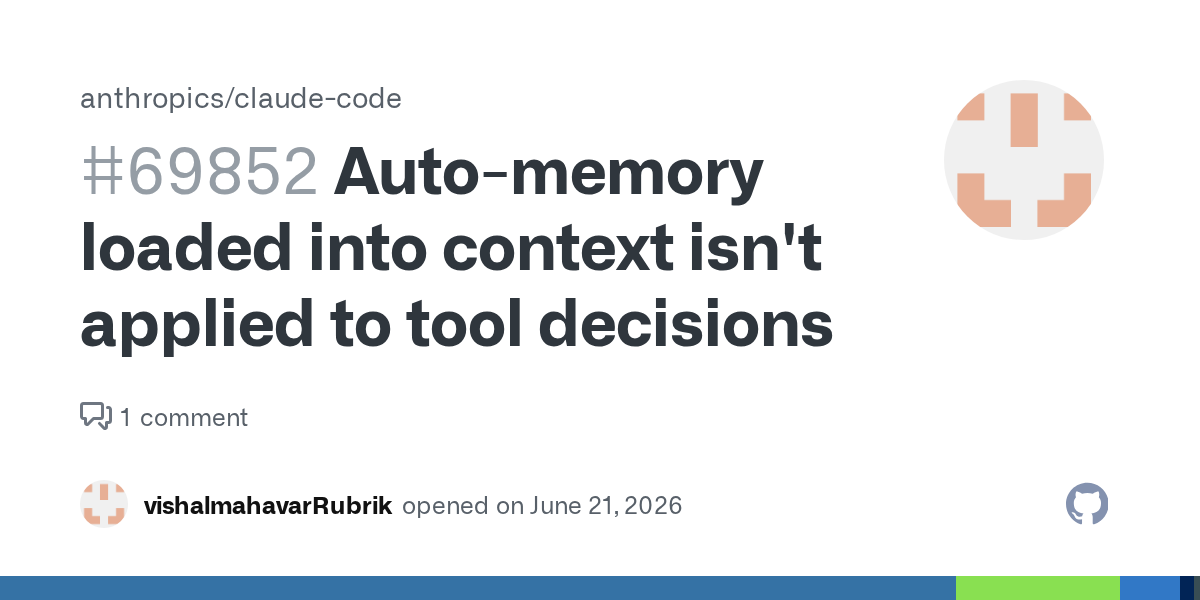
A new Claude Code issue captures the problem in miniature. The reporter says an auto-memory file was loaded into context with a clear rule: always invoke devpod via lab/bin/devpod from the repository root, never by relying on the bare devpod PATH lookup. The session was allegedly already at the repo root, so the condition applied. Claude Code still formed a Bash command using an absolute path like /Users/.../sdmain/lab/bin/devpod create ... instead of the specified relative invocation.
That is a small path-choice bug. The more interesting part is the reported repair instinct: after correction, the agent allegedly tried to edit the memory to make it stricter rather than simply applying the memory that already existed. That is how memory turns into expensive wallpaper — loaded, visible, and decorative, but not steering the tool call at the moment it matters.
The file was named feedback_devpod_binary_path.md and was loaded through a MEMORY.md pointer line. The instruction reportedly said: “ALWAYS invoke devpod via lab/bin/devpod, never the bare devpod PATH lookup … From the repo root, invoke as lab/bin/devpod <args>.” The issue asks whether memory-derived constraints are being weighted below default tool-argument heuristics during tool-call formation. That is the right question. The problem is not that the model needed louder prose. It is that the relevant rule did not bind to the decision boundary.
Loaded context is not enforced policy
Claude Code’s memory documentation is careful here. CLAUDE.md and auto memory are loaded as context. They are not enforced configuration. The permissions documentation points users toward hooks when an action must be blocked regardless of what Claude decides. This distinction is easy to understand in the abstract and easy to forget in production. If a memory says “always use this binary path,” the user experiences violation as a configuration failure even if the architecture classifies it as a model mistake.
That distinction matters because memory is increasingly being asked to carry too much weight. Teams use it for preferences, conventions, local environment quirks, safety rules, tool recipes, deployment notes, and sometimes policy. Some of that is appropriate. Memory is useful for reducing repeated explanation. It is a poor substitute for an enforcement layer. If invoking devpod the wrong way merely annoys the user, memory may be enough. If invoking it the wrong way breaks environments, leaks state, or wastes time, the rule belongs in a wrapper, hook, Make target, script, permission rule, or CI check.
The duplicate cluster points in the same direction. Related issues complain that loaded memory or directives are visible and sometimes referenced, but not consistently honored in code generation, fast state processing, or behavior correction. One related report has several comments around the idea that memory can be present and still lose when it conflicts with the model’s defaults. That is exactly what practitioners should assume unless the runtime provides a stronger contract.
The fix is not more yelling in markdown
The worst possible outcome is a corpus full of escalating instructions: ALWAYS, ABSOLUTELY ALWAYS, NEVER EVER, CRITICAL, DO NOT IGNORE, IMPORTANT IMPORTANT IMPORTANT. That style feels satisfying after a failure because it converts frustration into text. It also bloats context, creates conflicts, and trains users to treat memory like a shouting match. If the existing rule was already specific and unambiguous, making it louder is usually a smell.
A healthier agent response would be: “I see the loaded memory rule requiring lab/bin/devpod from repo root. I violated it. I will retry with that exact invocation.” Editing memory should be reserved for cases where the rule is missing, stale, ambiguous, too broad, or contradicted by newer project reality. Otherwise the agent is degrading the corpus instead of improving behavior.
There is a product opportunity here for Claude Code and every agent runtime. Memory should become more active near tool planning. Before Bash is formed, the runtime could retrieve memory snippets tagged to the command, repo, or executable and surface them as constraints. For high-confidence literal rules — “always use X,” “never use Y” — the system could run a soft check before execution and ask the model to repair obvious violations. That is not full enforcement, and it should not pretend to be. But it moves memory from passive prompt material toward a guardrail with teeth.
Practitioners can build the stricter version today. Put common commands behind checked-in scripts or Make targets. Use make devpod-create instead of asking the model to remember command shape. Add a PreToolUse hook if the platform supports it, rejecting bad Bash patterns before they run. Add permission rules for dangerous variants. Make the correct path the easiest path. Agent memory should reduce friction; it should not be the only thing preventing tool misuse.
The broader architecture lesson is that durable memory is not valuable because it persists. Persistence is table stakes. The hard parts are retrieval, priority, conflict resolution, specificity, decay, feedback, and enforcement. Without those, memory is just a larger prompt with better branding.
The issue’s implicit thesis is the one teams should adopt: the fix likely is not “load more memory.” The fix is making the right memory actionable at the decision boundary — and enforcing anything that cannot be allowed to fail.
Sources: Anthropic Claude Code issue #69852, Claude Code memory documentation, Claude Code permissions documentation