Claude Code Proxy Is a Cost-Control Hack With a Big Architecture Lesson

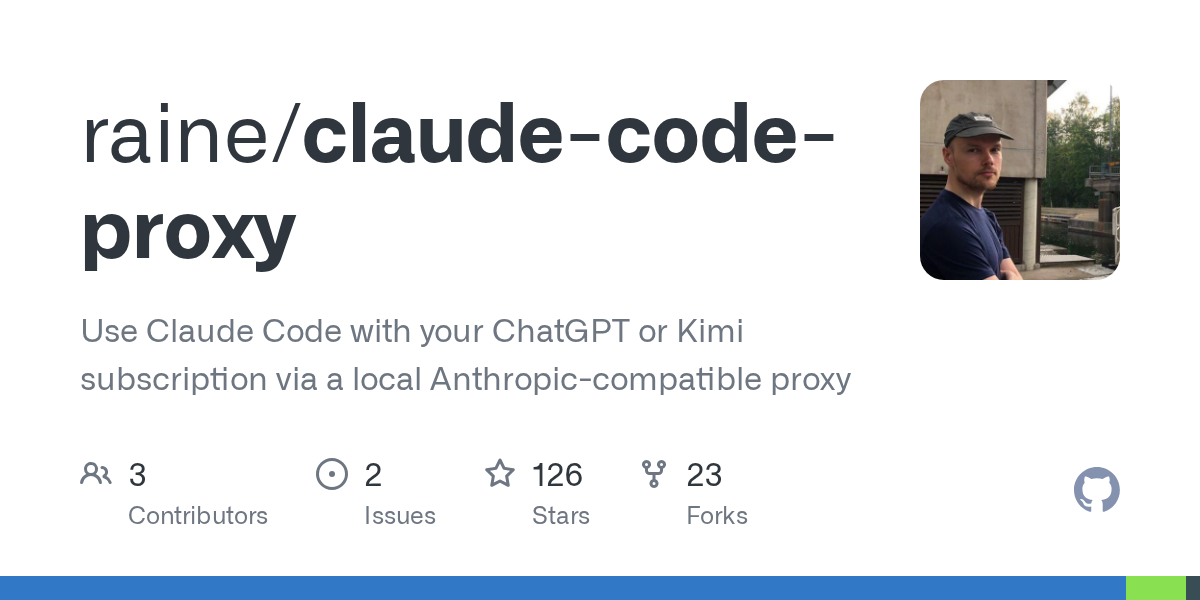
claude-code-proxy looks like a cost hack because that is the obvious reason people will install it. Point Claude Code at a local Anthropic-compatible server, route requests to ChatGPT Plus/Pro Codex models or Kimi Code, and suddenly the expensive part of a coding-agent workflow is negotiable. But the more important lesson is architectural: developers are separating the Claude Code harness from the Anthropic model backend, and that separation is becoming a normal operating pattern.
The project’s fresh v0.0.15 release fixed a specific Claude Code compatibility issue: Anthropic requests that omit stream now receive JSON responses, which fixes Claude Code /model validation through the proxy. The previous v0.0.14 release was even more revealing. It kept Codex streaming responsive during long Read tool calls by sending keepalive pings while tool arguments are buffered, returned clear errors for truncated streams instead of pretending incomplete tool calls were complete, and improved timeout/retry diagnostics for stalled Codex requests.
That is the whole story in miniature. API proxying looks easy until a real coding agent starts streaming tool arguments, reading large files, resuming sessions, counting tokens for compaction, generating titles, validating models, and retrying partial work. “Anthropic-compatible” is not just a schema shape. It is a behavioral contract under stress.
At research time, raine/claude-code-proxy had 126 stars, 23 forks, and 5 open issues. The v0.0.15 release shipped 12 assets across macOS, Linux, and Windows, with SHA256 files. The HN launch was quiet — 3 points and no comments — but the repo’s six-week accumulation of stars and the release cadence around Claude Code-specific failures are the stronger signals. This is not a generic reverse proxy wearing an AI badge. It is being shaped by the weird edge cases of agent traffic.
Cost control is turning into routing control
The setup is deliberately local. The proxy binds to 127.0.0.1 by default on port 18765. Claude Code points ANTHROPIC_BASE_URL at the proxy and uses an unused auth token. Model names route upstream providers: names like gpt-5.5, gpt-5.4, gpt-5.3-codex, and gpt-5.4-mini route to Codex, while kimi-for-coding, kimi-k2.6, and k2.6 route to Kimi.
The economic reason is obvious. Coding agents are token-hungry, and developers are already juggling subscription ceilings, API bills, local models, BYOK requirements, and provider-specific strengths. A proxy lets users keep the Claude Code harness — terminal flow, skills, permissions, compaction, tool loop, and session muscle memory — while changing the marginal token economics. That is powerful because the harness has become valuable in its own right. People are not merely buying “Claude answers.” They are buying a workflow around software change.
The risk is that every routing layer becomes part of the reliability and security boundary. If the proxy mishandles a partial stream, the agent can proceed on corrupted state. If it retries the wrong request after a tool call, the bug can duplicate side effects. If it logs bodies too verbosely, source code and secrets can land in the wrong file. If model semantics differ enough, compaction and tool decisions may drift in ways that are hard to diagnose. Cost-control infrastructure is still infrastructure.
The README’s recommended environment flags are not decoration. CLAUDE_CODE_DISABLE_NONESSENTIAL_TRAFFIC=1 reduces background calls the proxy may not support. CLAUDE_CODE_DISABLE_NONSTREAMING_FALLBACK=1 avoids retrying a partially completed stream in a way that can duplicate tool calls. The project also documents Claude Code’s [1m] model-name suffix to raise the auto-compaction threshold for upstream models with larger context windows. These details expose the invisible coupling between a harness and its expected model backend. When users route around the default backend, they inherit that coupling.
The proxy is now in the trust path
Practitioners should treat this kind of tool less like a clever shell trick and more like a local agent gateway. Run it only on a trusted machine. Keep it loopback-only unless you have a serious reason and a better security story. Know where credentials live: the project stores OAuth credentials in Keychain on macOS, %APPDATA% on Windows, and ${XDG_CONFIG_HOME:-$HOME/.config}/claude-code-proxy/.../auth.json on Linux with mode 0600 where supported. Turn off verbose body logging unless you intentionally want repo contents in logs.
Before using a proxy on real work, test the boring failures. Run long Read calls. Trigger tool calls with large JSON arguments. Validate /model. Force a stalled upstream request. Check what happens when a stream truncates. Run a session long enough to exercise compaction. Resume. Edit files. Then inspect the logs. If your confidence is based on a one-turn prompt, you have tested the easiest part and ignored the part where coding agents fail expensively.
Teams need an even stricter posture. Do not let every developer invent a private model-routing policy with environment variables and hope procurement, security, and incident response can reconstruct it later. Decide which upstreams are allowed, which repos can use proxy routing, whether generated code from a routed model needs different review, what telemetry is retained, and when tasks must use the official provider path. If the work touches customer data, regulated code, production credentials, or proprietary IP, model routing is not just a developer preference.
There is also a vendor lesson. Developers want the best harness and the best token economics, and they will glue them together if vendors do not provide a clean abstraction. Claude Code proxies, LiteLLM gateways, Kimi routes, Codex subscriptions, local models, and BYOK stacks are all symptoms of the same pressure. Cost pressure is making model routing a habit. The winners will make that habit first-class, observable, and governable. Everyone else will watch the ecosystem implement it with localhost servers, OAuth files, and comments in README troubleshooting sections.
claude-code-proxy is useful precisely because it is slightly uncomfortable. It proves the harness and the model backend can be unbundled, but it also shows how many behavioral assumptions sit between them. That is the architecture lesson hiding inside the cost hack: once coding agents become serious tools, the boundary between harness, model, proxy, and policy has to be designed. Otherwise the bill gets smaller and the failure modes get weirder.
Sources: claude-code-proxy v0.0.15 release, claude-code-proxy README, claude-code-proxy changelog, HN Show HN item