Claude Code’s Opus 4.8 Hotfix Is the Boring Launch Detail Teams Should Actually Read

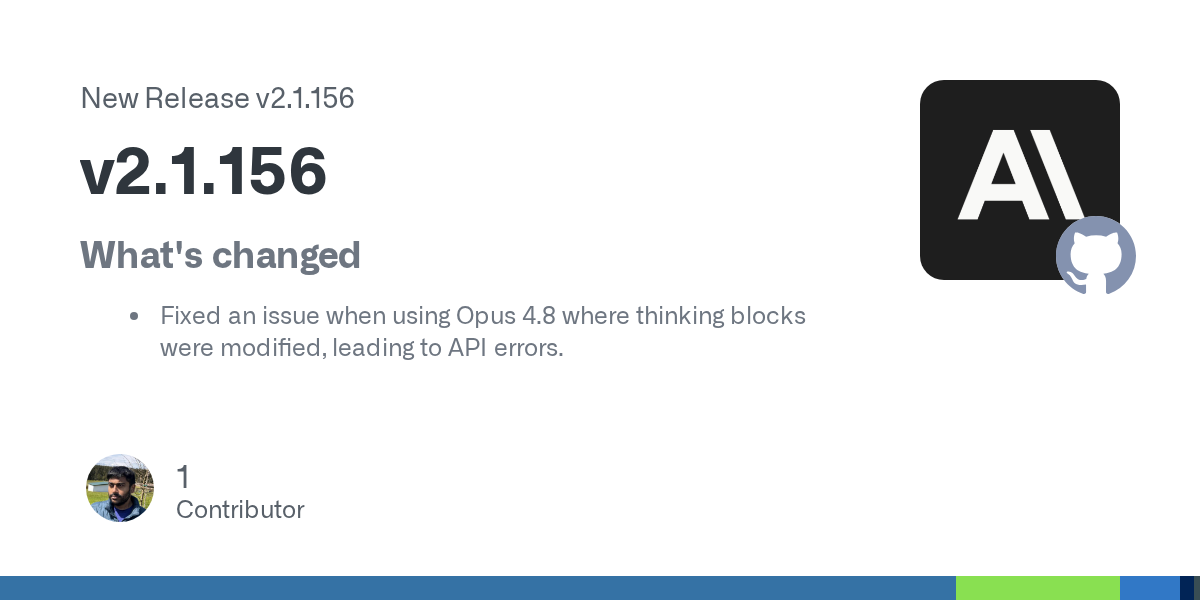
The important part of Claude Code v2.1.156 is not that Anthropic shipped a hotfix. Hotfixes happen. The important part is what broke: Opus 4.8 thinking blocks were being modified in a way that caused API errors. That is a small release note with a large architectural smell. Modern coding agents are no longer thin chat wrappers; they are runtimes negotiating model semantics, tool calls, workflow state, cost controls, safety classifiers, and developer trust in real time.
The GitHub release says exactly one thing: “Fixed an issue when using Opus 4.8 where thinking blocks were modified, leading to API errors.” That sentence landed in v2.1.156 at 2026-05-29 01:42 UTC, less than eight hours after v2.1.154 introduced Opus 4.8 support into Claude Code’s newly expanded stack: default high effort, /effort xhigh, dynamic workflows, cheaper fast mode, leaner system-prompt defaults, and multiple fixes for background agents and runtime behavior.
On paper, v2.1.156 is a boring patch. In practice, it is the kind of boring patch teams should read before they let a frontier model near expensive workflows.
New model support is a migration, not a dropdown
Opus 4.8 changes more than model quality. Anthropic’s platform docs describe a model with adaptive thinking through effort, not manual extended-thinking budgets. It supports 1M context, 128k output, prompt caching down to 1,024 tokens, task budgets, the advisor tool, computer use, mid-conversation system messages, and fast mode. It also rejects some request shapes developers may have grown used to: requests with non-default temperature, top_p, or top_k return 400 errors.
That makes the hotfix less surprising. When a model changes how reasoning is represented, how request validation works, and how runtime controls like effort and task budgets are expressed, every layer above it has assumptions to revisit. Claude Code has to preserve tool-call structure, thinking behavior, transcript integrity, prompt-cache economics, permission prompts, background-session recovery, and workflow orchestration while swapping in a model with different operational semantics. That is not “select the new model from the menu.” That is an integration migration wearing a product-launch hoodie.
The phrase “thinking blocks were modified” is especially instructive. Thinking blocks are not just UX decoration if the runtime, API, transcript tooling, or workflow coordinator depends on their shape. A coding-agent harness may stream them, hide them, summarize them, preserve them, bill around them, or use them to recover state after tool execution. Modify that structure in the wrong place and the API may reject the request, downstream parsers may fail, or a background workflow may stall in a way that looks like random model flakiness.
This is the uncomfortable truth for engineering teams adopting agentic coding tools: the model launch is now part of your runtime change-management process. It belongs closer to upgrading a database driver or CI runner than changing a syntax-highlighting theme.
The safety fixes around the launch matter too
The previous Claude Code release, v2.1.154, did not merely add Opus 4.8 support. It also fixed several runtime safety issues: background-session subagents bypassing worktree isolation, rm -rf $HOME not being blocked when $HOME had a trailing slash, .mcp.json servers being auto-approved when piped, and data-exfiltration classifier detection. Those fixes are not side quests. They define the blast radius of the new model’s ambition.
High-effort defaults and dynamic workflows encourage bigger jobs. Bigger jobs mean more tool calls, more subagents, more files touched, more cache churn, more opportunities for permission prompts to matter, and more places where an apparently small runtime bug can multiply. A thinking-block mutation causing API errors is annoying in one terminal session. In a dynamic workflow, it can waste budget across phases, strand partial work, or produce failures that a human only sees after the agent has already burned through time and tokens.
That is why the community reaction around Opus 4.8 is slightly beside the point. The main Hacker News thread for the launch had more than 1,500 points and more than 1,100 comments during research, with many developers debating whether Opus 4.8 represents a meaningful quality jump and whether agent costs are under control. Fair questions. But for teams, the runtime reliability delta may be more immediately felt than the benchmark delta. A model that is five percent smarter but ten percent less predictable in your harness is not an upgrade; it is a new incident class.
What teams should do before turning this on everywhere
If your team uses Claude Code casually, the practical move is simple: upgrade to v2.1.156 or newer before doing serious Opus 4.8 work. If you use Claude Code in CI, shared dev containers, remote sessions, managed background jobs, or anything with subagents and MCP servers, treat the rollout more deliberately.
Pin Claude Code versions in team documentation instead of assuming everyone’s global install is current. Upgrade a small cohort first. Run the same representative repository task on the previous model and Opus 4.8: one task that requires reading code, one that requires editing and tests, and one that uses tools or MCP. Watch for API 400s, malformed thinking output, unexpected permission prompts, changed tool-loop behavior, and token/cost shifts. If you parse transcripts, audit logs, or tool traces, verify that thinking blocks and tool-call structures still match what your own systems expect.
For API builders, the checklist is sharper. Use Opus 4.8’s adaptive thinking through effort; do not send unsupported sampling knobs; add explicit handling for model-specific 400s; verify prompt-caching behavior under long conversations; and test any code that stores, redacts, or replays reasoning-adjacent blocks. If your product exposes a “switch to latest Claude” feature, make sure that switch includes compatibility gating, not just a model string.
There is also a governance lesson here. Claude Code is accumulating the shape of production infrastructure: dynamic workflows, background sessions, model routing, prompt caching, MCP subprocesses, browser control, safety classifiers, effort levels, and task budgets. Infrastructure needs staged rollouts, observable failures, clear version baselines, rollback paths, and boring smoke tests. The agent may feel like a colleague in the terminal, but operationally it behaves like a distributed system that occasionally writes code.
So yes, v2.1.156 is a one-line hotfix. That is exactly why it is useful. It exposes the hidden contract between model behavior and coding-agent runtime behavior. The teams that will get the most value from Opus 4.8 are not the ones that click the upgrade fastest; they are the ones that understand that every frontier-model launch now carries schema risk, cost risk, workflow risk, and recovery risk. Read the boring release note. It is where the production story usually starts.
Sources: Claude Code GitHub release v2.1.156, Claude Code release v2.1.154, Anthropic: Introducing Claude Opus 4.8, Claude platform docs, Hacker News discussion