Codex App-Server Is Becoming the Control Plane OpenAI Needs for MCP, Remote Execution, and Real Client Apps

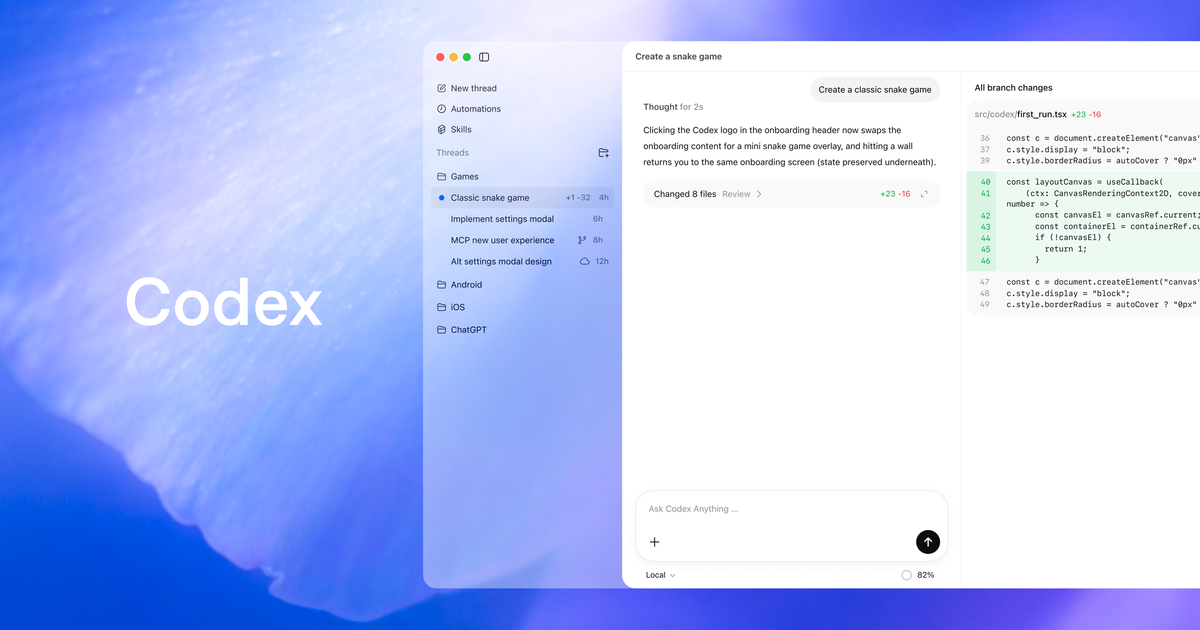
OpenAI’s Codex story is getting less interesting as a CLI story and more interesting as a control-plane story. That is a compliment. A coding agent that only lives in a terminal can hide a lot of operational mess behind the human sitting in front of it. A coding agent that is expected to run inside ChatGPT, mobile clients, editor integrations, MCP-heavy workflows, and remote execution hosts needs something less magical and more inspectable: stable nouns, transports, thread lifecycle, backpressure, status surfaces, and security boundaries that do not depend on the model being in a cooperative mood.
That is the useful read on OpenAI’s June Codex changelog and the related Codex releases around rust-v0.136.0 and the early 0.137.0-alpha train. The headline items are easy to recognize: Sites preview, Bedrock model-provider support, iOS updates, and the usual CLI release notes. But the sharper practitioner story is the app-server work underneath: resumable threads, initial-turn pagination, richer MCP server status, codex app-server --stdio, CODEX_API_KEY support for remote execution registration on approved OpenAI hosts, and short-lived server tokens replacing ChatGPT access tokens for remote-control websockets.
That is not polish. That is OpenAI turning Codex into something applications can safely drive.
The CLI is becoming an API surface
The app-server README describes a JSON-RPC-like protocol with stdio, experimental websocket, unix socket, and off transports. It names the primitives that matter for clients: Thread, Turn, and Item. It streams user messages, reasoning, shell commands, file edits, tool progress, and token usage. It can reject saturated ingress with JSON-RPC error code -32001 and the message Server overloaded; retry later, with clients expected to back off with jitter. Websocket health endpoints reject requests with an Origin header using 403 Forbidden.
Those details are not brochure copy. They are runtime seams. Once a coding agent becomes a service surface, the important questions change from “can it edit the repo?” to “can a client resume the same thread, understand which turn produced which item, survive overload, display tool progress correctly, and preserve enough identity for audit?” That is why the move from CLI state to app-server state matters. A terminal can be forgiving. A product integration cannot.
The generated TypeScript and JSON schemas are another signal. When frameworks and clients depend on a protocol, handwritten assumptions become bugs with good branding. If a VS Code extension, a ChatGPT surface, a web client, and a remote execution environment all speak to the same Codex runtime, they need versioned schemas and explicit fields more than they need another inspirational demo. Builders should treat those schemas as part of the contract, pin against known Codex versions, and test every integration against the exact binary they ship.
MCP status is where approval UX stops lying
The changelog’s “richer MCP server status” line is the kind of note that looks small until you build a real agent UI. MCP makes coding agents more useful by exposing tools, repositories, services, docs, and internal systems through a standard-ish connection layer. It also makes them more dangerous when clients cannot show which servers are live, authorized, errored, unavailable, or misconfigured.
Approval prompts without runtime status are theater. If a user is asked to approve a tool call, the UI should show which server is being used, whether it is connected, what capability is being invoked, and whether the runtime has the same view the model appears to have. Otherwise the approval is little more than a vibe check. The model says it wants to do something; the user clicks yes; nobody has proven that the tool boundary is the one the user thinks it is.
Codex app-server surfacing richer MCP status suggests OpenAI understands that the client is now part of the security model. This is the right direction. The model should propose. The runtime should enforce. The client should display status and collect approval with enough context to be meaningful. If any of those layers collapses into “the assistant probably knows,” the whole setup is back to prompt etiquette pretending to be governance.
Remote execution needs short-lived trust, not borrowed session tokens
The remote-control token change is probably the most important security detail in the batch. Moving remote-control websockets away from ChatGPT access tokens and toward short-lived server tokens reduces blast radius. It does not make remote execution safe by default, and nobody serious should read it that way. But it moves the trust boundary to a layer that can be constrained, rotated, logged, and scoped.
The same release train includes hardening that points in the same direction: /diff no longer runs repository-provided Git helpers or hooks, PowerShell parser execution is avoided on non-Windows hosts, browser-origin exec-server websocket handshakes are rejected, deny-read sandboxing remains enforced for safe-command and approval-bypass paths, and Windows sandbox networking denial cleanup improves. These are not glamorous features. They are exactly the features that matter when a coding agent can touch code, shell, credentials, local files, and remote hosts.
The pattern is worth copying even if your team never builds on Codex. Agent security belongs at the boundary where actions cross into the real world: transport, token lifetime, sandbox profile, filesystem read policy, command execution, MCP server authorization, and audit identity. The system prompt can describe the policy. It cannot be the policy.
There is also a compliance clue in clientInfo.name. OpenAI says client initialization requires it and uses it to identify clients for the OpenAI Compliance Logs Platform; enterprise integrations are told to contact OpenAI to be added to a known-clients list. That is the kind of requirement hobby wrappers will ignore and enterprise customers will ask about in procurement. If your Codex integration is going to run in a company with regulated code, customer data, or internal credentials, anonymous client identity is not going to survive review.
What builders should do now
If you are building a client or workflow on top of Codex, treat app-server integration like infrastructure. Generate or consume schemas for the Codex version you support. Preserve Thread, Turn, and Item identifiers in logs. Implement retry and jitter for -32001 overload instead of hammering the runtime. Display MCP server status directly in the UI before asking for approvals. Separate user approval from runtime policy. A user clicking “approve” should not bypass filesystem restrictions, deny-read policy, token scoping, or command safety.
For teams comparing Codex to Claude Code, Cursor, OpenCode, Gemini CLI, or homegrown coding-agent runtimes, this is now one of the real comparison axes. Not “which one writes the better React component in a demo?” but: which one exposes state cleanly enough for clients, preserves identity across remote execution, surfaces MCP health, handles backpressure, prevents ambient browser access, and makes approval decisions auditable?
The caution is version churn. The June 3 alpha releases have sparse release bodies, while the changelog and README contain most of the substance. That means serious integrations should pin versions, read both the changelog and source docs, and maintain regression tests around app-server behavior. Protocol-driven agent clients are powerful precisely because they can automate more of the agent lifecycle. They are also fragile when wire fields, transport defaults, or permission projections shift underneath them.
Codex is not merely becoming “a better coding CLI.” It is becoming a runtime surface for other products to drive. That is the right architectural move, and it raises the bar. Once MCP, remote execution, ChatGPT integrations, and app clients are in the loop, trust comes from visible status, bounded transports, scoped tokens, persistent identity, and enforceable policy. The agent can still be smart. The runtime has to be boring on purpose.
Sources: OpenAI Codex changelog, Codex CLI 0.136.0 release, Codex app-server README, OpenAI Codex app docs, Codex 0.137.0 alpha 5 release