Control UI Token Pairing Shows the Cost of Security Fixes That Break Local Trust Paths

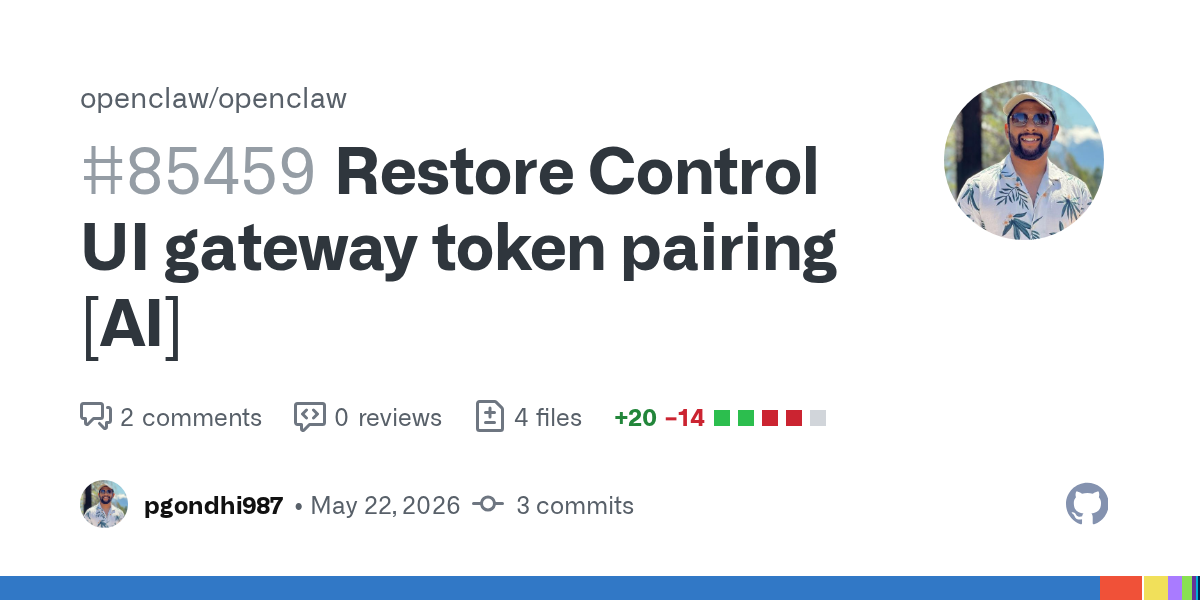
Security hardening is easy to applaud until it breaks the control surface people need to run the system. OpenClaw PR #85459 is a good example of that uncomfortable middle ground. It restores local Control UI and WebChat browser-origin pairing when the client has a valid gateway token, after a previous browser-hardening change rejected every browser-origin request even when the request resolved as local.
This is not a simple “security versus UX” story. That framing is too lazy. The better framing is trust-model design. OpenClaw needs first-party local browser interfaces because humans need a way to control the gateway. It also needs to avoid treating arbitrary browser-origin clients as trusted just because they can reach a local address. The bug was that an earlier fix collapsed those cases into one broad rejection rule.
When “browser-origin” is too blunt
The previous behavior came from PR #81289, which changed shouldAllowSilentLocalPairing to reject every request with a browser-origin header. That closed one durable-device-token security path, but it also regressed fresh Control UI access. A local browser with a valid gateway token could no longer silently pair as the trusted first-party control surface. It needed explicit pairing even though it had the local token path the system itself expected users to rely on.
PR #85459 narrows the condition. Instead of rejecting all browser-origin requests, it rejects browser-origin requests only when they are not Control UI and not WebChat: if (params.hasBrowserOriginHeader && !params.isControlUi && !params.isWebchat) { return false; }. The tests now assert that local browser-origin Control UI clients with a valid gateway token silently auto-pair, appear in paired, and do not create a pending pairing request. They also assert that other browser-origin clients remain explicit.
That is the right direction because it separates origin class from product identity. A browser-origin header is a risk signal, not a complete verdict. Control UI and WebChat are browser-based, but they are also first-party local surfaces. Treating them exactly like arbitrary browser-origin clients breaks legitimate operation. Treating every browser client as first-party would be worse. The patch threads the immediate needle by restoring the trusted local path only for the two known first-party surfaces.
Localhost is not a magic boundary
The hard part is that “local” is no longer as simple as it sounds. Developer machines run reverse proxies, tunnels, remote IDEs, containers, VPNs, browser extensions, and shared workstations. A request that appears local may have traveled through more machinery than the word suggests. Browser contexts are especially messy because they bring origin headers, cookies, local storage, device tokens, and user-mediated navigation into the same trust conversation.
That is why the PR body’s longer-term note matters. It says auto-minted browser device tokens should be tagged with the shared gateway auth generation that created them, then rejected after gateway-token rotation. That is a sharper model than “browser-origin bad” or “local token good.” It binds a browser device token to the generation of gateway auth that authorized it, giving token rotation a way to invalidate old browser trust. Without that, durable device tokens risk outliving the trust event that created them.
For an agent platform, this is not academic. The Control UI is privileged. WebChat is privileged. They are not just frontends; they are gateway clients with access to a runtime that may hold model credentials, channel integrations, tool execution, memory, and workspace access. If local browser-origin clients can silently pair, the system must be precise about who qualifies, how that qualification is proven, and how it expires.
The labels are doing useful work
The PR is tiny — 19 insertions and 14 deletions in its first commit across tests and handshake-auth-helpers.ts — but the label set is more honest than many larger security changes: merge-risk: security-boundary, merge-risk: auth-provider, and P1. That is how this should be treated. It is a usability regression fix, yes, but it touches the pairing logic for privileged clients. There is no such thing as a harmless auth-boundary tweak.
The useful practitioner lesson is to inventory trust boundaries as product surfaces, not just protocol checks. “Control UI” is a trust role. “WebChat” is a trust role. “Arbitrary browser-origin client” is a different role. “Local with valid gateway token” is another. If the code represents all of those with one or two booleans, regressions are almost guaranteed. The tests added here help because they pin the intended distinction: first-party local browser surfaces can auto-pair with a valid gateway token; other browser-origin clients still require explicit pairing.
Teams deploying OpenClaw in shared or enterprise environments should audit their gateway exposure assumptions. Is the gateway bound only where you think it is? Are users accessing Control UI over localhost, a tunnel, a remote dev URL, or a reverse proxy? How are gateway tokens rotated? What happens to browser device tokens after rotation? Can a stale browser context keep acting as trusted after the original authorization context is gone? Those are the questions that matter more than whether one PR restored a convenient pairing path.
The immediate fix is probably correct. Breaking fresh Control UI onboarding is a serious regression, and a valid local gateway token should mean something. But the PR itself admits this is not the final form. The durable-token generation model still needs work, and OpenClaw should eventually make local first-party trust explicit enough that security fixes do not need to swing between over-broad rejection and narrowly carved exceptions.
The editorial take: agent platforms need local control surfaces, but they cannot afford fuzzy local trust. PR #85459 restores the path users need today. The next step is making sure the path still proves what it claims after browsers, tokens, and rotation get involved.
Sources: OpenClaw PR #85459, PR patch, related browser hardening PR