Copilot Auto Model Selection Turns Model Choice Into a Routing Problem

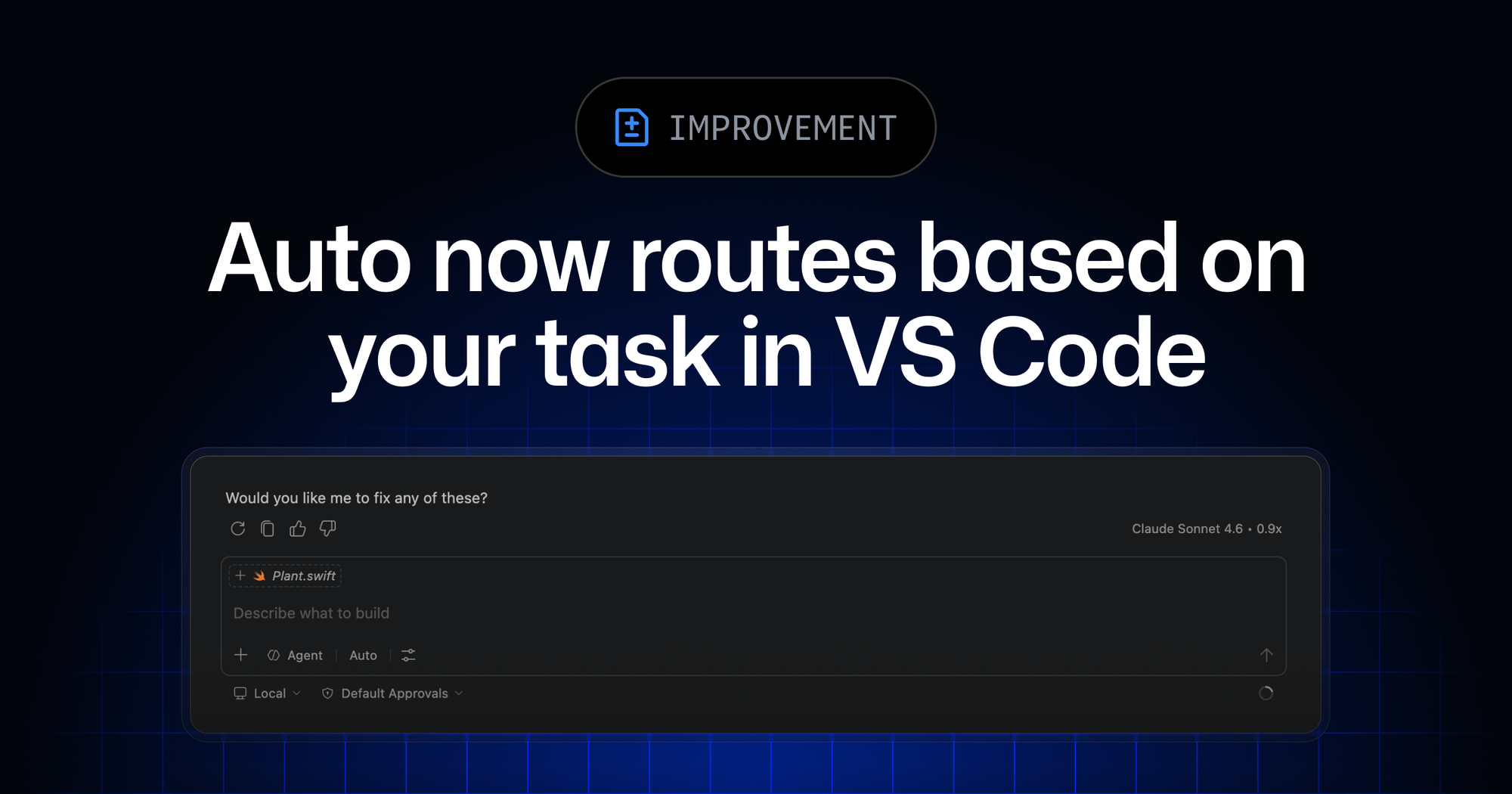
The most important button in Copilot is no longer the prompt box. It is the routing layer deciding how much model to spend on the work in front of you.
GitHub updated Copilot auto model selection in VS Code so “Auto” no longer just means availability fallback; it now evaluates the task and routes to the model GitHub thinks is the best fit. The routing looks at real-time model availability/reliability plus task dimensions such as reasoning, code-generation complexity, bug-diagnosis difficulty, and tool-orchestration needs. The useful takeaway for teams is not “let GitHub pick everything.” It is that model choice is becoming a runtime policy surface: quality, cost, cache behavior, admin approvals, and task class all meet in one dropdown.
The dropdown became infrastructure
- GitHub says Auto now weighs real-time model availability and reliability signals, then evaluates task dimensions including reasoning, code generation complexity, bug diagnosis difficulty, and tool orchestration needs.
- Users can see which model was used by hovering over the Copilot response, and can switch between Auto and a specific model at any time.
- Auto honors organization/admin model policies and only uses models available under the user’s plan and policy settings.
- GitHub says Auto currently selects only models with 0x to 1x multipliers.
- Paid Copilot subscribers get a 10% multiplier discount when using Auto: a 1x model draws down 0.9 premium requests instead of 1.
- The docs say Auto routes along “natural cache boundaries” because switching models mid-session increased cost without enough quality gain.
- GitHub says its evaluations show token-efficiency gains with no quality regression because not all tasks need high-reasoning or token-intensive models.
- Auto model selection with task optimization is generally available in Copilot Chat in VS Code; reliability/availability-optimized Auto also exists across Copilot Chat, Copilot CLI, and Copilot cloud agent.
- GitHub’s docs list Auto support for third-party coding agents too: OpenAI Codex Auto can select among GPT-5.2-Codex, GPT-5.3-Codex, GPT-5.4, and GPT-5.4 nano, subject to plan and policy.
- HN Algolia returned 0 matching stories for the exact launch title during the research run.
Public practitioner discussion was effectively absent during the research window: HN had 0 exact-title hits, and the linked GitHub Community announcements surface did not expose a substantive thread in the fetched content. That silence is normal for admin/runtime behavior. Developers notice routing systems only after the model choice feels wrong, the bill changes, or an expensive reasoning model stops getting used for boilerplate.
This is GitHub admitting the model picker has become too complicated for normal humans. That is not a criticism. Copilot now spans OpenAI, Anthropic, and Google models; some are fast, some are expensive, some are better at agentic edits, some are being retired, and some are not approved inside a given enterprise. Expecting every developer to make the optimal choice before every prompt is product-design negligence with a dropdown attached.
The interesting part is that GitHub is not hiding the mechanics entirely. Showing which model was used matters because Auto without observability is just a shrug button. If a bug diagnosis succeeded because Auto picked a stronger model, teams should be able to learn from that. If a simple explanation burned a higher-cost model, they should catch that too. The 10% discount is a nudge: GitHub wants teams to delegate routing, but it is also telling admins that model selection has become a cost-control primitive.
The cache-boundary detail is the one builders should not skip. Model routing sounds easy until a multi-turn debugging session accumulates context, cached tokens, partial tool state, and reviewer expectations. Switching models midstream may look clever in a diagram and dumb on an invoice. Routing at natural boundaries is the sort of boring implementation constraint that determines whether “Auto” is actually useful or just another source of non-determinism.
For teams, the right move is to treat Auto as a pilotable policy, not a faith-based default. Pick representative tasks — failing tests, small refactors, dependency upgrades, code review, security-sensitive edits, legacy-code explanation — and compare Auto against pinned models. Track total premium requests, retry rate, reviewer corrections, CI pass rate, and whether the model used matched the task’s risk. If Auto is good, standardize it by workload. If it is uneven, write a routing guide humans can understand.
This also changes the Codex/Copilot comparison. Codex CLI is adding runtime controls, structured resumes, SDK auth, and remote execution plumbing; Copilot is adding enterprise-friendly model routing inside the GitHub workflow. The differentiator is less “which model is smartest?” and more “which surface lets us spend intelligence where it pays for itself without losing auditability?” That is the adult version of the coding-agent race. Fewer leaderboard screenshots, more policy tables. Finally.
Read this as Copilot turning the model dropdown into an infrastructure router. The take: Auto is useful only if teams can observe, evaluate, and govern it — otherwise it is just a cost decision outsourced to a button.
For teams comparing coding-agent stacks, the practical checklist is simple: record which surface triggered the agent, which model or runtime handled the work, which permissions were active, and what evidence reviewers can inspect later. If a vendor cannot answer those questions, the feature is still a demo no matter how polished the dropdown looks.
Sources: GitHub Changelog — Auto model selection now routes based on your task in VS Code, GitHub Docs — About Copilot auto model selection, GitHub Docs — Requests in GitHub Copilot, GitHub Docs — Supported AI models in Copilot, HN Algolia exact-title search