Copilot Gets Claude Opus 4.8, and the 15X Multiplier Is the Real Governance Signal

GitHub just added Claude Opus 4.8 to Copilot, but the most important number in the announcement is not a benchmark. It is 15X.
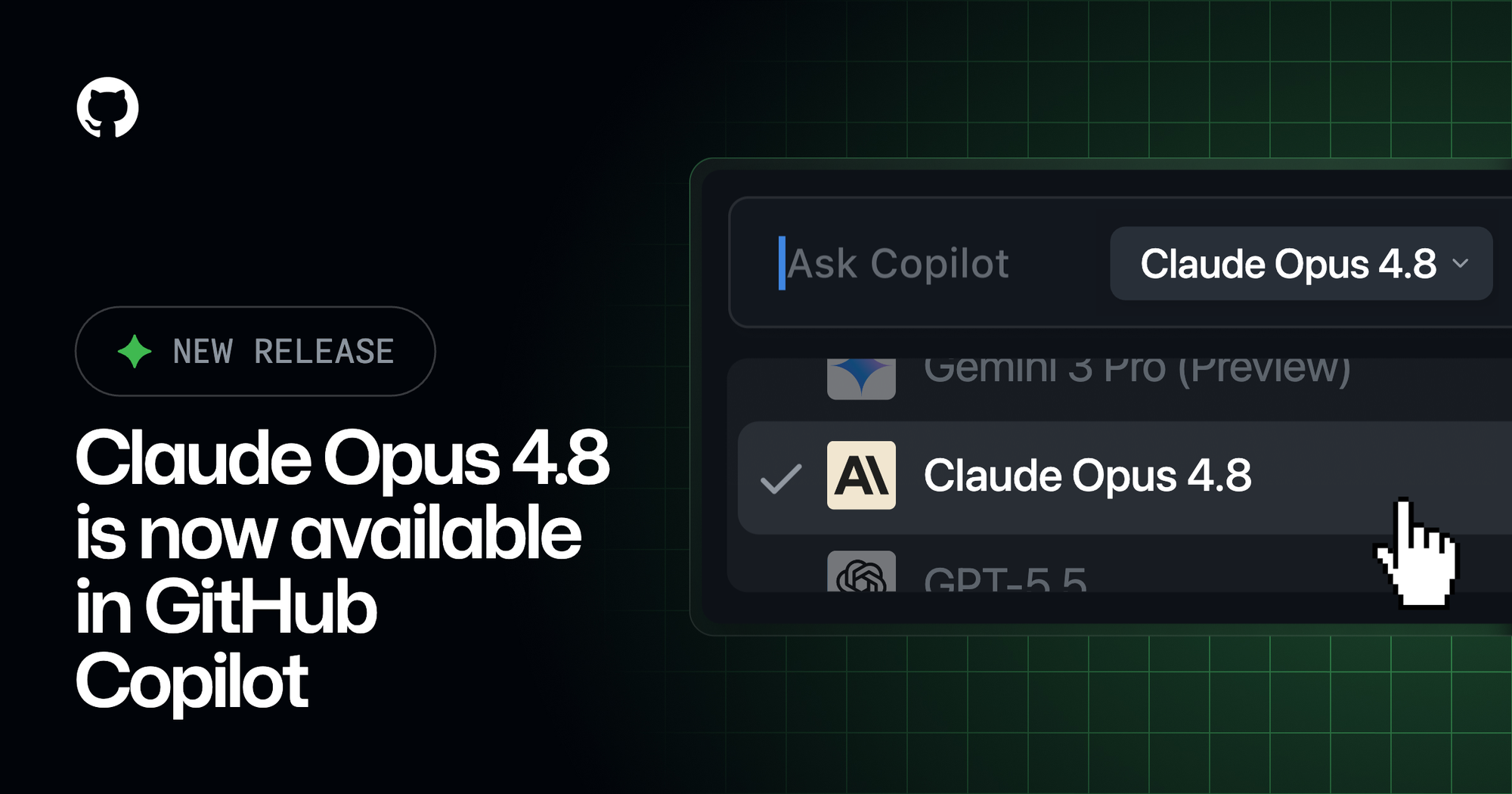
Claude Opus 4.8 is now generally available for GitHub Copilot Pro+, Business, and Enterprise users, with rollout across VS Code chat, ask, edit, and agent modes; Visual Studio; Copilot CLI; Copilot cloud agent; GitHub.com; GitHub Mobile; JetBrains; Xcode; Eclipse; and the Copilot app. GitHub says the model is a “clear step forward in code understanding and generation” and improves complex problem-solving and large-codebase navigation. Fine. That is the expected launch phrasing. The real news is that Opus 4.8 ships with a 15X premium request multiplier until Copilot usage-based billing starts on June 1, and Business/Enterprise admins must explicitly enable the Claude Opus 4.8 policy before their developers can use it.
That combination is where the enterprise coding-agent story is finally becoming honest. Model choice is not a vibe anymore. It is a policy decision, a budget decision, and a code-quality decision pretending to be a dropdown.
The expensive model may be the cheap option — sometimes
The lazy take is that a 15X multiplier makes Opus 4.8 too expensive for routine Copilot work. Mostly, yes. You probably do not need a premium reasoning model to rename a variable, explain a familiar API, or scaffold a small test. But the useful question is not whether Opus is expensive per request. It is whether it reduces the expensive part of software engineering: human uncertainty.
If Opus 4.8 can navigate a large codebase more reliably, keep architectural context in mind, and avoid burying flaws in its own diffs, then it may be the right tool for high-friction tasks: dependency migrations, multi-service refactors, bug hunts across unclear ownership boundaries, test-suite repair, and agentic PR work where the model has to plan, edit, run checks, and revise. A premium request multiplier is wasteful when it buys nicer prose. It is cheap when it saves a senior engineer from spending an afternoon spelunking a code path nobody admits owning.
That is exactly why the admin gate matters. GitHub is not simply tossing a stronger model into everyone’s editor. Copilot Business and Enterprise administrators have to enable the Opus 4.8 policy in Copilot settings. Good. The default workflow should not be “every developer finds the shiny model and finance discovers the bill later.” The right rollout is narrower: enable it for a pilot group, define the task classes where it is allowed, measure outcomes, then expand only where the data says it earns its keep.
Anthropic’s “honesty” claim is the one to test
Anthropic’s launch post makes the usual capability claims — better coding, stronger agentic tasks, more effective collaboration — but one claim deserves attention from engineering teams: Opus 4.8 is “around four times less likely than its predecessor to allow flaws in code it has written to pass unremarked.” That is a genuinely interesting promise if it survives contact with real repos.
AI coding tools do not fail only by writing broken code. They fail by writing plausible code and then acting as if the job is done. The damaging behavior is not a syntax error; CI catches that. The damaging behavior is a model that misses a hidden migration constraint, forgets an auth path, creates a performance regression, or patches the symptom while leaving the invariant broken — then explains the change confidently enough that a tired reviewer lets it through.
So do not evaluate Opus 4.8 with toy prompts. Build a small internal eval set from bugs your team actually shipped or almost shipped: missing tenant checks, flaky async behavior, brittle tests, unsafe null handling, schema migrations with rollback traps, authorization paths that differ between web and API calls, and “looks correct until production data is weird” cases. Ask Opus 4.8 to implement the fix, critique its own patch, run or reason through the tests, and identify what could still be wrong. Compare that against GPT-5.2-Codex, GPT-5.4 mini, Sonnet, Auto, and whatever model your team currently uses. The metric is not charm. It is reviewer minutes saved per safe merged diff.
This is where Anthropic’s other release details connect back to Copilot. Opus 4.8 keeps Anthropic’s regular API price at $5 per million input tokens and $25 per million output tokens, while fast mode is priced at $10/$50 per million and runs at 2.5× speed. Anthropic also says users can control effort levels, and that higher effort spends more tokens for better results. That tradeoff is sensible, but it means engineering managers need to stop treating “better model” as a universal good. Better for what? Faster under which latency budget? More accurate at what cost? More autonomous inside which permission boundary?
Cloud agents make model choice operational
The Copilot cloud-agent angle is the part to watch. A model in inline chat is a productivity tool. A model inside a cloud agent that can pick up an issue, modify a repo, run checks, and propose a PR is an operational actor. Giving that actor a stronger reasoning model changes the size of tasks teams are willing to delegate.
That is useful. It is also where “model picker” becomes inadequate as a control plane. Larger agent tasks need scoped repo permissions, branch protections, CI gates, audit logs, model rules, tool/MCP governance, and clear ownership of the generated diff. A stronger model does not remove those requirements. It makes them more important because the agent will be credible enough to get trusted with bigger work.
There is also an uncomfortable management problem here: teams will be tempted to compare models by anecdote. Someone will say Opus “feels smarter.” Someone else will say Auto is “good enough.” The bill will arrive, and suddenly the debate will become political. Avoid that. Define task buckets before June 1: cheap/default models for routine explanations and local edits; fast models for interactive loops; Opus 4.8 for high-complexity, high-uncertainty work where deeper reasoning plausibly reduces human review time; explicit approval for long-running cloud-agent sessions; and periodic review of premium-request burn alongside merged PR quality.
The last clause matters. Cost dashboards alone will push teams toward the cheapest model. PR quality alone will let teams rationalize waste. You need both in the same review. Look at premium requests consumed, tests passed, diff size, rollback rate, reviewer comments, time-to-merge, and whether the model caught its own mistakes before humans did. If Opus 4.8 improves those numbers on hard work, keep it. If it mostly writes better explanations around ordinary edits, turn it off outside specialist workflows. Nice model, wrong job.
The model picker is becoming the new platform policy surface
GitHub’s documentation already frames Copilot as a multi-model product: different models optimize for speed, cost efficiency, accuracy, reasoning, or multimodal work, with availability varying by plan and surface. That sounds like user choice. In enterprises, it is platform policy.
Microsoft and GitHub have been assembling this in pieces: model policies, model rules, Copilot cloud agent, CLI surfaces, audit/config APIs, premium request multipliers, and now usage-based billing. Opus 4.8 is another powerful engine in that garage. The teams that benefit will not be the ones that turn it on everywhere and call that modernization. They will be the ones that know which tasks deserve the expensive engine, which tasks should stay on cheaper defaults, and which agent workflows should require a human hand on the approval loop.
My take: enable Opus 4.8 deliberately, not enthusiastically. Use it where its claimed strengths — large-codebase navigation, agentic reliability, and better self-critique — can be measured against real engineering pain. The 15X multiplier is not a reason to ignore the model. It is the reminder that AI coding agents have crossed from tooling preference into production governance. The dropdown is now part of the architecture review.
Sources: GitHub Changelog, Anthropic, GitHub Docs