Copilot Health Is Microsoft’s Hardest Trust Test Yet

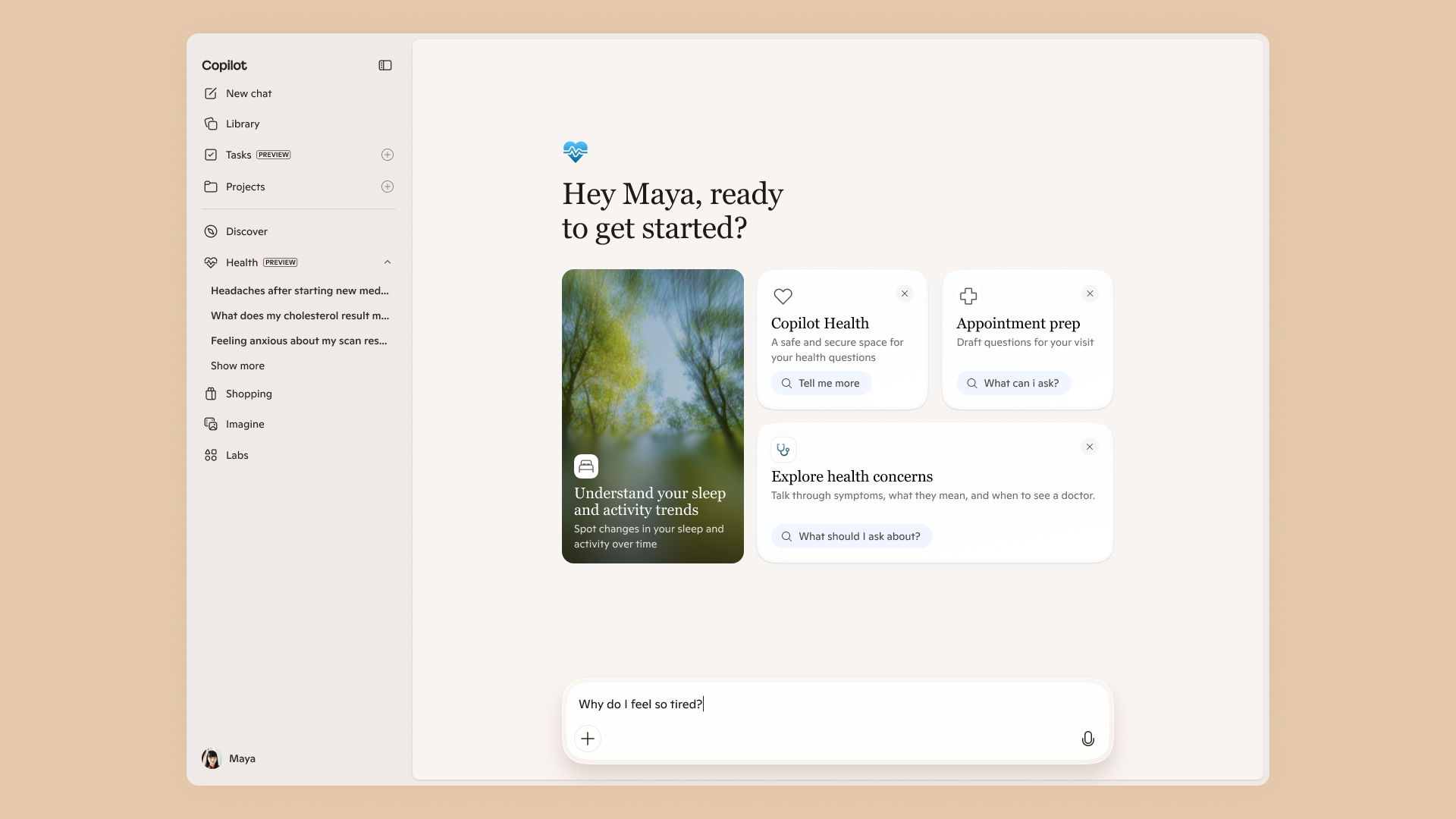
Microsoft’s most interesting Copilot launch this week is not another model picker, agent builder, or productivity sidebar. It is a health product asking consumers to connect the kind of context software companies normally only get after a very serious consent screen: symptoms, wearable signals, medical records, lab results, medications, provider history, and late-night anxiety typed into a chat box.
That makes Copilot Health moving into preview more than a consumer AI feature. It is a governance test. Microsoft is trying to prove that Copilot can become a family of domain-specific assistants with different data boundaries, evidence standards, and escalation behavior — not one universal prompt box wearing a different icon per vertical.
The preview is available at Copilot.microsoft.com/health for US users aged 18 and over with Microsoft 365 Personal, Family, or Premium subscriptions. Work accounts are excluded. That is the correct starting constraint: health context should not casually bleed into workplace identity, admin surfaces, or enterprise telemetry just because Microsoft owns both productivity and consumer accounts. The uncomfortable question is whether the product behavior is as clean as the eligibility boundary.
Microsoft says its consumer products already answer well over 50 million health questions a day. That number explains the strategy. People are already asking general-purpose AI systems and search engines about symptoms, test results, sleep data, medication interactions, and whether the thing they are worried about at 1 a.m. is urgent. The choice is not between “AI health advice” and “no AI health advice.” The real product question is whether that behavior happens in a constrained experience with better sources, explicit limits, deletion controls, and care navigation — or in a generic chatbot optimized to answer everything with the same confidence.
The product is not diagnosis. The risk is that users will ask for one anyway.
Copilot Health is framed around sense-making rather than replacement medicine. Microsoft says the preview can use wearable and wellness data beginning with Apple Health, with more connectors promised later. The broader Copilot Health launch material described support for more than 50 wearable devices, including Apple Health, Oura, and Fitbit. The preview can also connect to health records from more than 50,000 US provider organizations, with Microsoft previously naming HealthEx for records and Function for comprehensive lab-test results.
That is a serious context graph. Wearables tell one story. Lab results tell another. Visit notes and medication lists tell another. Patients often bring all of that into a clinical conversation as screenshots, vague memories, and “I think this number was high last time.” A useful assistant would not pretend to be the clinician. It would help users organize the mess: summarize trends, highlight anomalies worth asking about, explain what a lab marker generally means, prepare questions for a doctor, and find an appropriate provider by specialty, language, gender, insurance, and location.
That workflow is plausible. It is also fragile. The same interface that can help someone prepare for care can also produce an answer-shaped object that feels like a diagnosis. Microsoft’s disclaimer is clear: Copilot Health is not intended to diagnose, treat, or prevent disease and is not a substitute for professional medical advice. Good. But disclaimers are the seatbelts of AI product launches: necessary, not sufficient. The real safety layer is whether the assistant refuses false precision, represents uncertainty well, escalates urgent scenarios appropriately, and keeps nudging users toward professional care when the context deserves it.
Privacy claims are the opening bid, not the whole contract.
Microsoft says Copilot Health conversations are separated from the rest of Copilot, are not used to train AI, and are encrypted at rest and in transit. Users can manage, delete, or disconnect health data sources. Those are table-stakes claims for a product touching health records and wearable data, but they are still important because they set a higher baseline than the usual “trust us, it improves the experience” fog.
The practitioner questions start after the launch copy. What telemetry is retained for safety monitoring and abuse prevention? How are model outputs reviewed after a potential incident? Are citations stable enough to audit later? How does the system represent connector failures or stale data? Can a user export a visit summary without accidentally laundering hallucinated certainty into a medical appointment? What happens when a user asks about self-harm, pregnancy, medication changes, chest pain, or ambiguous symptoms that could be harmless or urgent?
Those questions are not edge-case pedantry. In health AI, the edges are the product. The user may be scared, sleep-deprived, underinsured, medically inexperienced, or searching because they cannot get a timely appointment. A system that is merely “usually helpful” can still fail in exactly the moments where confidence should drop and escalation should rise.
Microsoft is trying to answer part of that concern with process. The company says Copilot Health was developed with its internal clinical team and an external panel of more than 250 physicians from over 24 countries. It also points to trusted health organizations globally, principles independently published by the National Academy of Medicine, a partnership with Harvard Health, and ISO/IEC 42001 certification for AI management systems.
The certification point is worth respecting without mythologizing. ISO/IEC 42001 is a governance signal, not a medical accuracy stamp. It says something about management-system discipline: documented controls, process maturity, accountability structures, and auditable AI governance. It does not mean every answer is clinically safe. For builders, the useful lesson is that high-risk AI products need independently reviewable process claims because “we prompted it carefully” is not an operating model.
Copilot is becoming bounded runtimes, not one assistant.
The broader Microsoft story is that Copilot is splintering into task-specific runtimes. That is not a failure of the universal assistant dream; it is the adult version of it. A coding agent, sales assistant, health helper, spreadsheet analyst, and HR workflow bot should not share the same memory rules, tool permissions, evidence thresholds, or data-retention behavior. Their risks are different. Their users are different. Their acceptable failure modes are wildly different.
Copilot Health makes that architectural truth impossible to dodge. If Microsoft can keep health conversations separate, avoid training on them, enforce connector controls, cite appropriate sources, route users toward care, and expose deletion/disconnection options in a way normal people understand, it has a credible pattern for sensitive-domain AI. If it cannot, the brand risk is not limited to one health preview. It weakens the entire Copilot argument that Microsoft can wrap AI in enterprise-grade and consumer-grade trust boundaries.
For engineering teams building AI over sensitive data, the action item is not to copy the feature list. Copy the risk posture. Create a dedicated experience instead of letting high-risk workflows leak into a generic assistant. Make data boundaries explicit. Keep training defaults conservative. Build deletion and connector controls before launch, not after the privacy review finds them missing. Use domain-reviewed sources. Bring qualified domain experts into evaluation early. Test refusal, escalation, and uncertainty behavior as first-class product paths. And treat auditability as a user-safety feature, not only a compliance artifact.
The community reaction so far is muted. Hacker News activity around the fresh Copilot Health coverage was nearly nonexistent during collection, while mainstream and privacy-focused writeups are carrying the expected caution: use it to prepare for a doctor conversation, not to replace one. That silence from developers does not mean the launch is small. It means the most important debates will likely happen in legal reviews, clinical-safety evaluations, privacy assessments, and product incident channels before they show up as engineering-thread consensus.
My read: Copilot Health is interesting precisely because it is not a flashy developer-platform release. It is Microsoft taking the Copilot architecture into a domain where generic chatbot behavior is visibly inadequate. The product will be useful if it helps people turn fragmented health context into better questions and better care navigation. It will be dangerous if it optimizes for confident answer generation in a domain where uncertainty is often the most honest output.
The line to watch is simple: does Copilot Health behave like preparation for care, or like a prettier WebMD with a model behind it? The former is worth building. The latter should stay in preview until it learns humility.
Sources: Microsoft Copilot Blog, Microsoft AI, XDA Developers, HN Algolia