Copilot Sandboxes Are the Execution Layer Agentic Coding Was Missing

Copilot getting sandboxes is not a cosmetic safety feature. It is GitHub admitting that an AI coding assistant with a shell is no longer an editor plugin; it is an execution system that needs a place to make mistakes without inheriting the full authority of a developer’s laptop.
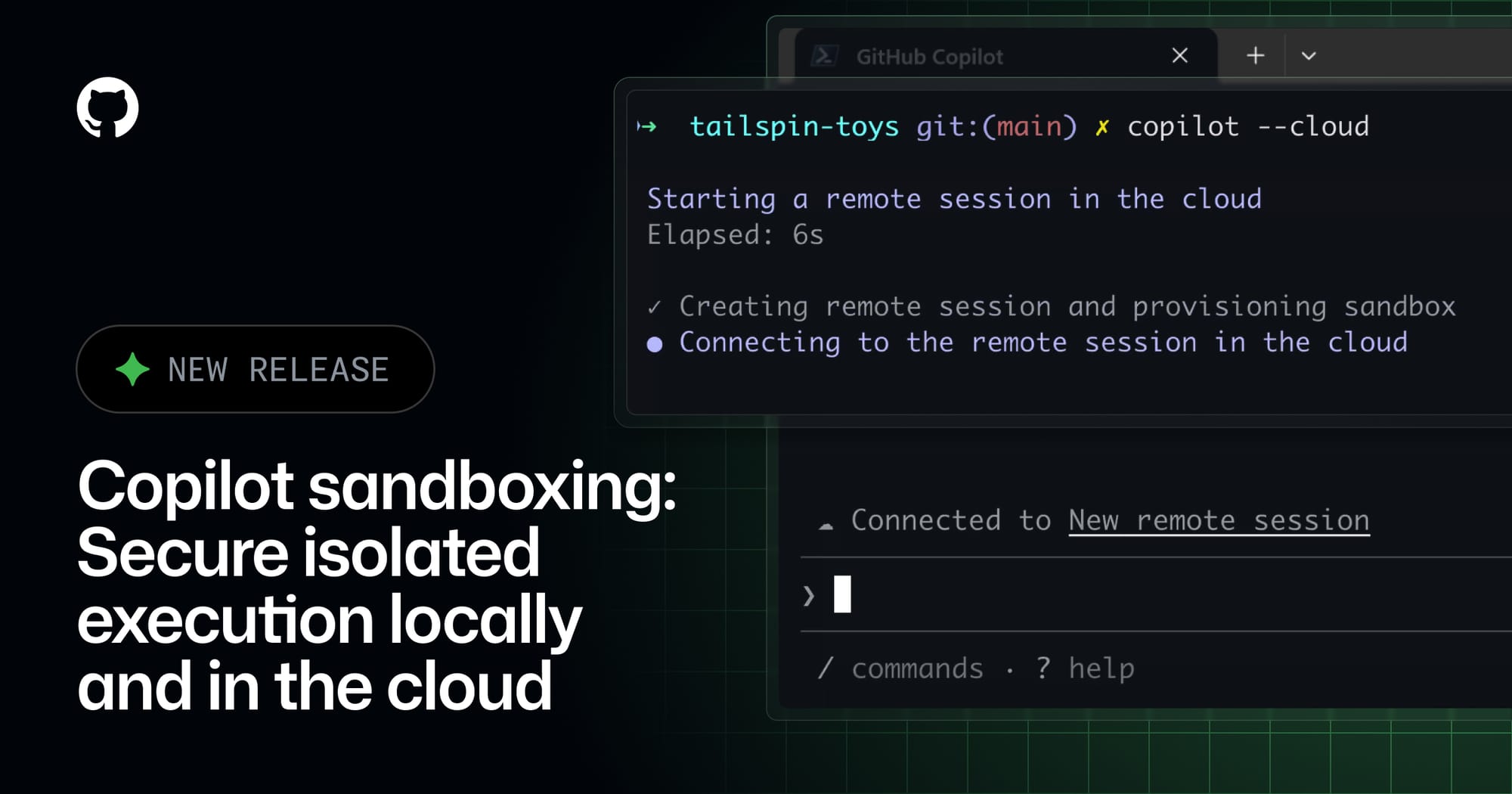
GitHub put cloud and local sandboxes for GitHub Copilot into public preview on June 2. The local version can be enabled inside a Copilot CLI session with /sandbox enable. The cloud version starts with copilot --cloud and runs the session in an isolated, ephemeral Linux environment hosted by GitHub. For now, sandboxing is centered on Copilot CLI, with cloud sandboxes also available for sessions in the GitHub Copilot app.
That sounds like plumbing because it is. It is also the exact plumbing agentic coding has been missing. Once an assistant can read a repository, decide on commands, run tests, install packages, inspect logs, and edit files, “human in the loop” is not enough of a safety model. The human may approve the broad task, but the blast radius of each shell command depends on the runtime boundary underneath it.
The sandbox is the agent runtime growing up
GitHub’s local sandboxing restricts filesystem, network, and system capability access for commands Copilot executes on the user’s behalf. Under the hood, it uses Microsoft Execution Containers, or MXC, across macOS, Linux, and Windows. That cross-platform detail matters. Most serious engineering teams do not get to standardize every developer on one OS, and security controls that only work on one surface become optional by accident.
The enterprise angle is equally important: local sandbox policy can be centrally configured through Microsoft Intune and other MDM platforms. That turns the feature from “a developer toggled a thing” into something platform teams can actually manage. If agentic coding is going to be deployed across companies rather than power-user laptops, runtime containment has to be policy-controlled, not vibes-controlled.
Cloud sandboxes take the model further. GitHub describes them as fully isolated, ephemeral Linux environments built on Azure Container Apps Sandboxes. Sessions have lifecycle states: Active, Stopped, and Deleted. A stopped session snapshots state for later resume. A deleted session removes the environment and snapshot. This is not just a safety feature; it is a new developer-workload primitive. Agent sessions are becoming disposable dev environments with memory, billing, policy, and cross-device continuity.
That continuity is useful. A developer can kick off a branch-building task, stop it, resume elsewhere, and avoid tying their local machine to a long-running workflow. But it also means teams need the same operational hygiene they apply to dev containers, CI runners, and cloud workspaces: ownership, retention, access rules, cleanup, and cost tracking.
Cloud sandboxes make Copilot part of the infrastructure bill
The pricing details should not be skipped. Local sandboxing is included with the standard Copilot seat. Cloud sandboxing is metered across compute seconds at $0.000024, memory GiB seconds at $0.000003, and snapshot storage at $0.005 per GiB month. One session is unlikely to bankrupt anyone. A company-wide rollout with stopped snapshots nobody cleans up is how “developer productivity” becomes another cloud-cost mystery line.
This lands one day after GitHub’s broader Copilot usage-based billing shift made AI credits a mainstream engineering governance issue. Put the two together and the shape is obvious: agentic coding is now both token spend and runtime spend. The model call is not the only cost. The environment executing the agent’s plan is part of the bill too.
For practitioners, the immediate move is to treat cloud sandboxes like controlled infrastructure, not magic developer convenience. Require an organization or enterprise owner to enable the cloud sandbox access policy. Decide which repositories can use remote execution. Set expectations around stopped-session retention. Track usage by owner or team. Delete stale snapshots. If you already have rules for cloud dev environments, start there and add agent-specific review gates.
The local version should become the default for experiments, especially in unfamiliar repositories. If a developer clones a random project and asks Copilot CLI to inspect, test, or modify it, the commands should not run with unbounded access to the rest of the machine. This is basic least privilege. It only feels novel because developer machines have historically been treated as trusted snowflakes.
Do not let “sandboxed” become “safe enough”
The most responsible detail in this announcement is not from the announcement itself. It is from the MXC repository, which calls the technology an early preview and warns that current generated policies can be overly permissive and should not yet be treated as complete security boundaries.
That caveat is not a reason to ignore the feature. It is a reason to use it correctly. A sandbox is defense-in-depth. It is not a permission slip to remove human review, expose secrets, allow arbitrary network access, or let agents run against production credentials. If a malicious repository can trick an agent into executing dangerous behavior, containment should reduce the damage. It should not be the only control between generated commands and sensitive systems.
The better operating model is layered. Use local sandboxing by default. Keep repo and network access narrow. Avoid giving agent sessions ambient credentials. Require PR review and CI gates for generated changes. Log the commands the agent runs. For cloud sessions, define what data can be copied into the environment and how long snapshots live. The boring controls are the product here.
The bigger significance is that GitHub is giving Copilot an execution layer. That is the point at which coding agents stop being judged only by answer quality and start being judged by runtime design: isolation, resumability, policy, observability, and cost. The demo question is “can it fix the bug?” The production question is “where did it run, what could it touch, who paid for it, and what happens when it is wrong?”
Copilot sandboxes are a strong step toward answering that. They are necessary infrastructure for serious agentic coding. They are not permission to stop thinking. The best teams will enable them early, document their limits, and treat them as the execution substrate for a governed workflow rather than the safety label on an otherwise unmanaged robot with a terminal.
Sources: GitHub Changelog, GitHub Docs, Microsoft MXC, Microsoft Security Blog