CrewAI 1.14.6 Is a Governance Release Wearing a Patch-Version Hoodie

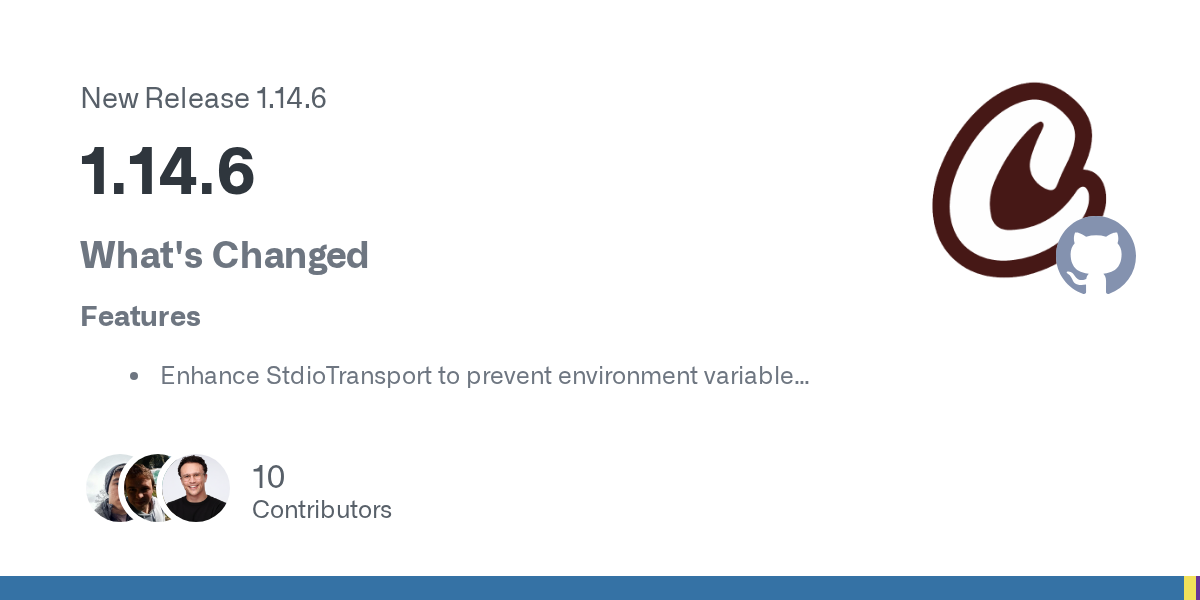
CrewAI 1.14.6 is the kind of release that looks minor until you read it like an operator instead of a demo builder. The version number says patch. The substance says governance. Environment isolation for stdio MCP subprocesses, structured-output cleanup in tool loops, checkpoint restore fixes, experimental gating for registry-backed skills, and new Agent Control Plane documentation all point at the same uncomfortable truth: production agents need fewer vibes and more boundaries.
The release landed May 28 and bundles changes that are easy to underestimate because none of them produces a flashy GIF. That is precisely why they matter. Agent frameworks are moving from orchestration ergonomics toward runtime control: least privilege, telemetry, replay, cost visibility, policy, and supply-chain discipline. CrewAI 1.14.6 is a useful snapshot of that market shift.
The subprocess environment was the real security story
The sharpest fix is in stdio MCP transport handling. PR #5506 replaces the old pattern of copying the full parent process environment with the MCP SDK’s default environment handling. The practical effect is simple: spawned stdio MCP servers should no longer inherit every ambient secret sitting in the parent process unless the application explicitly passes those variables through.
That is not cosmetic hardening. MCP servers and agent tools are exactly where convenience turns into accidental exfiltration. A parent process environment may contain AWS credentials, API keys, CI tokens, database URLs, telemetry secrets, feature flags, and whatever else a developer’s shell or deployment platform injected. If every child tool receives all of it by default, the permission boundary is fiction. The tool did not ask for production cloud credentials. It merely inherited them because the runtime was too helpful.
CrewAI’s new default is the right one: minimal environment first, explicit variables when needed. Some integrations will break because they depended on ambient state. Good. That breakage is useful information. Teams should audit every stdio MCP tool that previously worked by accident and replace the accident with documented configuration. If a Databricks query tool needs specific environment variables, declare them. If a web scraper does not need cloud credentials, it should never see them.
Tool loops and final schemas are different jobs
The structured-output fix in PR #5897 is quieter but also important. The issue: agents using tools plus a response format could push structured-output expectations into every ReAct or native tool step. CrewAI now clears the response model during tool loops and reserves it for final-answer shaping.
That sounds like framework housekeeping. It is actually a boundary between two different phases of work. During a tool loop, the agent should be deciding what action to take, interpreting observations, and making progress. At the end, the agent should format the result into the schema downstream code expects. Mixing those concerns can distort intermediate reasoning and tool selection. You get an agent that appears type-safe while doing odd things because it is trying to satisfy a final response contract before it has finished gathering evidence.
Builders should retest agents that combine tools and structured outputs after upgrading. Expect the final response validation to remain the point of schema enforcement, not every intermediate model call. That is usually what you wanted in the first place: reliable final structure without turning tool use into a schema compliance exercise.
Control planes are becoming the framework roadmap
The new Agent Control Plane documentation matters because it describes where CrewAI wants production operations to land. The Beta operations hub for CrewAI AMP includes Automations and Rules views, fleet health, execution counts, errors, active executions, token usage, cost, provider/model breakdowns, tags, and version visibility. Monitoring requires CrewAI v1.13+ telemetry; older deployments show up as stale or zeroed rows until updated and redeployed.
That telemetry requirement is a useful tell. Governance cannot be bolted onto an uninstrumented runtime after the incident. If the framework does not emit execution, health, token, cost, and version data, the control plane cannot invent a trustworthy picture later. Production agents are no different from distributed systems here: if you did not collect the signal at runtime, your postmortem will be mostly storytelling.
ACP Rules currently support organization-wide PII Redaction, with Enterprise or Ultra plan requirements for rule creation and editing. RBAC separates read access from manage access, all rule changes are versioned for auditing, and rules can be scoped by exact tool set and automation tags. An enabled organization-wide rule overrides matching per-deployment PII settings for future executions without redeploy.
That last part is the important operational capability. Central policy should not require every team to remember to redeploy every agent. If a company discovers a PII risk, the control plane needs to enforce the rule across matching deployments quickly, consistently, and with an audit trail. Prompt-level instructions are not enough. Per-agent configuration is not enough. Governance has to live above individual workflows.
The checkpoint work fits the same theme. CrewAI’s checkpointing docs describe snapshots of crew, flow, or agent state, kickoff inputs, event history, and lineage IDs. The default trigger is task completion, with higher-frequency events such as completed LLM calls available at higher storage cost. Providers include JSON and SQLite with WAL mode for concurrent reads. PR #5908 fixes experimental executor restore by making excluded fields nullable during serialization restore and reattaching the LLM on resume. Not glamorous. Very relevant if a long-running agent needs to survive process death without becoming a ghost story.
The Skills Repository move behind CREWAI_EXPERIMENTAL=1 is also the correct posture. Registry-backed skills are a supply-chain surface. Pulling executable or prompt-like capabilities from a registry should come with provenance, signing, policy, review, and cache discipline. Until that machinery is boring, “experimental” is exactly where it belongs.
For practitioners, the upgrade checklist is concrete. First, upgrade in dev or staging and run every stdio MCP tool. Any failure caused by missing environment variables should become an explicit allowlist, not a rollback. Second, retest agents that mix tools with structured output. Third, exercise checkpoint restore paths, especially standalone agents and long-running flows. Fourth, if using registry-backed skills, verify the new experimental namespace and CLI path before a deployment script surprises you. Fifth, if you are evaluating Agent Control Plane, make sure the runtime versions emit telemetry before judging the dashboard.
The bigger read is that CrewAI is converging with the rest of the serious agent-framework market. LangGraph is hardening streams and checkpoints. Microsoft is pushing policy enforcement through Agent Governance Toolkit. Managed agent platforms are adding cost and model controls. CrewAI 1.14.6 belongs in that same pattern: the demo layer is no longer the differentiator. The permission boundary, audit trail, restore path, telemetry feed, and cost controls are.
The patch-version hoodie is doing a lot of work here. This is a governance release, and that is a compliment.
Sources: CrewAI 1.14.6 release, PR #5506, PR #5897, PR #5939, PR #5963, CrewAI Agent Control Plane docs, CrewAI checkpointing docs