DeepSeek V4.1 Flash Hit OpenRouter’s Top Seven Before Its First Full Week

The most important number on this week’s model leaderboard is not an Elo score. It is 3.64 trillion: the number of tokens DeepSeek V4.1 Flash processed through OpenRouter’s public routing layer before the model had even accumulated a full comparison week. That was enough to move it from eleventh to seventh in a day.
That does not make V4.1 Flash the seventh-best language model. It makes it one of the fastest models to acquire visible developer traffic, and those are different claims. The distinction matters because the industry keeps collapsing preference, benchmark performance, API consumption and product quality into one vaguely impressive concept called “winning.” This week’s tables are useful precisely because they refuse to tell one tidy story.
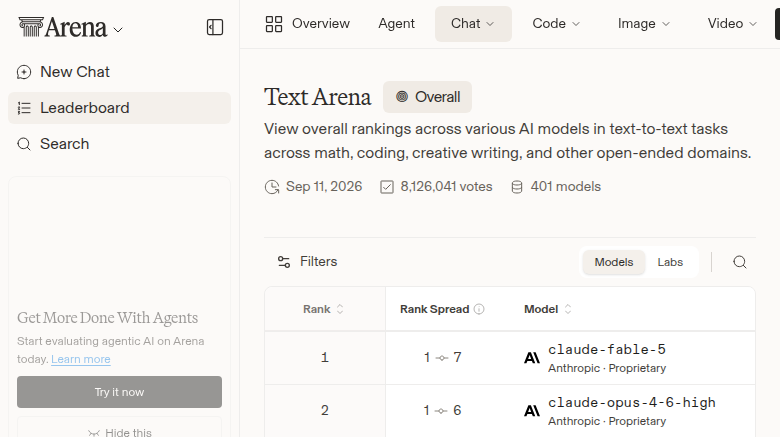
Arena’s overall top 20 did not move. Anthropic still owns six of the first nine positions, led by Claude Fable 5, while Meta’s Muse Spark variants and Google’s Gemini models fill much of the remaining upper table. DeepSeek V4.1 Flash does not appear in that top 20 at all. OpenRouter, meanwhile, shows DeepSeek holding four of its 20 busiest model slots: V4 Flash 0731 at number four with 11.6T weekly tokens, V4 Flash 0423 at number six with 4.47T, V4.1 Flash at number seven with 3.64T, and V4 Pro 0423 entering at number 20 with 1.25T.
Add those displayed totals and the DeepSeek family accounts for 20.96T tokens in the trailing window. That arithmetic is striking, but it is not market share in the conventional sense. It does not reveal unique users, requests, revenue or successful tasks, and it covers only public traffic routed through OpenRouter. Still, four models in the top 20 is not a benchmark stunt. It is evidence that DeepSeek has become a portfolio engineers are actively trying, routing and, at least for now, keeping busy.
Integration readiness is becoming a distribution channel
V4.1 Flash is designed to remove the excuses that once kept lower-cost models in the experimentation bucket. OpenRouter’s catalog describes it as DeepSeek’s first Causal Encoder-Decoder model, using a sparse mixture-of-experts architecture that activates 8 billion parameters while processing input and 16 billion while generating output. It accepts both text and images, exposes a 1,048,576-token context window, and allows up to 384,000 completion tokens. Tool use, structured output, reasoning controls and log probabilities are available rather than promised on a roadmap.
Those details help explain the speed of adoption more than any single quality claim. An OpenAI-compatible API plus tool calling and schema-constrained output means a team can put V4.1 behind an existing router and run production-shaped evaluations without rewriting its application. A million-token context window makes it tempting for repository analysis, long-document processing and agent memory. The model did not need months to build a bespoke ecosystem; it arrived fitting the interfaces developers already use.
This is the first original takeaway from the week’s movement: API compatibility has become a form of distribution. Model providers used to win adoption by owning the application or the cloud account. Increasingly, they can win by being a low-friction option inside an independent router. Every capability that conforms to familiar tool and response schemas shortens the distance between “interesting release” and a real workload producing billions of tokens.
The price sharpens that advantage. Listed base rates are $0.15 per million input tokens and $0.60 per million output tokens, while cached input is listed at $0.003 per million. At face value, that cache rate is an invitation to test retrieval-heavy agents and stable, long-prefix workflows. But OpenRouter also displays time-of-day pricing overrides. Any cost model based only on the headline rate is incomplete before the first spreadsheet formula is written.
Tokens measure appetite, not nutrition
OpenRouter calculates its rankings from prompt and completion tokens in UTC daily buckets, with “This Week” representing a trailing seven-day window. Private activity is excluded. V4.1 Flash’s total rose from 2.22T in the previous snapshot to 3.64T, an increase of roughly 1.42T while four models were passed. OpenRouter marks it “new” because the comparison period contains no earlier usage, not because the model materialized yesterday.
A rolling window can make a launch look even more dramatic than it is. A large day entering the window and a quiet day falling out can create a sharp jump without the underlying daily run rate changing as much. Huge contexts can also inflate token volume relative to the number of jobs completed, while verbose output can make a less efficient model appear more popular. Free tiers and launch promotions generate exploration that may never become retained production traffic.
That leads to the second takeaway: token rank is best treated as a demand sensor. It tells us where developers are spending inference, not whether they are getting good answers. Arena asks humans which of two outputs they prefer; OpenRouter counts routed token volume. Neither measures whether an agent correctly updated a customer record, repaired a failing test or cited the right clause in a contract. The model-selection metric that matters lives inside the application.
The lack of a strong, verifiable Hacker News, Reddit or X reaction is also worth saying plainly. There is no need to manufacture a chorus of “developers say” quotes when the behavioral signal is already measurable. The traffic is evidence of curiosity and deployability. Retention, reliability and completed work per dollar will decide whether it becomes evidence of value.
Benchmark the workload, not the model name
Teams considering V4.1 Flash should not replace their default model because a ranking arrow points upward. Put it into a shadow evaluation against representative production traces. Measure task success, p95 latency, valid tool-call rate, output tokens per successful task and the total cost after retries. A model that costs half as much per token but needs twice the output and more recovery calls has not saved anything.
Long-context tests should be separated into cached and uncached cases. The $0.003 cached-input rate can be excellent for stable system prompts, reusable corpora and repeated analysis of a fixed repository. It is much less relevant when every request assembles a different context and misses the cache. Track cache-hit rate explicitly, then price the workload using the actual endpoint and billing window rather than a static catalog figure.
Tool use deserves its own scorecard. Validate argument schemas, execution sequencing, recovery after a failed tool and behavior when a tool returns partial data. For coding agents, include repository navigation, test repair and patch review—not just isolated code generation. For multimodal applications, test the image inputs that actually fail today: dense screenshots, charts with small labels and documents mixing text with layout.
DeepSeek’s four ranked variants create another engineering problem: choice overload. The new model has not displaced the two older Flash versions. That may reflect useful workload segmentation, or it may be temporary fragmentation while users migrate. Do not encode “latest” as a routing policy. Define workload classes and fallbacks, then let measured quality, latency and cost decide which sibling receives traffic. If the family’s combined volume keeps expanding over the next several snapshots, DeepSeek is capturing workloads; if V4.1 rises while the older variants shrink, this is mostly migration wearing a growth badge.
There is a second race at the top of OpenRouter. Tencent’s Hy4 preview remains first at 17.2T weekly tokens, but OpenAI’s GPT-5.6 Luna reached 16.4T after adding 1.8T between snapshots. Hy4’s total declined by 0.6T, shrinking the lead to 0.8T. Luna is up 35% week over week against Hy4’s 22%, but the rolling-window mechanics make a coronation premature. One unusually large expired day can move the table as dramatically as fresh demand.
The broader pattern is more durable than any daily arrow. Model selection is turning into routing: several capable models, evaluated continuously, assigned by workload rather than brand loyalty. Cheap models with production-grade interfaces can earn enormous trial volume almost instantly, while preference leaders do not automatically dominate API consumption. The teams that benefit will maintain their own compact evaluation suite and treat public leaderboards as candidate generators, not purchasing instructions.
DeepSeek V4.1 Flash has earned a benchmark slot. It has not earned blind trust. Its arrival at number seven before a full week elapsed says the market is willing to test aggressively when price, context and integration line up. The next question is whether those 3.64T tokens produced enough completed work to stay there after the launch window closes. That is the ranking engineers should care about, even if no public leaderboard can print it.
Sources: OpenRouter Rankings, OpenRouter model catalog API, DeepSeek V4.1 Flash model page, Arena AI leaderboard