DeepSeek’s 7.46-Trillion-Token Week Is a Vote for Disposable Agents

The most important number in this week’s model rankings is not DeepSeek’s first-place badge. It is the 13.61 trillion tokens split between two versions of the same Flash model in OpenRouter’s top three. That is what a production migration looks like when the new release arrives faster than teams can drain traffic from the old one.
DeepSeek V4 Flash 0731 reached 7.46 trillion weekly tokens and moved from second to first, while the older 0423 checkpoint fell from first to third but still handled 6.15 trillion. Tencent’s Hy3 rose to second. MiMo-V2.5 and OpenAI’s GPT-5.6 Luna held fourth and fifth, with Luna growing from 4.15 trillion to 4.45 trillion tokens without changing rank.
Those figures do not prove that DeepSeek built the world’s smartest model. OpenRouter ranks consumption, not intelligence: pricing, provider availability, default routing, promotions, context length, and verbose outputs all affect token volume. But 7.46 trillion tokens in a week, from a checkpoint released July 31, is too large to wave away as launch-day tourism. Builders have found work for it.
A 284-billion-parameter model priced like background infrastructure
DeepSeek describes V4 Flash 0731 as a 284-billion-parameter sparse mixture-of-experts model with 13 billion parameters active per token. OpenRouter lists it at $0.09 per million input tokens and $0.18 per million output tokens. At those prices, a million-token experiment stops being a budget meeting and becomes something an engineer can rerun before lunch.
The release keeps the preview architecture and its DSpark speculative-decoding module, but DeepSeek says it substantially changed post-training for coding, tool use, and long agent loops. Its reported Terminal Bench 2.1 score rose from 61.8 for the preview to 82.7, ahead of the company’s V4 Pro Preview at 72.1 and GLM-5.2 at 81.0, though still behind Opus 4.8 at 85.0. On NL2Repo, it moved from 39.4 to 54.2. DeepSWE showed the most dramatic claimed increase, from 7.3 to 54.4, while Toolathlon-Verified rose from 49.7 to 70.3 and AutomationBench Public from 10.8 to 25.1.
Those are meaningful deltas, but they arrive with the usual benchmark footnotes. DeepSeek used its own unreleased minimal agent harness for public coding tasks, ran at maximum reasoning effort, and includes favorable results from internal DSBench-FullStack and DSBench-Hard sets. Until independent teams reproduce the gains, the scores should be read as a hypothesis about capability, not a service-level agreement.
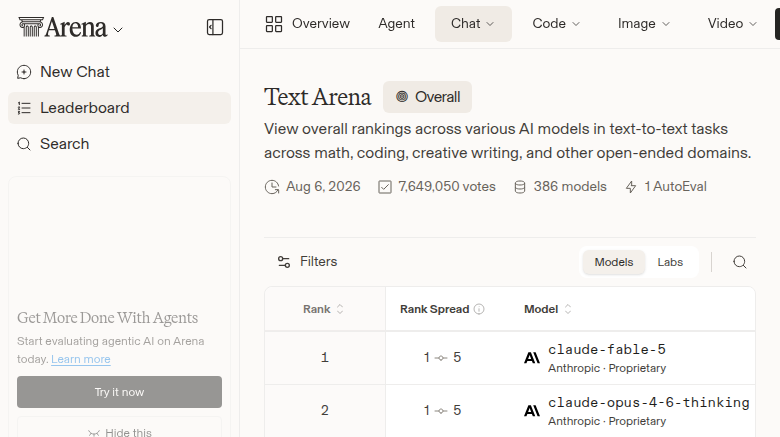
The Arena leaderboard provides a useful contrast. Its overall text top 20 did not change, with Anthropic models occupying six of the first eight places and OpenAI’s highest entry, GPT-5.5-high, at number 16. Arena did not expose sufficiently trustworthy Elo or vote data in the latest collection, so there is no honest numerical comparison to manufacture. The broad pattern is enough: preference leadership and usage leadership are measuring different things.
The new unit of economics is the accepted result
Token price alone is a weak procurement metric. Engineers should care about cost per accepted result: the full expense of generation, retries, tool calls, verification, latency, and human review. A model that charges one-tenth as much but creates ten times the cleanup is not cheap. A model that supports ten parallel attempts, with a test suite rejecting nine automatically, can be extraordinarily cheap even when its pass-at-one rate trails a frontier model.
That distinction explains why Flash’s rise matters. Low prices make failure disposable. A team can ask several agents to diagnose the same CI failure, generate competing patches, or explore different repository paths, then keep only the candidate that compiles and passes tests. It can assign a model to every dependency update, every flaky test report, or every new security finding instead of reserving automation for incidents expensive enough to justify a premium-model call.
The right architecture is not “replace Claude everywhere.” Use the strongest model you can justify for ambiguous decomposition, acceptance criteria, security-sensitive decisions, and cases where a subtle mistake is expensive. Route bounded implementation, repository search, test generation, log classification, and repetitive verification to the cheaper model. Then require deterministic evidence—tests, type checks, linters, policy engines, or sandboxed execution—before promoting the output.
This is the first original lesson in the ranking: model routing should follow verifiability, not task prestige. Writing a small database migration may sound more consequential than summarizing logs, but the migration can be safer to delegate if a disposable environment can apply it, exercise rollback, and compare schemas automatically. Conversely, a one-paragraph incident update may deserve the premium model if a misleading sentence can send responders in the wrong direction.
The second lesson is that cheap models change optimal agent design. With expensive inference, architects compress workflows into one heroic prompt and hope the model gets everything right. With cheap inference, narrow roles become practical: one model proposes, another criticizes, a third verifies requirements, and deterministic tooling decides what survives. More calls are not automatically better, but redundancy becomes an engineering option rather than a luxury.
Open weights still come with a data-center-shaped footnote
DeepSeek’s MIT-licensed weights make V4 Flash attractive to teams that need control or data locality, but “open” should not be confused with “easy to host.” The documented vLLM recipe calls for a single four-GPU GB300 node, FP8 KV cache, expert parallelism, and seven speculative tokens through DSpark. Thirteen billion active parameters per token reduce compute relative to a dense 284-billion-parameter model; they do not turn the checkpoint into a laptop download.
Most teams should validate through an API-compatible provider before buying capacity. Pin the exact model version, log provider and sampling configuration, and keep a fallback route. DeepSeek recommends temperature 1.0 and top_p 0.95 for agentic work, offers low, high, and max reasoning effort, and permits output lengths up to 384,000 tokens at high or max effort. Those settings can materially change quality, latency, and spend, so copying a benchmark score without copying its runtime conditions is cargo-cult evaluation.
A credible internal trial should use real repository tasks and track pass-at-one, pass-with-retry, wall-clock time, tokens per accepted result, tool failures, and minutes of human review. Include adversarial cases: ambiguous requirements, partial test coverage, malformed tool output, and repositories with misleading documentation. Run the same harness against a premium baseline. The goal is not to crown a winner; it is to draw a routing boundary your production system can enforce.
The third lesson is operational. If inference becomes nearly free, the scarce resource shifts to verification and authority management. A model can now inspect every CI failure or security alert, but that does not mean it should receive production credentials. Start with read-only tools, ephemeral workspaces, allowlisted commands, and explicit approval for writes. Preserve prompts, tool calls, diffs, and verifier results so a cheap automated action does not become an expensive forensic mystery.
Community reaction already reflects this split. In a Hacker News discussion, one practitioner said five or six concurrent sessions—effectively 12 streams—struggled to spend more than $5 per day, making throwaway CI repair, generated tests, monitoring, and continuous review plausible. Skeptics correctly noted that small error-rate differences compound across long-horizon work, and a premium model may still cost less than human cleanup. Both sides are right because they are describing different systems: an unconstrained autonomous worker and a bounded candidate generator with strong rejection machinery.
DeepSeek’s usage crown is therefore less a beauty contest than a vote for a new operating model. Intelligence still matters, especially at the edge of what can be specified or verified. But for the growing middle of software work—tasks that are bounded, repeatable, and mechanically checkable—the winning model may be the one cheap enough to fail several times. Teams that build excellent verification will capture that advantage first. Everyone else will merely generate mistakes at a discount.
Sources: DeepSeek model card, OpenRouter rankings, OpenRouter model page, Arena AI leaderboard, Hacker News discussion, r/unsloth discussion