Developers Prefer Claude, Then Spend Their Tokens Elsewhere

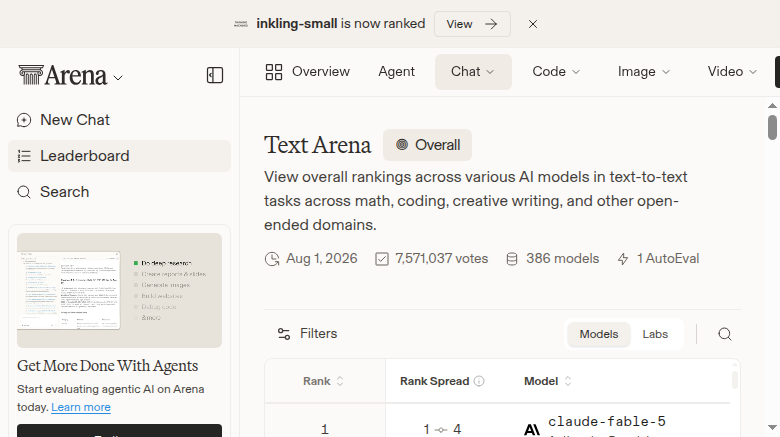
The most useful LLM leaderboard this week is not a leaderboard at all. It is the gap between two of them.
On Arena, where people compare model answers head-to-head, Anthropic holds eight of the top ten positions. On OpenRouter, which measures weekly tokens consumed through its marketplace, Anthropic does not appear until number 14. The first five slots belong to DeepSeek, Xiaomi, Tencent, DeepSeek again, and Z.ai. Developers appear to prefer Claude in a blind comparison, then send the bulk of their production tokens somewhere cheaper.
That is not a contradiction. It is a reasonably accurate picture of how software teams buy infrastructure: reserve the strongest tool for the cases that need it, then optimize the high-volume path for cost, latency, context length, availability, and acceptable quality. The charts are measuring different decisions, and confusing them produces bad engineering.
Luna's 620% week is an economics result
OpenAI's GPT-5.6 Luna climbed two places to number six on OpenRouter with 2.45 trillion weekly tokens and a displayed 620% weekly increase. That sounds like a capability breakthrough until the calendar is checked. OpenAI cut Luna's price by 80% on July 30. OpenRouter now lists it at $0.10 per million input tokens and $0.60 per million output tokens, with a 1.05-million-token context window.
OpenAI says Luna and its larger sibling Terra outperform Claude Fable 5 on Agents' Last Exam at roughly one-sixteenth the estimated cost. Its coding-agent comparison puts Luna above Opus 4.8, while Terra sits just above Fable 5; OpenAI claims both use about half as many output tokens, finish in roughly one-third of the time, and cost around one-quarter as much. Those are vendor-selected benchmarks, so treat them as hypotheses to reproduce, not a purchase order.
Still, the usage response is real. At Luna's current list price, a team can run a great deal of classification, extraction, summarization, and low-risk agent work before the bill resembles frontier-model spending. Terra, whose price fell 20% to $1 per million input tokens and $6 per million output tokens, entered OpenRouter's top 20 at number 19 with 571 billion tokens. OpenAI is not merely shipping models; it is filling price bands so routers have fewer reasons to leave its catalog.
The practical implication is that the default-model debate is becoming obsolete. Luna does not need to beat Claude on every difficult task to be economically important. It needs to pass an acceptance threshold on the large middle of the workload distribution. A model that succeeds on 95% of routine jobs at a fraction of the price can fund escalation to a premium model for the remaining 5%.
DeepSeek is turning repeated context into a pricing weapon
DeepSeek V4 Flash 0731 made the week's other large move, rising four places to number eight with 2.33 trillion tokens. The older 0423 checkpoint remains number one at 7.1 trillion, so this is adoption in progress rather than a clean migration. That lag can reflect capacity, provider defaults, pinned model identifiers, or simple operational caution; it is not evidence that users have rejected the newer build.
The refreshed model is a 284-billion-parameter mixture of experts that activates 13 billion parameters per token and supports a one-million-token context window. Artificial Analysis measured an Intelligence Index score of 50, ten points above the April version. Its GDPval-AA v2 Elo rose from 1189 to 1559, while Terminal-Bench 2.1 improved by 17 points to 79%. The evaluation also consumed about 206 million output tokens, 12% fewer than the predecessor's 234 million.
The more consequential number for agent builders may be DeepSeek's first-party cache-hit price: $0.0028 per million tokens, described as a 98% discount. Agents repeatedly resend system instructions, repository maps, policy documents, tool schemas, and stable conversation prefixes. If those prefixes reliably hit cache, the cost curve changes much more than a modest benchmark gain would suggest.
But cache discounts are only as useful as the observed hit rate. Teams should log cache-read and uncached tokens separately, run cold and warm versions of the same traces, and verify the provider's prefix rules. A spreadsheet that applies best-case cache pricing to constantly changing prompts is not a forecast; it is fan fiction with decimals.
Free tokens are demand, not proof of willingness to pay
Poolside's Laguna S 2.1 also jumped four places, reaching number 13 with 1.17 trillion tokens and a displayed 395% weekly increase. Its free OpenRouter route matters. Free access can reveal developer curiosity, integration quality, and whether a model is useful enough to keep in a router. It cannot reveal durable paid demand.
Laguna is nevertheless technically interesting. The model has 118 billion total parameters, activates 8 billion per token, and supports a one-million-token context. Poolside reports 70.2% on Terminal-Bench 2.1, 40.4% on DeepSWE, 78.5% on SWE-Bench Multilingual, and 59.4% on the public SWE-Bench Pro dataset. It also publishes evaluation trajectories, giving practitioners more to inspect than a single final score.
That transparency comes with an important caveat from Poolside itself: its comparison table mixes vendor results, benchmark-author results, and third-party maxima, and the harnesses differ. This is why a ten-task internal reproduction is more valuable than a polished benchmark matrix. Use repositories, tool calls, and failure modes that resemble your system, not the model vendor's best day in the lab.
Build a router, not a fandom
Arena's top 12 did not change. Below them, Kimi K3 Max dropped out, GPT-5.2 Chat Latest entered at number 19, and several models moved upward through compression. Arena uses pairwise human preferences and represents uncertainty through confidence intervals and rank spreads. A one-place daily move is frequently noise, not a model becoming smarter overnight.
OpenRouter's token chart has a different blind spot. Volume can be inflated by free routes, unusually verbose models, a few enormous customers, or workloads that are cheap but not demanding. Tokens consumed are not users retained, revenue earned, or tasks completed. The honest conclusion is narrower: Anthropic dominates observed answer preference, while price cuts, subsidies, and cache economics are moving aggregate production traffic faster than preference rankings move.
For engineering teams, the response should be boring and measurable. Build a fixed evaluation set from real traces: routine transformations, retrieval over long context, tool calls, code edits, recovery after a failed action, and the expensive edge cases that justify frontier reasoning. Shadow Luna, DeepSeek 0731, and Laguna without changing user-visible behavior. Record accepted-task cost, wall-clock latency, retries, cache-hit rate, and human correction time. Pin exact checkpoint identifiers, and set rollback thresholds before shifting traffic.
Most importantly, separate experimental free-route traffic from paid production conclusions. A cheap token that triggers three repair loops is expensive. A premium model used for a task a small model passes every time is waste. The winning architecture is likely a workload-aware router with an escalation path, not a single model crowned from a public chart.
The leaderboard split is widening because the market is maturing. Human preference tells us what people like when quality is isolated. Token volume tells us what survives contact with budgets, latency targets, and repetitive workloads. Both are useful, but neither replaces an internal benchmark. The teams that turn this week's movement into advantage will not be the ones switching defaults fastest. They will be the ones measuring where quality stops paying for itself.
Sources: OpenRouter LLM Rankings, OpenAI GPT-5.6 launch and pricing update, Poolside Laguna S 2.1 technical announcement, Artificial Analysis on DeepSeek V4 Flash 0731, Arena ranking methodology