Doosan Shows NVIDIA’s AI Factory Problem Is Also Power, Boards, and Robots

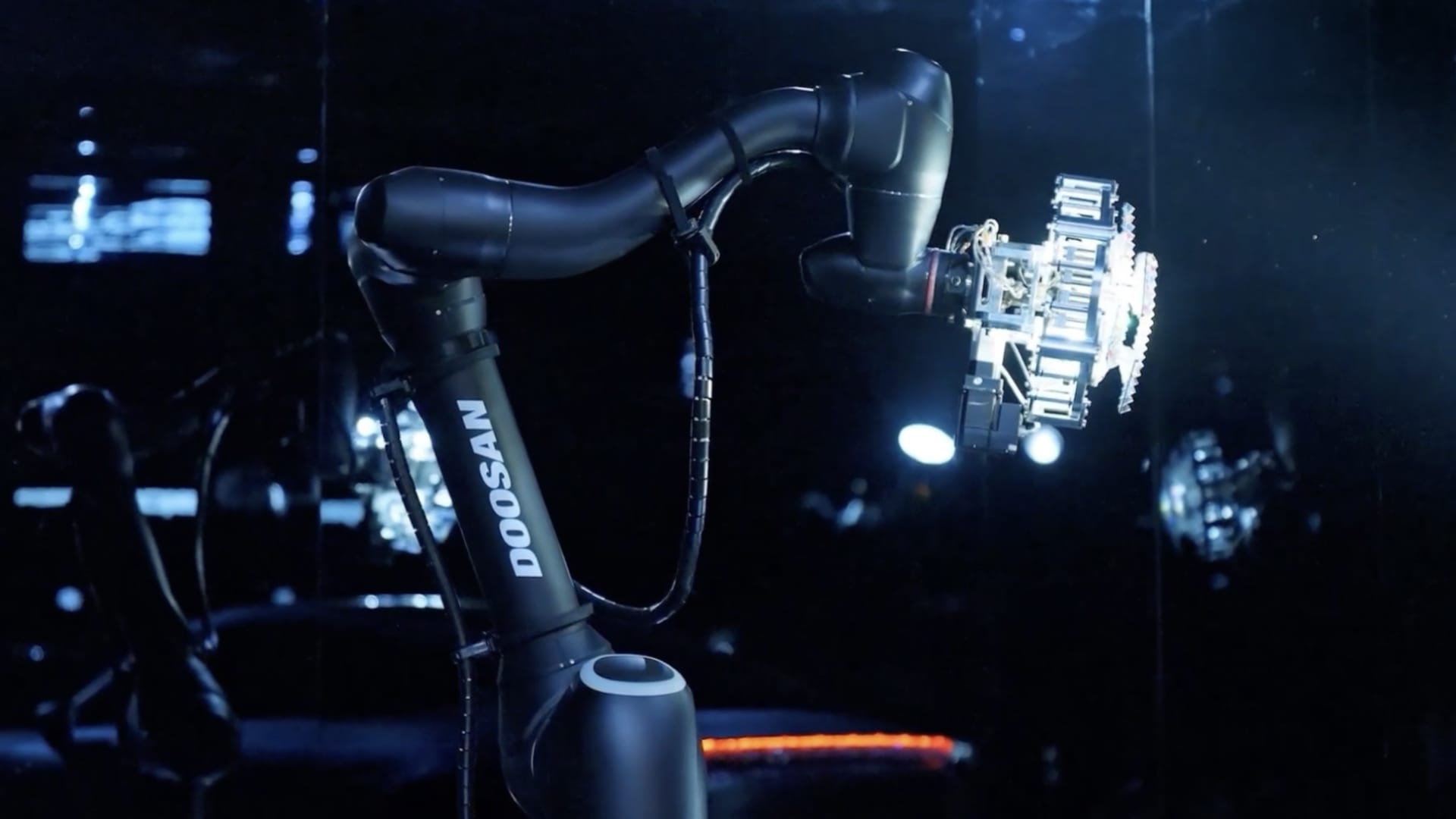
The Doosan announcement is the NVIDIA Korea story that looks the least like software news and the most like actual infrastructure news. That is exactly why it deserves attention. AI factories are usually described as if the hard part is choosing accelerators and drawing a heroic rack diagram. Doosan is a reminder that the real system also needs power, boards, materials, robots, maintenance, and industrial discipline.
NVIDIA and Doosan Group are expanding collaboration across physical AI, robotics, AI-factory infrastructure, power systems, and advanced electronics materials. Doosan Robotics is integrating NVIDIA Isaac Sim, Isaac Lab, Cosmos open world foundation models, the open-source Newton physics engine, and Jetson Thor into an Agentic Robot OS. Doosan Enerbility is exploring power infrastructure for NVIDIA DSX AI factories. Doosan Corporation Electro-Materials is positioning copper clad laminate for MGX-era AI data-center systems.
None of that has the instant-demo appeal of a frontier model answering a trick question. But it maps directly to the constraints that decide whether AI infrastructure actually ships.
“Agentic” means something different when the agent has a motor
The robotics part of the deal is technically interesting because Doosan’s Agentic Robot OS gives a name to a pattern many robotics teams are converging on: connect perception, reasoning, simulation, learning, and on-device inference into one runtime and development loop. NVIDIA’s toolchain is a plausible fit. Isaac Sim and Isaac Lab provide simulation and training environments. Cosmos contributes world-model and synthetic-data capabilities. Newton adds physics. Jetson Thor provides the on-device compute target.
NVIDIA and Doosan are exploring reference use cases including depalletizing and sanding, plus new robot form factors such as dual-arm and humanoid platforms. Doosan Bobcat plans to explore NVIDIA physical-AI technologies for construction, landscaping, agriculture, and material-handling equipment. These are not toy environments. Depalletizing sounds boring until you remember that warehouses contain damaged boxes, weird lighting, partial labels, inconsistent stacking, human workers, and managers who do not care that the foundation model had a nice leaderboard score.
This is where the word “agentic” needs adult supervision. In a coding agent, a bad plan may create a broken branch or a dubious pull request. In robotics, a bad plan can become motion, force, collision, downtime, or injury. Agentic robotics needs hard safety envelopes, deterministic control boundaries, sensor-fusion discipline, task-specific validation, and rollback behavior. An LLM issuing tool calls is not a robot policy. At best, it is one component in a system that needs to be constrained by physics, controls, and operational rules.
The useful read is that NVIDIA is trying to make the physical-AI development loop more repeatable. Simulate the task, generate or augment data, train and validate policies, deploy to Jetson-class edge hardware, observe failures, and feed them back into the loop. That is the right shape. The risk is that teams mistake a coherent vendor stack for a complete safety case.
The power paragraph is not a sustainability garnish
The Doosan Enerbility section may be the more strategically important part of the announcement. Doosan is exploring support for NVIDIA AI factories and DSX through gas turbines, steam turbines, small modular reactors, and hydrogen fuel-cell systems. Future collaboration could include power-supply design for AI-factory deployments, generation-equipment optimization, and evaluation of low-carbon power sources such as small modular reactors.
This is not background color. NVIDIA’s DSX pitch assumes customers can deploy scalable AI infrastructure quickly enough to meet demand. That assumption fails if grid interconnects take too long, backup power is insufficient, cooling systems are late, energy prices wreck the unit economics, or local regulators decide the project’s megawatt appetite is someone else’s problem.
For software teams, this may feel far away. It is not. Model economics is increasingly energy economics with a user interface. The cost of a long-context agent workflow depends on accelerator utilization, memory pressure, batching, and routing, but also on whether the facility can deliver sustained power at the density the architecture assumes. When infrastructure teams say “capacity,” they no longer mean only GPU count. They mean megawatts, cooling loops, substations, permits, generators, and service windows.
Doosan’s energy portfolio is relevant because AI factories are becoming industrial sites. The industry can call them data centers if it wants, but the load profiles and deployment timelines look more like major physical infrastructure projects. That changes who has leverage in the AI stack. Utilities, equipment makers, thermal engineers, and materials suppliers suddenly matter to product teams that thought they were buying cloud capacity.
Boards and substrates are part of the scaling story
The materials angle is easy to skip and would be a mistake. Doosan Corporation Electro-Materials is supporting next-generation AI data-center infrastructure through copper clad laminate, a foundational printed-circuit-board material. NVIDIA notes that high-performance CCLs are used in PCBs for networking equipment, AI accelerators, and AI server motherboards where low signal loss and high reliability matter. Doosan’s Korean newsroom adds that the company is building a new Thailand production base targeting 2028 mass production for expanded CCL output.
This is where rack-scale AI becomes brutally physical. High-speed interconnects, dense accelerator boards, networking gear, and modular server architectures punish weak signal integrity. NVIDIA MGX, its modular reference architecture for accelerated systems, depends on more than chips and clever software. It depends on the materials layer being able to support bandwidth, reliability, thermal behavior, and manufacturing scale.
If the PCB and materials ecosystem lags, the rack-scale roadmap does not move cleanly. The bottleneck may not be a CUDA kernel. It may be substrate supply, board yield, thermal constraints, or a reliability issue that only appears under sustained data-center duty cycles. This is the kind of problem that does not trend on developer forums until it has already delayed someone’s deployment.
The builder takeaway: widen the design review
If you are planning a physical-AI deployment, Doosan’s role is a reminder to widen the architecture review beyond model selection. For robotics, review sim-to-real validation, safety boundaries, task-specific benchmarks, on-device inference failover, sensor failure modes, and human override paths. If your robot stack cannot explain what happens when perception confidence drops, a planner times out, or the edge device overheats, it is not production-ready.
If you are planning AI-factory infrastructure, review power procurement, cooling, rack deployment lead times, networking, PCB/server supply chain, and workload-level energy efficiency. Ask whether the deployment plan assumes a best-case utility timeline. Ask whether the cooling design matches sustained utilization rather than launch-week demos. Ask whether the system can degrade gracefully when capacity is constrained.
The software team may not own turbines, hydrogen fuel cells, or copper clad laminate. But the software team absolutely owns assumptions that depend on them. An inference roadmap that ignores power and materials is fantasy-driven development with a better dashboard.
Doosan matters because it makes NVIDIA’s “AI factory” language less metaphorical. The future AI stack is not just GPUs, models, and orchestration software. It is watts, boards, robots, materials, simulation, edge compute, and manufacturing capacity. The companies that understand that will build systems. The ones that do not will build demos and then discover the real world has a procurement department.
Sources: NVIDIA Blog, Doosan Newsroom, NVIDIA DSX, NVIDIA MGX, NVIDIA Jetson Thor, NVIDIA Newton