Dreambeans Is Google Now Rebuilt for the Personal-Data Era

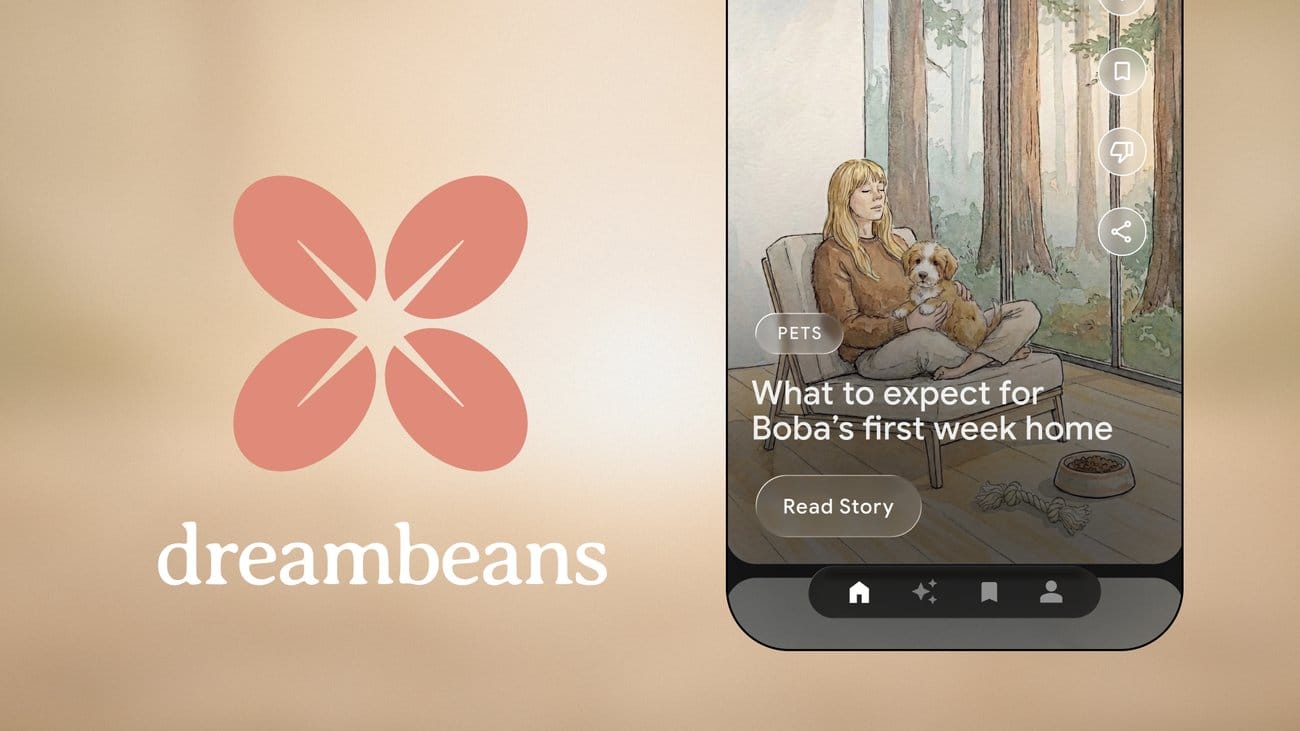
Dreambeans sounds like a product name generated by a committee that had too much espresso and one open tab of whimsy. Ignore the name for a minute. Google Labs’ new experiment is one of the clearer signs of where consumer AI is heading: away from “ask a chatbot” and toward “let the assistant read the ambient state of your life and decide what might matter before you ask.”
Google describes Dreambeans as an Android and iOS app that uses Personal Intelligence and Nano Banana 2 to generate a finite set of personalized daily stories. With permission, it can connect Gmail, Calendar, Photos, YouTube, and Search history. It then turns that material into recommendations, prompts, illustrations, and web-backed follow-ups. The launch is limited: starting June 3 for eligible Google AI Ultra subscribers, age 18 and older, in the United States, with a waitlist for everyone else using a personal Google account.
The example is deliberately soft. A Gmail delivery confirmation for puppy treats plus a Calendar reminder that a friend is visiting becomes training tips and dog-friendly restaurant recommendations. Each story gets an illustration reflecting “the people and places you frequent the most.” Users can tap into a story to go deeper, ask for web-backed actions like nearby dog parks or puppy training classes, save favorites, correct bad recommendations, and add missing interests or hobbies.
That sounds cute. It is also architecturally significant. Dreambeans requires at least one connected app and works best when all supported apps are enabled. Google says Dreambeans settings do not affect Personal Intelligence settings in Gemini Apps or AI Mode, which is an important boundary. But the basic bargain is still clear: the more of your Google life you connect, the more useful and more sensitive the product becomes.
Google Now, but with a generative memory palace
The obvious comparison is Google Now, and 9to5Google makes it directly. Google has been trying for more than a decade to build proactive computing: cards, reminders, commute alerts, package updates, trip details, restaurant suggestions, calendar nudges. Dreambeans is that ambition rebuilt for the Gemini era. Instead of showing a factual card, it assembles context into a small story, illustrates it, and offers next actions.
TechCrunch reports that product lead Gozde Oznur described Dreambeans stories as “places to visit, topics to explore, things to try, upcoming trips, events that you should be aware of.” The typical daily set is 10 to 14 stories. Oznur also said the “dream” part is literal: the app works while the user sleeps, processes connected apps overnight, and delivers a “freshly brewed” morning set of ideas.
The finite feed is the best design decision in the product. Google is explicitly pitching Dreambeans as an alternative to doomscrolling: a capped morning brief, not an endless engagement slot machine. That constraint matters. Infinite feeds are optimized to convert attention into inventory. A small daily set at least gives the product a chance to be useful without becoming another reflexive tap target.
But a finite feed does not automatically make a product humane. If the recommendations are wrong, too intimate, or badly timed, the story format may make the failure feel worse. “You bought dog treats, here are puppy tips” is fine. “We noticed private patterns across your inbox, photos, calendar, searches, and viewing history, so here is an illustrated suggestion” can cross the line with one bad inference. Personal AI does not get to be casually wrong. It is operating on context users did not necessarily mean to convert into a narrative.
The privacy challenge is product design, not a settings page
For builders, Dreambeans is a useful case study in permissioned context assembly. Most personal AI products want the same thing: access to email, calendar, documents, messages, photos, location, browser history, purchases, and preferences. The utility goes up as sources increase. So does the blast radius. The hard part is not technically connecting APIs; it is making the scope legible, reversible, and emotionally acceptable.
Google appears to understand at least part of that. Dreambeans requires users to choose connected apps, and Google says those choices do not change broader Personal Intelligence settings in Gemini or AI Mode. That separation is good. Settings for one experiment should not silently become a global AI-memory decision. But serious trust will require more than toggles. Users need to know which source contributed to a story, why a recommendation appeared, what data was excluded, how to delete a bad inference, and whether feedback changes only Dreambeans or a larger profile.
The generated-illustration layer adds another subtle risk. Nano Banana 2 is not just decoration; it is emotional packaging. The app is not merely recommending something, it is presenting a personalized scene that reflects people and places from the user’s life. That can make the experience delightful when it is accurate. It can also launder weak reasoning through pretty art. A beautifully illustrated hallucinated recommendation is worse than a plain-text “not sure.” Product teams building generative interfaces should separate confidence from presentation quality. The image should never make a shaky inference feel authoritative.
Dreambeans also hints at how Google may distribute personal AI. The standalone app probably matters less than the pattern. Google Labs experiments often graduate into larger surfaces; 9to5Google notes that the earlier “CC” experiment eventually became Daily Brief in the Gemini app. If Dreambeans works, expect pieces of it to appear inside Gemini, Search, Android, Workspace, Pixel, or notification surfaces: finite briefs, proactive suggestions, connected-app context, web-backed next steps, and personalized generated visuals.
That future is useful if the controls are excellent. Imagine a morning brief that spots a calendar conflict, finds the relevant document, reminds you about an unanswered email, suggests a route change, and queues a restaurant reservation because a friend is visiting. That is the good version. The bad version is a platform that turns private exhaust into illustrated engagement bait and calls it assistance.
Engineers building similar systems should take three notes. First, cap the feed. Scarcity is a product virtue when the input is someone’s life. Second, make every story auditable: source, reason, confidence, and controls. Third, keep generated presentation subordinate to truth. The prettier the system gets, the more explicit it must be about uncertainty.
Dreambeans is not important because everyone needs a personalized cartoon morning brief. It is important because Google is testing proactive personal AI as a product surface, not a chatbot feature. The old assistant waited for commands. The new one wakes up early, reads the room, draws a picture, and suggests your next move. That can be genuinely helpful. It also deserves the raised eyebrow that comes with giving an algorithm narrative rights over your day.
Sources: Google Blog, TechCrunch, 9to5Google, Google Labs