DSX Is NVIDIA Admitting Tokens Are an Industrial Operations Problem

NVIDIA’s DSX announcement is easy to file under “more AI factory branding,” which would be a mistake. The useful thing buried in the launch is not the phrase AI factory. It is the phrase token performance per megawatt. That is NVIDIA admitting, out loud, that tokens are no longer just a developer-facing API unit. They are an industrial output, constrained by power, cooling, utilization, scheduling, grid events, hardware faults, and the amount of operational chaos an infrastructure team can remove from the system.
That shift matters because most software teams still talk about inference cost as if it begins and ends with a model price sheet. They compare dollars per million tokens, argue about context windows, and maybe benchmark time-to-first-token. Infrastructure operators see the uglier version: stranded power, racks that cannot run at useful density, cooling envelopes, tenant isolation, GPU failures, runtime drift, networking bottlenecks, demand-response events, and months lost between purchase order and production workload. DSX is NVIDIA’s attempt to package that mess into a platform playbook.
At GTC Taipei, NVIDIA described DSX as a platform for designing, simulating, building, and operating AI factories across chips, systems, software, facilities, and partner technologies. The launch includes reference designs, DSX Sim, DSX Flex, DSX Exchange, the open-source modular DSX OS, and a new MaxLPS software layer for maximizing token performance per megawatt. Jensen Huang’s line was direct: “We’re not just shipping chips — we’re giving every infrastructure builder a complete playbook to build AI factories.”
That is also a moat statement. NVIDIA is no longer content to sell the accelerators and let someone else define the operating model. It wants the reference design, the simulation layer, the lifecycle software, the grid interface, the runtime stack, and the partner ecosystem to orbit the same architecture. Depending on your vantage point, that is either exactly what large-scale inference needs or the start of another very expensive dependency graph. Probably both.
The 40% claim is really about stranded capacity
The most concrete DSX addition is DSX MaxLPS, which NVIDIA says combines 45°C liquid cooling with in-rack technologies that optimize performance per watt. The company claims this lets operators run up to 40% more GPUs at their most energy-efficient operating point inside a fixed power budget, with minimal impact on inference workload performance.
Read that carefully. This is not a generic “faster GPU” story. It is about recovering capacity that is already paid for but constrained by power and thermal limits. In a world where power availability can decide whether an AI cloud comes online in 2027 or sits in permitting purgatory, turning the same megawatt into more useful tokens is margin. It is also supply. If demand for inference keeps rising, the cheapest new capacity may be the capacity operators stop wasting.
For application teams, this should be a warning. Infrastructure can optimize only so much if the workloads are sloppy. Chatty agent loops, oversized context stuffing, poor batching, avoidable cache misses, inefficient tool calls, and model routing that sends every request to the biggest model will happily burn the gains created by better racks and cooling. Token governance is now full-stack governance. The app team can create a power problem without ever seeing a power bill.
This is the first original practitioner lesson from DSX: stop benchmarking inference in isolation. Time-to-first-token, tokens per second, cache hit rate, batch shape, prefill/decode split, model routing, tenant quotas, and context length all eventually map to watts and utilization. If your architecture review does not include token-per-watt, you are optimizing the part of the invoice your dashboard happens to expose.
DSX OS is the boring layer that could matter most
DSX OS may be the more durable story. NVIDIA describes it as open-source, modular software for lifecycle management, intelligent scheduling, runtime consistency, health automation, resiliency, multi-tenant operations, and platform services. The developer material says it includes components for IT/OT communication, provisioning, health monitoring, workload scheduling, unified inference APIs, and operational automation.
The component list is telling. DSX Exchange is an MQTT-based hub connecting compute, networking, energy, cooling, facilities, and operational signals. DSX Flex connects workloads to grid services such as demand response, load shedding, pricing events, renewable availability, and onsite storage. NVIDIA Infra Controller handles API-driven bare-metal lifecycle management and tenant isolation. Fleet Intelligence and NVSentinel handle visibility, health checks, and remediation. KAI Scheduler, Run:ai, Dynamo, Grove, and NVIDIA Cloud Functions sit closer to scheduling and inference serving.
That stack is not glamorous. It is also exactly where large GPU fleets go to die when ignored. Hardware degradation is daily life at scale. Runtime drift causes silent performance and reliability bugs. Tenant transitions need to be auditable. Grid signals are no longer facilities-only trivia if the workload can adapt. NVIDIA’s framing is that an AI factory needs coordinated software across the five-layer stack: energy, chips, infrastructure, models, and applications.
The second practitioner lesson is to treat operational consistency as a feature, not overhead. A fast model served on a fragile fleet is not production infrastructure. Teams buying inference capacity should ask how runtime versions are pinned, how nodes are remediated, how GPU faults are detected, how workloads move during maintenance, how tenants are isolated, and how capacity reacts to grid or cooling constraints. If the answer is a spreadsheet, a heroic SRE, and a Slack channel named after an incident, request changes.
Open source, but with gravity
NVIDIA says DSX OS components are open source and designed for incremental adoption. That matters. Operators may want DSX Exchange for IT/OT coordination, Infra Controller for lifecycle management, Fleet Intelligence for visibility, or NVCF for unified inference APIs without adopting every part of the stack at once. Incremental adoption is the difference between useful platform primitives and a monolith wearing a modular badge.
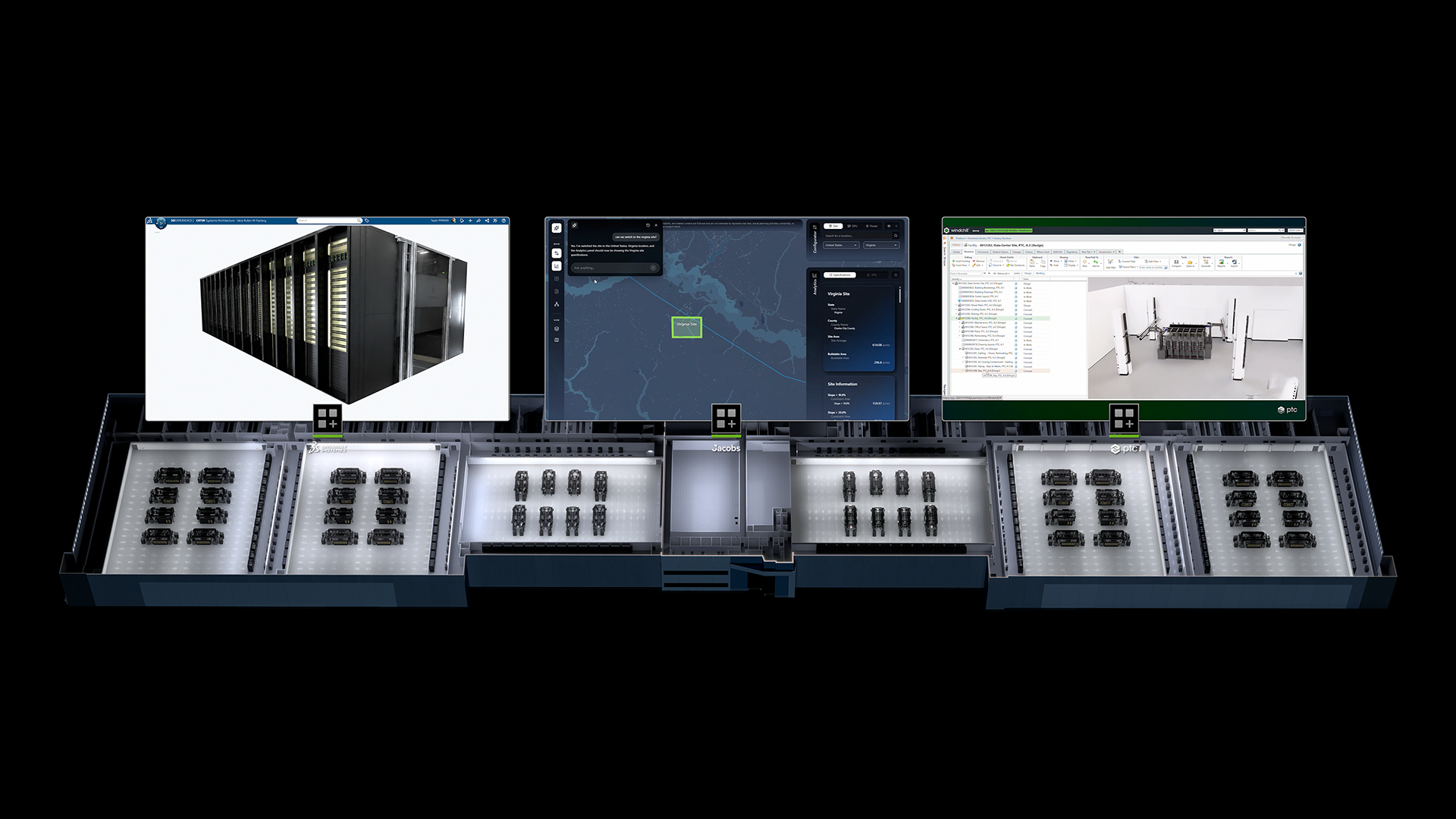
Still, the gravity is obvious. DSX-ready systems are coming from Dell, HPE, Lenovo, Supermicro, ASUS, Foxconn, Gigabyte, Pegatron, QCT, Wistron, and Wiwynn. Cloud and infrastructure partners including CoreWeave, Crusoe, Firmus, IREN, Lambda, Nebius, Nscale, and Yotta are deploying DSX components. QCT and Pegatron are working with Dassault Systèmes on digital-twin configurators; Cadence, PTC, and Siemens show up around simulation and facility modeling; Emerald AI and Silicon Valley Power are piloting grid-responsive AI factories.
That ecosystem is valuable because AI factories are multidisciplinary systems. It is also a lock-in vector because the more layers NVIDIA coordinates, the harder it becomes to swap assumptions later. The right response is not cynicism. It is explicit accounting. If DSX reduces deployment risk, improves utilization, and cuts time to first production, that is real value. If it quietly makes every operational choice depend on NVIDIA’s stack, price that dependency like any other architectural commitment.
For engineering leaders, the action item is straightforward: add infrastructure economics to agent and inference design reviews. Measure token-per-watt, not just latency. Budget agent loops and context growth. Require load tests that include batching, cache behavior, tenant contention, and failure modes. Ask providers how they handle demand response, GPU faults, runtime drift, autoscaling, isolation, and observability. DSX is NVIDIA’s answer to those questions. You still need acceptance tests that reflect your workloads.
The editorial take: DSX is NVIDIA industrializing inference. Tokens are the output, megawatts are the input, and operations software is where the margin goes to live or die. The GPU still matters. But the next cost curve may be won by whoever wastes the least power turning those GPUs into reliable production tokens.
Sources: NVIDIA Newsroom, NVIDIA Developer Blog, NVIDIA DSX docs