ETCHR Says Multimodal Models Should Stop Pretending Text Is Enough for Visual Reasoning

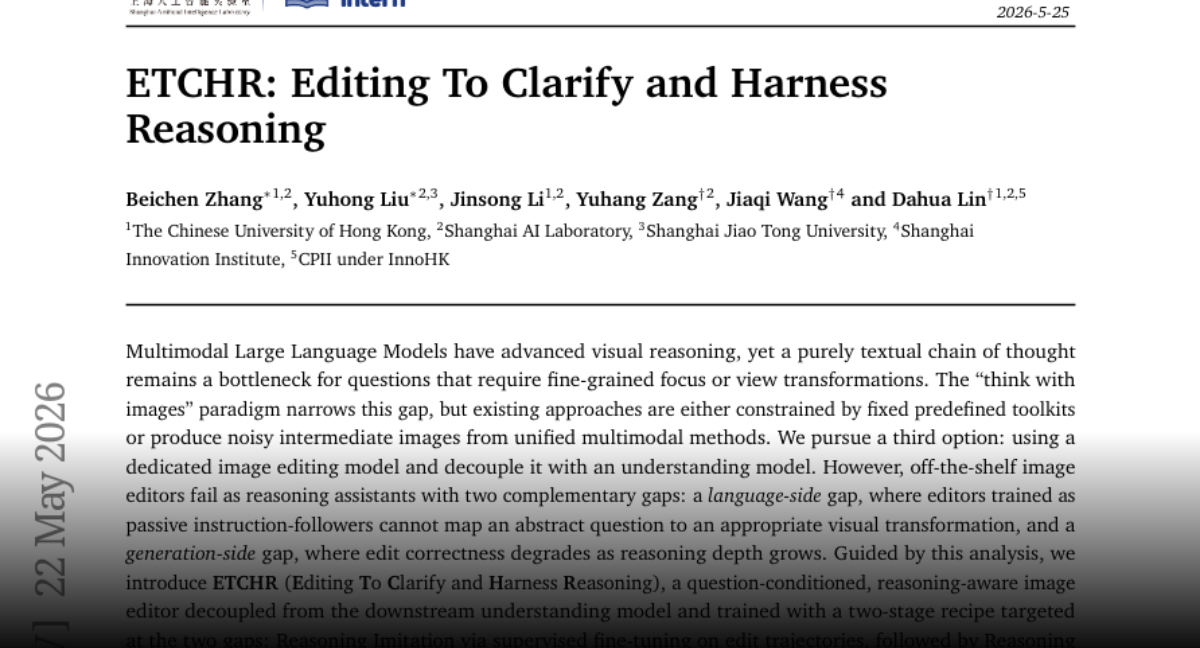
Multimodal models keep being asked to reason about images by turning them into words and hoping nothing important got lost in translation. ETCHR is interesting because it calls that bluff.
The paper, surfaced on Hugging Face Papers, proposes a question-conditioned image editor that helps vision-language models solve visual reasoning problems by creating intermediate images. That sounds like another tool-augmented AI trick until you hit the key design choice: the system does not assume the generated image is trustworthy. It edits, verifies, then reasons. If the understanding model decides the edit is unreliable, the pipeline falls back to the original image.
That small verification loop is the difference between “cool demo” and a pattern worth stealing.
ETCHR — Editing To Clarify and Harness Reasoning — targets the class of visual tasks where ordinary text chain-of-thought is a leaky abstraction. Fine-grained perception, chart reading, path reasoning, jigsaw restoration, and 3D spatial understanding often require manipulating the visual scene, not merely describing it. A model may need to zoom, isolate, restore, transform, or reframe evidence before the answer becomes obvious. If all it can do is narrate its uncertainty, the reasoning is already downstream of a lossy self-generated caption.
The model is allowed to think with pixels
The authors decouple the image editor from the understanding model. Instead of forcing one giant multimodal model to both understand and generate, ETCHR uses a dedicated image-to-image editor trained to infer useful transformations from the question. The downstream MLLM then verifies the edited image and answers using either the intermediate image or the original, depending on whether the edit passes the reliability check.
The training recipe has two stages. First comes Reasoning Imitation, using supervised fine-tuning on edit trajectories. Then comes Reasoning Enhancement, using VLM-derived rewards for edit correctness and downstream reasoning accuracy. The released model, ETCHR-FLUX.2-klein-9B, is based on FLUX.2-klein-base-9B and follows the FLUX non-commercial license. The team also released SFT and GRPO datasets on Hugging Face and training/evaluation code in the InternLM GitHub repo.
The reported gains are not cartoonishly large, which is part of why they are credible enough to discuss seriously. Across five task families, ETCHR improves Qwen3-VL-8B from 55.95 to 60.77 Pass@1, Gemini-3.1-Flash-Lite from 65.08 to 70.55, and Kimi K2.5 1T from 76.55 to 81.16. The benchmark suite spans V*Bench, HRBench, ChartQA, CharXiv, Maze, Frozen Lake, COCO-derived jigsaw tasks, and ViewSpatial.
A roughly five-point end-to-end lift is meaningful in visual reasoning, especially when it comes from a plug-in specialist rather than fine-tuning the understanding model. But it is not magic. It is an engineering trade: more components, more latency, more GPU memory, more licensing complexity, and one more failure mode in exchange for better performance on tasks where visual transformation is the bottleneck.
Generated evidence needs a verifier
The most reusable idea in ETCHR is not image editing. It is distrust.
Intermediate artifacts are dangerous precisely because they are useful. A generated crop, restored jigsaw, highlighted chart, transformed scene, SQL query, test case, exploit report, or meeting summary can look plausible while encoding the wrong state. Once the agent treats that artifact as evidence, the final answer may become more confident and less correct. Anyone who has watched an AI assistant summarize a log it misread has seen this failure mode in plain clothes.
ETCHR’s edit-verify-reason loop is a clean pattern: let the specialist module create an artifact, but require another step to decide whether the artifact should influence the answer. If verification fails, fall back. That is not glamorous, but it is the shape production systems need. Generated evidence should earn trust; it should not inherit it from the model’s fluency.
For practitioners, this suggests a broader design rule. If an agent creates something that it will later use as evidence, add a verifier at the boundary. Generated tests should be checked against known behavior or reviewed for vacuity. Generated SQL should be inspected or dry-run before execution. Generated security findings should include reproducible evidence and deduplication. Generated visual transformations should be accepted only when they preserve the relevant facts. The same architecture applies across modalities because the failure mode is not visual. It is self-contamination.
That is also where ETCHR fits the larger model-routing story. The industry keeps oscillating between two lazy extremes: one giant model should do everything, or every task needs a hand-built tool chain. ETCHR argues for a more practical middle path. Use a specialist generator when the task structure demands transformation. Pair it with a capable understanding model. Add verification so the specialist cannot silently poison the reasoning path. Route selectively instead of making every request pay the specialist tax.
How builders should evaluate this
No team should swap in ETCHR, or any similar visual editor, because a paper reports better averages. The right evaluation is task-specific.
Start by segmenting your visual workload. Are users asking about charts, UI screenshots, documents, maps, robotics views, medical images, product photos, spatial layouts, or ordinary image captions? Measure baseline performance by category. Then run the editor only on categories where visual transformation plausibly helps. Track task success, edit acceptance rate, bad-edit rejection rate, latency, memory footprint, and the percentage of cases where the edited image changes the answer. Human-inspect failed edits. If the editor improves Maze-like and chart tasks but slows simple VQA, route it accordingly.
Also test operational constraints early. ETCHR’s released model is non-commercial under the FLUX license path, so product teams need to treat it as research infrastructure unless licensing allows otherwise. The repo’s example path uses a vLLM server for the downstream understanding model, which is useful for experimentation but still leaves real deployment questions: batching, streaming, GPU allocation, monitoring, data retention, and fallback behavior under load.
The community signal is still quiet. HN had no visible ETCHR thread during the research window, and Hugging Face engagement was modest. That is fine. This is not a hype-cycle launch for people chasing the general LLM leaderboard. It is a systems-design paper for builders who have watched multimodal models confidently fail at charts, maps, and spatial questions and know the problem is not solved by asking for a longer chain of thought.
The editorial take is simple: multimodal reasoning will not be fixed by text alone. Sometimes the model needs a better visual workspace. But the moment that workspace contains generated evidence, the system needs skepticism built in. ETCHR gets that part right. The future of multimodal agents probably looks less like one omniscient model and more like routed specialists with verification gates. Less monolith, more pipeline discipline. Good. Pipelines can be inspected.
Sources: Hugging Face Papers, arXiv, InternLM ETCHR GitHub repo, ETCHR model page