Fix with Copilot Turns Failed GitHub Actions Into Agent Work. Useful, If You Keep the Blast Radius Small.

“Fix with Copilot” for failing GitHub Actions is a genuinely good agent use case, which is precisely why it deserves more scrutiny than the average AI button. CI failures are narrow, evidence-rich, and measurable. They are also where teams often confuse “green” with “correct.” GitHub has put an agent directly into that loop. Useful. Sharp edges included.
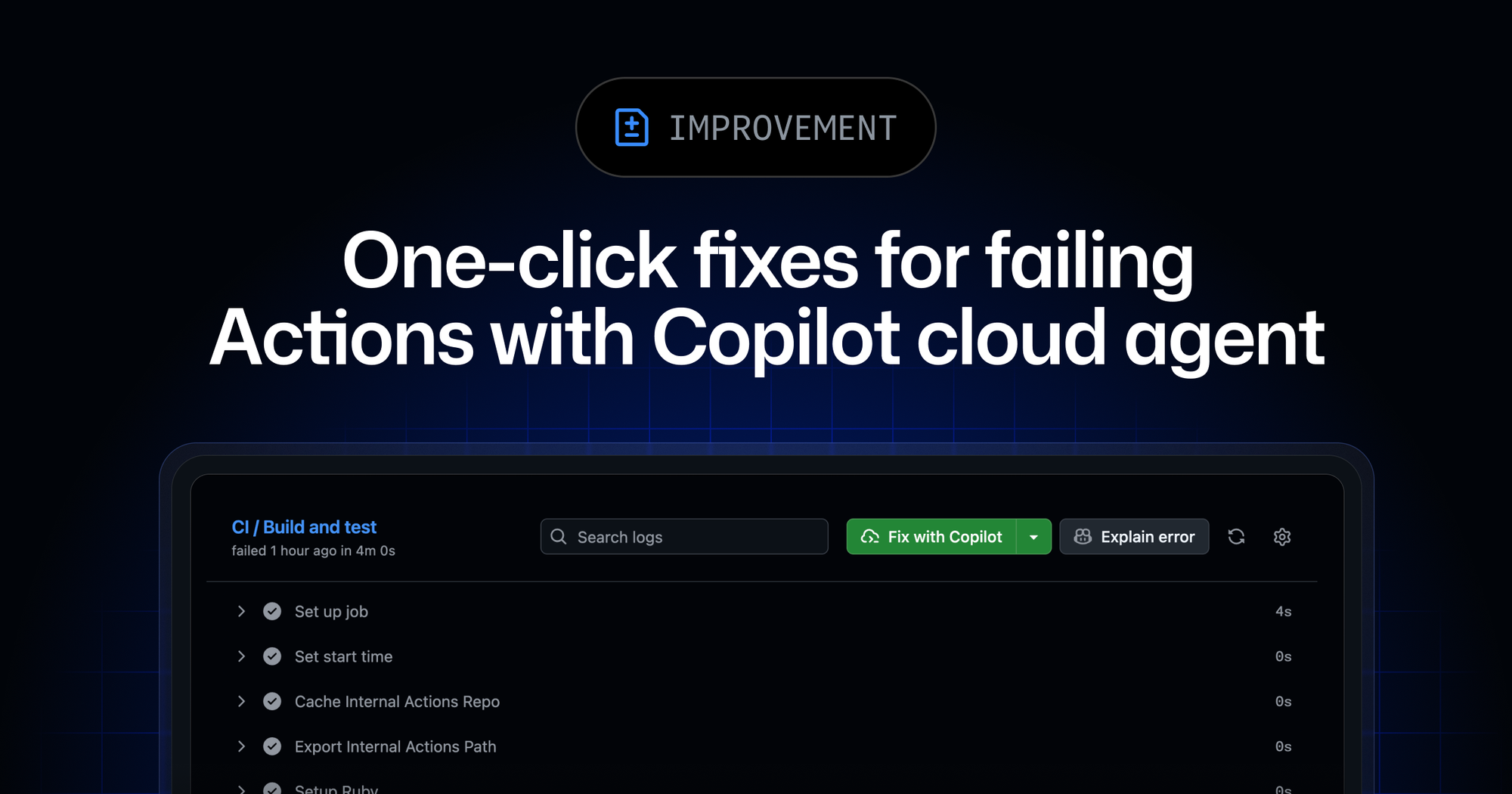
The feature is now available to Copilot Pro, Pro+, and Max subscribers. From the workflow run logs page, users can click Fix with Copilot, and GitHub says Copilot cloud agent will “investigate the failure, push a fix to your branch, and tag you for review when it’s done.” It runs the work in its own cloud-based development environment. That is exactly the right amount of product surface for an agent: give it a bounded failure, let it draft a fix, keep a human in the review path.
CI is one of the few places agents get a real harness
Most coding-agent prompts are vague enough to be performance art. “Improve this module.” “Make this cleaner.” “Refactor the auth flow.” Good luck grading that without a senior engineer and a bottle of aspirin. A failed GitHub Actions job is different. It has logs. It has a branch. It has a recent diff. It has commands. It has a pass/fail target. It may have artifacts, stack traces, linter output, dependency errors, snapshot mismatches, or platform-specific failures. In other words, it has a harness.
That makes the workflow credible. For linter failures, missing imports, broken snapshots, small test regressions, dependency-pin drift, flaky formatting, or build-script mistakes, a cloud agent can save real time. The developer does not need to context-switch into a red build, scan logs, patch the obvious issue, push, wait, and return to the task they were doing before CI interrupted them. Copilot can take the first pass and tag the human when it has something reviewable.
GitHub’s cloud-agent docs describe a broader capability set: the agent can research a repository, create implementation plans, fix bugs, improve tests, update docs, address technical debt, and resolve merge conflicts. It runs in an ephemeral development environment powered by GitHub Actions, where it can explore code, make changes, and execute automated tests and linters. GitHub also exposes cloud-agent starting points across issues, dashboards, chat, failing Actions runs, GitHub Mobile, IDEs, REST API, GitHub CLI, MCP Server, Jira, Slack, Teams, Azure Boards, Linear, and Raycast. The Actions button is not a toy feature bolted onto CI. It is another entry point into GitHub’s agent job system.
That has product implications. Once a failed workflow can become an agent task with one click, the red build is no longer just a signal to a developer. It is a queue item for cloud automation.
The agent can make CI green and still be wrong
The danger is not that Copilot will fail. Failure is visible. The danger is that it will succeed narrowly. CI failures are symptoms, not always causes. A test can fail because the code is wrong. It can also fail because the test is brittle, the fixture is stale, the requirement is under-specified, an external service changed, an environment variable expired, a secret rotated, a race condition surfaced, a migration assumption broke, or infrastructure coughed.
An agent optimizing for a green check may patch the nearest assertion instead of the underlying behavior. It may widen a timeout, update a snapshot, loosen a matcher, skip an edge case, or paper over a flaky dependency. Sometimes that is correct. Sometimes it is how bugs acquire a passing test suite and a charming little commit message.
That is why GitHub’s branch-push-and-tag-for-review shape matters. The agent investigates, pushes a fix to the branch, and tags the user. The human still owns merge. Teams should preserve that friction. Do not wire this into auto-merge because the second workflow passed. Do not treat “Copilot fixed it” as a root-cause analysis. Require a diff review, require tests, and for production-impacting changes require a short explanation of what failed and why the patch addresses the cause.
A useful policy is to categorize failures before clicking the button. Low-risk: formatting, lint, type imports, obvious unit-test breakage, generated artifacts, docs build failures, small dependency pin fixes. Higher-risk: security checks, production deployment failures, database migrations, authentication/authorization tests, payment flows, data-loss paths, credential errors, flaky external integrations, and protected release branches. The former are good agent fodder. The latter deserve a human reading logs first.
Every red build can become a spending event
The cost angle is not a footnote. Copilot cloud agent uses GitHub Actions minutes and AI credits. Copilot code review also consumes Actions minutes on private repositories. GitHub’s broader Copilot shift toward usage-based billing means agent convenience now sits directly on top of budget governance. The same VS Code 1.122 wave reinforces this direction with model cost visibility, AI credit dashboard changes, and warnings that larger context windows can increase AI credit usage.
That changes the CI hygiene calculation. A flaky test used to waste developer attention and runner minutes. Now it can also invite repeated cloud-agent sessions. A noisy monorepo with poor logs becomes a place where the agent spends time guessing. A workflow that fails with 5,000 lines of unstructured output forces the model to dig through garbage. A test suite that cannot reproduce locally gives the agent fewer good moves and more ways to burn credits.
So the first optimization is not prompt engineering. It is better CI. Make logs specific. Fail fast where possible. Keep test output readable. Separate lint, typecheck, unit, integration, and deploy jobs so the agent has a bounded problem. Name jobs like a human will read them at 11 p.m. Preserve artifacts. Make flaky-test detection explicit. If the workflow says “build failed,” do not be surprised when the agent writes a build-shaped guess.
Teams should track acceptance rate. How often does Fix with Copilot produce a patch that is merged unchanged, edited, rejected, or reverted later? Which repos benefit? Which jobs produce bad patches? Which models or task types cost the most? If acceptance is low, the answer may not be “the model is bad.” It may be that your CI is bad at explaining itself.
How to adopt the button without letting it adopt you
Start with small, well-tested repositories. Give developers written guidance: use the button for low-risk branch fixes with clear logs; avoid it for security, credentials, production deploy, migrations, and release branches unless a human has already diagnosed the issue. Require Copilot-authored commits or branches to remain reviewable by humans. Add labels or commit trailers if your process needs to track agent involvement.
For maintainers, make the review checklist explicit. Did Copilot change production code or only tests? Did it update snapshots because UI changed intentionally or because it missed a regression? Did it remove coverage? Did it skip tests? Did it alter retries, timeouts, or concurrency? Did it add dependencies? Did it touch generated files without updating the generator? Did the patch explain root cause? A green check answers none of those questions.
For platform teams, wire this into observability before it becomes habit. Track failed workflow to agent task to branch to review outcome. Record AI credits and Actions minutes where available. Watch for repeated failures that trigger repeated agent attempts. Put budgets around heavy repos. Give teams a way to disable the feature for protected workflows or sensitive branches. The button should reduce toil, not create an invisible spending loop.
The bigger industry read is that GitHub is moving agents from chat surfaces into operational interrupts. A failed build is an interrupt. A one-click repair agent is a reasonable response. But the rule remains: CI green is not the same thing as engineering judgment. Copilot can draft the repair. The team still owns the blast radius.
Sources: GitHub Changelog, GitHub Docs — Copilot cloud agent, GitHub Docs — starting Copilot sessions, GitHub Community usage-based billing discussion, VS Code 1.122 release notes