GLM 5.2 Won the Token Race. Opus 5 Is Selling Fewer Retries.

The useful story in this week’s model rankings is not that one model moved up one slot. It is that the two most visible leaderboards are measuring increasingly different things—and production teams can get expensive answers by pretending otherwise.
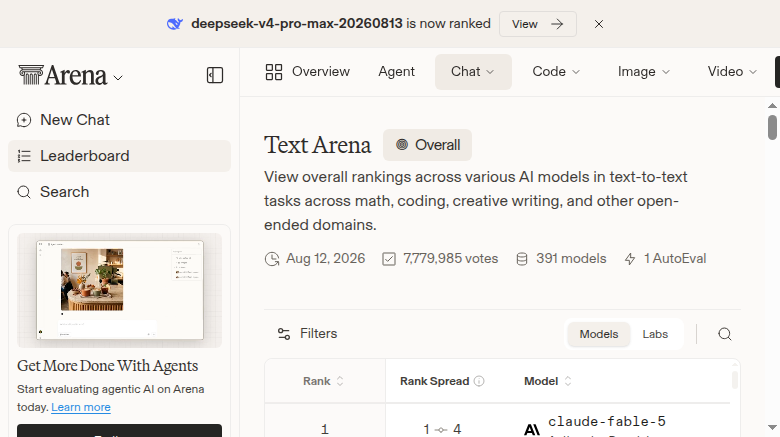
Arena AI’s extracted overall top 20 did not change from the previous day. OpenRouter’s usage chart did. Z.ai’s GLM 5.2 climbed from sixth to fifth with 4.04 trillion weekly tokens, narrowly passing Xiaomi’s MiMo-V2.5 at 4.03 trillion. Claude Opus 5 also moved from eleventh to tenth as its weekly total rose from 1.6 trillion to 1.7 trillion tokens. Human preference was static while routed production traffic shifted.
That contrast is more useful than another “model X beats model Y” headline. Arena approximates what people prefer in blinded comparisons. OpenRouter measures prompt plus completion tokens flowing through a marketplace. One is a quality signal shaped by voters and matchups; the other is a consumption signal shaped by price, context length, free tiers, batching, agent loops, availability, and the mix of applications using the router. They are related, but they are not interchangeable.
Four trillion tokens is adoption, but ten billion is noise
GLM 5.2’s fifth-place finish deserves attention and restraint in equal measure. Its displayed weekly usage grew from 3.68 trillion to 4.04 trillion tokens in a day, an increase of roughly 360 billion, or 9.8%. That is a meaningful acceleration. The margin over MiMo-V2.5, however, is only 10 billion tokens—about one quarter of one percent of either model’s weekly total. A single large batch workload or routing change could reverse the order tomorrow.
The better reason to test GLM 5.2 is the alignment between its product design and its consumption. Z.ai pitches a one-million-token context window, output up to 128,000 tokens, and long-horizon engineering performance. It reports an 81.0 score on Terminal-Bench 2.1, up from 62.0 for GLM 5.1, and 62.1 on SWE-bench Pro versus 58.4 for the prior version. Z.ai also says GLM 5.2 remains four points behind Claude Opus 4.8 on Terminal-Bench 2.1, 81.0 to 85.0. Those are vendor-reported numbers, not neutral certification, but the OpenRouter increase is at least evidence that developers are giving the model real work rather than merely admiring a benchmark chart.
There is a broader pattern above it. DeepSeek V4 Flash 0731 remains first at 10.9 trillion weekly tokens, just ahead of Tencent’s Hy3 at 10.8 trillion. Together they account for 21.7 trillion tokens, more than the next four models combined. DeepSeek also holds fourth place with V4 Flash 0423 and seventh with V4 Pro. Raw model traffic is being won by systems that make enormous token budgets economically tolerable.
But token volume is not market share in the ordinary sense. A repository-scale coding agent can consume more tokens in an afternoon than thousands of short chat sessions. OpenRouter also warns that providers use different tokenizers, so a token counted by Anthropic is not perfectly equivalent to one counted by OpenAI, Z.ai, or DeepSeek. The ranking is best read like cloud consumption telemetry: it tells us where compute-heavy workloads are accumulating, not how many people chose a model or which model is objectively best.
Opus 5 is selling a different denominator
Claude Opus 5 reaching the top 10 is the more interesting economic counterexample. OpenRouter lists it at $5 per million input tokens and $25 per million output tokens, with the same one-million-token context and 128,000-token maximum output advertised for GLM 5.2. On unit price alone, it should struggle against aggressively priced open and open-weight alternatives. Yet it reached 1.7 trillion weekly tokens and displaced the free Laguna S 2.1 model.
Anthropic’s argument is that price per token is the wrong denominator for agentic work. The company says Opus 5 more than doubles Opus 4.8’s Frontier-Bench performance at a lower cost per task, and comes within 0.5% of Fable 5 on CursorBench 3.2 at maximum effort while costing half as much per task. It also reports gains of 10.2 percentage points on an internal organic-chemistry benchmark and 7.7 points on a protein-variation task.
Customer testimony supplied by Anthropic points in the same direction. Lovable reported a 22% improvement over Opus 4.7 on its hardest agentic coding tasks. A financial-modeling customer reported nine percentage points higher accuracy with one-third fewer turns and tool calls, completing work in 60% less time. A legal-work customer said it achieved similar quality to Opus 4.8 at maximum reasoning while using 26% fewer tokens. These claims were selected for a launch announcement, so they should be treated as attributed evidence rather than community consensus. Still, Opus 5’s move in actual marketplace traffic is consistent with the thesis.
For an engineering team, the lesson is concrete: measure the cost of the finished workflow. A model priced at one-fifth as much can still cost more if it needs repeated attempts, generates regressions, loses constraints midway through a task, or requires an engineer to rescue its tool calls. Conversely, a premium model is not “efficient” because its vendor presents a flattering cost-per-task graph. It earns that label only on your traces, with your tools, failure modes, and review standards.
Put leaderboards at the top of the funnel, not the end
Teams considering either model should run a controlled bake-off instead of changing the default route. Sample real tasks across at least three workload types: bounded bug fixes, repository-wide changes, and long-running tool workflows. Record completion rate, wall-clock time, input and output tokens, tool calls, retry count, human intervention minutes, and post-merge regression rate. For long-context tests, deliberately place architectural constraints early in the prompt and check whether the model still obeys them late in the run. A one-million-token checkbox is worthless if the model forgets the decision that mattered at token 50,000.
Keep routing conditions fixed. Cache behavior, concurrency limits, provider fallbacks, reasoning settings, and prompt truncation can swamp a model-level difference. Run enough repetitions to distinguish a reliable advantage from a lucky completion, and price human review time rather than pretending it is free. For agentic systems, the most useful metric is often successful tasks per engineer-hour per dollar—not benchmark score, tokens, or latency in isolation.
The daily chart should also be observed over a longer window. GLM 5.2’s 360-billion-token increase justifies adding it to an evaluation queue; its 10-billion-token lead does not justify a migration. Require three to seven days of persistence before calling the rank change a trend. The same caution applies to the smaller swaps: Claude Sonnet 5 rose from fifteenth to fourteenth, GPT-5.6 Terra from seventeenth to sixteenth, and Gemini 2.5 Flash Lite from twentieth to nineteenth, while Step 3.7 Flash, Gemini 3 Flash Preview, and GPT-5.6 Sol each slipped one place. No model entered or exited either monitored top 20.
The stable Arena table sharpens the editorial verdict. Buyers are optimizing dimensions that blinded preference tests do not capture: availability, integration fit, latency, guardrails, long-context behavior, and the economics of failure. Open models dominate the volume chart by making tokens cheap enough to spend freely. Opus 5 is trying to win by making fewer of those tokens—and fewer surrounding retries—necessary for a completed task. Both strategies can work because they optimize different denominators.
So do not crown GLM 5.2 because it beat MiMo-V2.5 by 10 billion tokens, and do not crown Opus 5 because it reached tenth place. Use Arena to discover quality candidates, OpenRouter to spot adoption and pricing pressure, and production-shaped evaluations to make procurement decisions. A leaderboard is a lead, not a policy.
Sources: OpenRouter Rankings, OpenRouter rankings dataset documentation, Z.ai GLM 5.2 documentation, Anthropic’s Claude Opus 5 announcement, OpenRouter Claude Opus 5 model page, and Arena AI leaderboard.