Google Health Is Turning Fitbit Into an AI Data Layer, Not Just a Dashboard

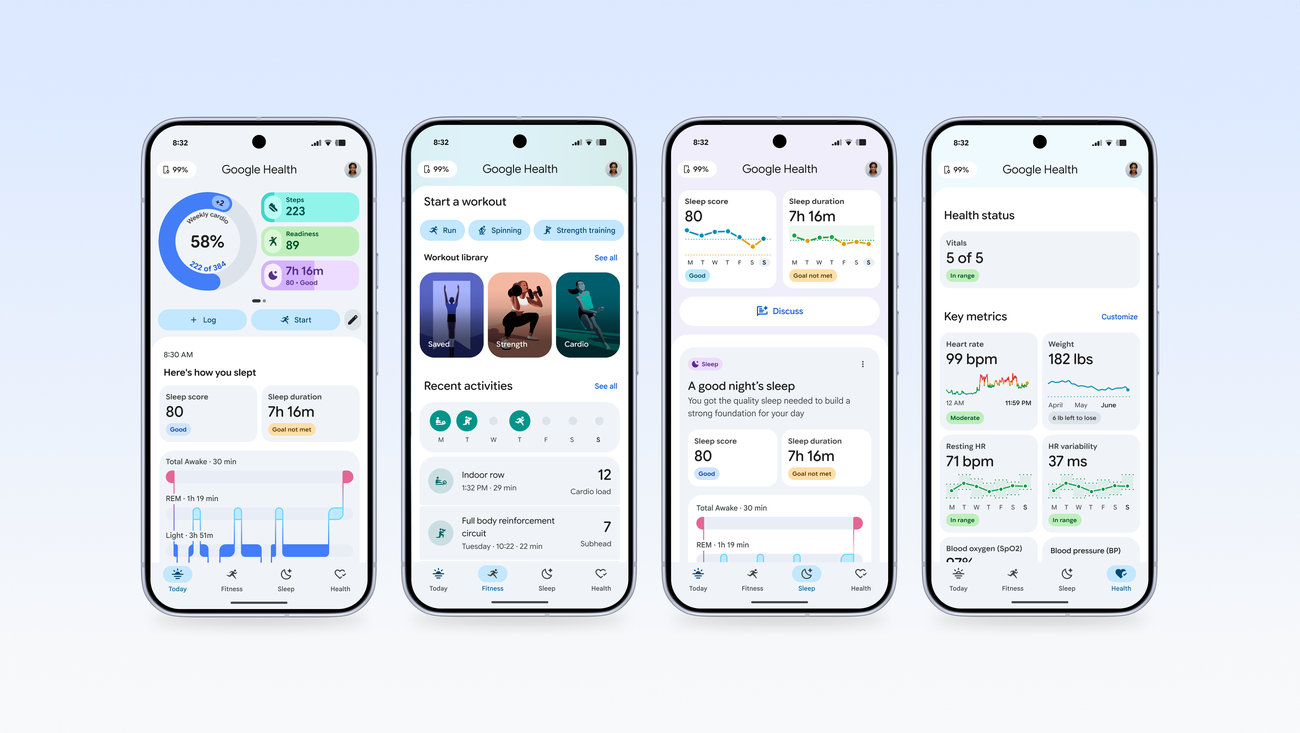
Google Health’s latest update is easy to misread as another wellness-app consolidation story. Fitbit gets renamed, Apple Health gets mentioned, Gemini gets the predictable product cameo, and everyone moves on. That would miss the actual architecture decision: Google is trying to turn personal health data into an agent-ready substrate.
A dashboard can show yesterday’s sleep score. An AI coach needs something more invasive and more useful: permissioned context, cross-device ingestion, medical-record access, export paths, stable schemas, and enough user control that the whole thing does not feel like a black box with a pulse animation. Google’s May 26 post is about that plumbing. Boring, yes. Also the part that decides whether “AI health coach” becomes a durable product or another motivational chatbot that tells you to hydrate.
The coach is not the product. The data layer is.
Google says the new Google Health app can connect data from wearables, smart scales, food logs, medical records, and third-party apps. It integrates through Health Connect, Apple Health, and the Google Health APIs, formerly associated with Fitbit APIs. In the U.S., users can sync medical records and view labs, vitals, medications, and other health information inside the app.
That matters because Google Health Coach, built with Gemini, is explicitly designed to sit on top of this unified context. The company says the Fitbit app becomes Google Health with four tabs — Today, Fitness, Sleep, and Health — and the Health Coach shows up across those surfaces with proactive insights, natural-language workout creation, weekly plans, sleep coaching, medical-record summaries, and multimodal logging through voice, images, and documents. The rollout started May 19 as an update for existing Fitbit users; Google says Google Fit users will be invited to migrate data later in 2026.
The May 26 follow-up adds the more strategically interesting part: portability. Google says users can share data with other apps through Health Connect or Google Health APIs, export workout data as TCX files, use Google Takeout, and soon share data to Apple Health. It also says medical records will be shareable with providers or family through Smart Health Links. The line that should make developers pause is even more direct: Google says users will be able to “explore and build on” their own data with tools like command-line interfaces and other AI skills.
That is not normal consumer fitness-app language. It is platform language. A CLI for personal health data is either a serious developer surface or a sentence that sounded good in a roadmap paragraph. The distinction matters.
Health agents have a partial-context problem
Google’s research writeup makes clear this is not just Gemini pasted into a Fitbit chat window. The personal health coach uses a multi-agent framework: a conversational agent for intent, orchestration, context gathering, and response generation; a data-science agent that can fetch, analyze, and summarize sleep and workout data using tools and code-generation capabilities; and domain experts such as a fitness expert that can generate and adapt plans. Google says its evaluation framework, SHARP, measures safety, helpfulness, accuracy, relevance, and personalization, with more than 1 million human annotations and over 100,000 hours of human evaluation by generalists and experts in sports, sleep, family medicine, cardiology, endocrinology, exercise, and behavioral science.
That is the right kind of rigor to claim. But health is also where model architecture runs directly into messy product reality. Google’s support documentation already warns that third-party data may not be available for all metrics and may not be used as input for every feature. Sleep score and Cardio Load, for example, currently use first-party data only. Google Health Coach workouts also do not yet sync to or appear on watches or trackers.
Those are not footnotes. They are failure modes. If a user connects an Apple Watch, Garmin, Oura ring, MyFitnessPal, a smart scale, and medical records, the coach has to know not only what data exists but what data is missing, stale, inconsistent, or excluded from a particular calculation. Otherwise it will do what bad agents do everywhere: produce confident guidance from incomplete context.
For engineers, this is the part worth stealing. If your agent depends on user data, build the data provenance UI before the charming chat UI. Show which sources were included. Show which sources were ignored. Show last sync time. Show what was inferred and what was measured. Show where the model is uncertain. “Personalized” is not a magic word; it is a liability unless users can inspect what personalization actually used.
The privacy promise is necessary, not sufficient
Google repeats that Google Health data is not used for Google Ads. Good. That needs to be table stakes. Users can also opt into features, export data, delete data, and control what they share. The company is clearly trying to preempt the obvious reaction: this is Google, health data is sensitive, and nobody wants their sleep debt turned into ad targeting.
But the harder trust problem is not only ad use. It is ongoing agency. Health agents operate in a domain where advice feels personal even when the disclaimers say it is informational guidance, not medical advice. Google’s own footnotes warn that AI answers may be inaccurate or incomplete and that users should consult health professionals before making changes. That is legally prudent. It is also product tension in plain text: the more useful the coach feels, the more users may treat it like advice.
The engineering response cannot be another modal. Agents in sensitive domains need revocation that is easy to find, audit logs that normal people can read, granular permissions that map to real use cases, and explanations that tell users what changed when a data source disappeared. If the coach used medical records yesterday but not today, the user should not need a support article to understand why the recommendation changed.
This is also where Google’s portability posture becomes a competitive tell. If Health Connect, Apple Health sharing, Takeout, TCX export, Smart Health Links, and future CLI or AI-skill access are robust, Google Health could become a genuinely useful personal data hub even for people who do not want Google’s coach as the only interface. If those surfaces are shallow while the best reasoning stays locked behind Google Health Premium, then “open ecosystem” becomes a nice phrase around a closed funnel.
What builders should do with this
Developers working on quantified-self tools, health-adjacent apps, coaching products, personal agents, or data infrastructure should treat this as a roadmap of what agent-ready consumer platforms will require. The winning product is not the chatbot. It is the consented context layer beneath it.
First, design ingestion as a first-class system. Google is pulling from Health Connect, Apple Health, direct APIs, medical records, third-party devices, food logs, and manual uploads because no single device owns a person’s health context. If your product assumes one canonical stream, it will be wrong for real users.
Second, design for conflicting data. Apple Health and Google Health may calculate values differently. Device makers expose different metrics. Some devices omit HRV, SpO2, skin temperature, VO2 max, maps, or detailed laps. Your agent should not smooth that away into a single fake certainty score. It should expose the mismatch and adapt recommendations accordingly.
Third, separate coaching from clinical claims. Google is careful to describe Health Coach as wellness guidance, not diagnosis or treatment. Builders should be just as disciplined. The temptation will be to make the agent sound authoritative because authority increases engagement. That is exactly the wrong optimization target in health.
Finally, make export real. The next credible personal AI products will compete on whether users can leave with their data and still have something useful. Lock-in may work for enterprise SaaS longer than anyone wants to admit. In personal health, it will corrode trust faster.
The LGTM read: Google Health is one of the more consequential Gemini surfaces precisely because it looks mundane. This is not a model-release story. It is a permissions, portability, and provenance story wearing a fitness-app hoodie. If Google gets the substrate right, Health Coach could become a serious example of personal AI that earns its context. If it gets it wrong, it will be a reminder that the hardest part of consumer AI is not answering the question. It is deserving the data.
Sources: Google Health, Google Health app announcement, Google Health Coach announcement, Google Research, Google Health Help