GPT-5.6 Luna's Top-20 Debut Is a Pricing Story Disguised as a Model Ranking

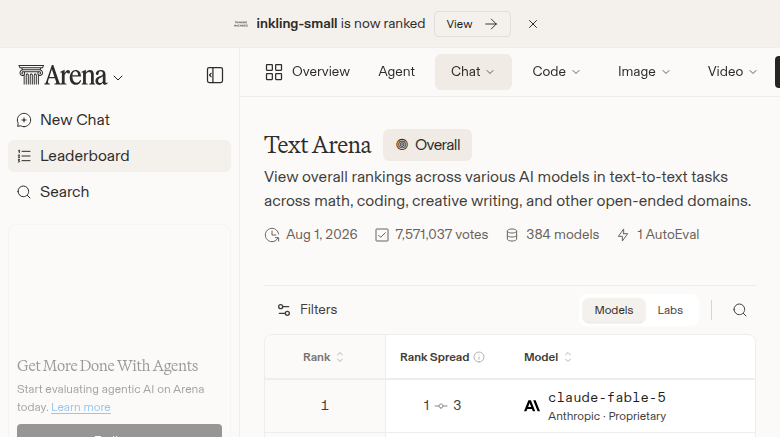
Model leaderboards invite the wrong kind of certainty. A model moves three places, screenshots circulate, and everyone pretends a single ordinal number has settled an architecture decision. This week’s useful signal came from somewhere less glamorous: the invoice. GPT-5.6 Luna entered OpenRouter’s weekly top 20 at number 15 with 835 billion tokens after an aggressive price cut, while Arena’s text leaderboard did not change at all. Quality preferences stood still; production allocation moved.
That divergence matters more than another benchmark trophy. On July 30, OpenAI cut Luna’s list price by 80%, to $0.20 per million input tokens and $1.20 per million output tokens. OpenRouter then temporarily halved those rates again, to $0.10 and $0.60. Within days, Luna was not merely clinging to twentieth place: its 835 billion weekly tokens put it ahead of Gemini 2.5 Flash Lite at 668 billion, MiMo-V2.5-Pro at 635 billion, Claude Opus 4.8 at 594 billion, Gemini 2.5 Flash at 575 billion, and Gemini 3.1 Flash Lite at 573 billion. OpenAI’s own gpt-oss-120b was pushed out of the list.
The displayed 151% week-over-week change is eye-catching, but the rank is more revealing than the percentage. OpenRouter’s top 14 kept exactly the same order, meaning Luna forced its way into an established traffic tier rather than benefiting from a general reshuffle. Claude Opus 5 remains just above it at number 14 with 927 billion tokens and a displayed growth rate above 999%. Luna has not replaced the premium tier. It has created a cheaper lane immediately beneath it.
A price cut is a production benchmark
Arena and OpenRouter measure different things. Arena’s blind comparisons are a preference signal: given two answers, which one do voters like? Its current text top ten is led by Anthropic’s claude-fable-5 at 1508 Elo, followed by claude-opus-4-6-thinking at 1505 and claude-opus-4-7-thinking at 1502. Luna does not appear in that top ten, and the entire Arena top 20 was unchanged in the latest snapshot.
OpenRouter measures requests people were willing to route and pay for. That does not make its ranking a quality oracle—free tiers, promotions, bots, and a few large customers can all distort volume—but it makes a sudden move after a price change an unusually clean natural experiment. The likely explanation is not that Luna became smarter on July 30. It became economical enough for teams to substitute it into workloads where the existing quality bar was already being met by something more expensive.
This is the first original lesson for builders: “best model” is becoming a malformed requirement. The useful question is which model sits on the cost-quality-latency frontier for a particular task. A cheaper model does not need to beat every frontier system in open-ended conversation. It needs to clear your acceptance test for extraction, classification, test generation, deterministic edits, document triage, or tool-driven workflows. Once it clears that threshold, extra benchmark points can be waste rather than value.
OpenAI says Luna delivers performance comparable to models that were frontier-class a year earlier at “roughly 6 cents on the dollar per task” and at nearly nine times the speed. On Agents’ Last Exam, the company claims Luna beats Claude Fable 5 at an estimated per-task cost nearly 99% lower. Its launch evaluations also report Luna outperforming Claude Opus 4.8 on the Artificial Analysis Coding Agent Index while taking roughly one-third the time, producing about half as many output tokens, and costing around one-quarter as much.
Those are vendor benchmarks, so treat them as test cases, not conclusions. “Cost per task” can hide the variables that make or break a real deployment: retries, malformed tool calls, longer prompts needed to constrain a weaker model, escalation to a stronger model, and human review. A run that costs one-quarter as much but succeeds half as often is not cheaper. It is a discounted incident generator.
The token price is only the visible part of the bill
The broader GPT-5.6 family includes Programmatic Tool Calling, which lets a model write a lightweight program to process intermediate tool results instead of serializing every result through another full model round trip. That could matter more than the posted token rate for high-volume agents. Repeatedly pouring search results, database rows, and tool payloads back into the context window increases cost, latency, and the chance that relevant evidence gets buried. Local filtering can remove all three.
It also creates a new failure surface. Model-authored orchestration code should run with strict sandboxing, time and memory limits, typed tool boundaries, allowlisted network access, and complete traces. If an agent can generate code that touches tools but the platform cannot show exactly what ran and why, the architecture has traded token waste for operational ambiguity. Cheap inference does not excuse expensive debugging.
OpenAI attributes some of the price reduction to its own models improving the serving stack. The company says GPT-5.6 Sol-assisted kernel rewrites reduced end-to-end serving cost by 20%, while experiments improved token-generation efficiency by more than 15%. If those figures hold, the second original lesson is that model competition is turning into systems competition. Training produces capability; kernel work, batching, routing, quantization, and utilization determine who can sell that capability profitably. Providers that cannot improve the whole inference stack will be forced to choose between weak margins and uncompetitive prices.
The OpenRouter table already shows the shape of that market. Its top ten is dominated by high-volume models from Xiaomi, DeepSeek, Tencent, Z.ai, Nvidia, MiniMax, StepFun, Moonshot, and InclusionAI. MiMo-V2.5 leads with 8.09 trillion weekly tokens, followed by DeepSeek V4 Flash at 7.56 trillion and Tencent’s Hy3 at 4.8 trillion. OpenAI entered the top 20 only after pricing Luna for throughput. Brand gets attention; unit economics gets requests.
Run a challenger, not a migration
Engineering teams should resist both obvious mistakes: dismissing Luna because it is not at the top of Arena, and replacing a proven default because the promotional price looks irresistible. Add it as a challenger. Start with tasks whose outputs can be automatically checked and shadow 5–10% of eligible production traffic. Use representative traces, including failures and ugly long-tail inputs, rather than a polished synthetic benchmark.
Measure task success, p50 and p95 latency, input and output tokens, valid tool-call rate, retry count, escalation rate, and human-review minutes. Then calculate cost per successful task, not cost per token. Segment the results by workload because averages conceal exactly where routing helps: Luna may be excellent at structured extraction and materially worse at multi-step tool recovery. A single blended score would turn actionable evidence back into leaderboard theater.
Set a hard escalation path for uncertainty and high-impact actions. The increasingly sensible architecture is a router that sends routine, verifiable work to the smallest model that passes a measured threshold, then promotes ambiguous cases to a stronger tier. This is not only a cost optimization. It limits the blast radius of weaker reasoning while reserving expensive inference for decisions where it changes the outcome.
There is one more test, and it cannot be run during the sale. OpenRouter explicitly describes the Luna discount as temporary. Promotions distort rankings, and traffic can rotate quickly when an application’s model abstraction is clean. Track Luna’s weekly tokens, rank, success cost, and workload mix for at least four weeks after promotional pricing ends. If it keeps the traffic at OpenAI’s $0.20/$1.20 list rate, the market found a durable price-performance tier. If it falls when the subsidy disappears, this was a successful customer-acquisition campaign masquerading as a leaderboard event.
Practitioners noticed the economics immediately. An indexed Reddit discussion comparing Luna with GPT-4.1 mini drew 330 votes and 44 comments, with attention focused on the stacked OpenRouter discount and whether tool calling remains reliable across multi-step jobs. That skepticism is healthy. The relevant question is no longer whether a smaller model can produce an impressive demo. It is whether it can survive your validation harness often enough to stay in the request path.
Luna’s number-15 debut is therefore not proof that it is the fifteenth-best model, or even that it will remain the fifteenth-most-used one. It is evidence that hundreds of billions of tokens can move in days when capable inference crosses a new economic threshold. Arena tells us what people prefer in a comparison. OpenRouter is showing what builders deploy under a price constraint. In production, the second signal is increasingly the one that ships.
Sources: OpenRouter weekly rankings, Arena AI text leaderboard, OpenAI price-performance announcement, OpenAI GPT-5.6 launch evaluations, OpenRouter GPT-5.6 Luna model page, Reddit practitioner discussion