Hy3’s Paid Usage Just Overtook Its Free Tier—and That Matters More Than the Ranking

The most interesting model movement this week is not a new number one. It is a free trial ending without the workload disappearing.
Tencent’s Hy3 paid endpoint climbed from sixth to fourth on OpenRouter’s weekly ranking, reaching 3.36 trillion tokens. Its free sibling moved the other way, falling from third to fifth as its rolling total contracted from 4.93 trillion to 3.32 trillion tokens. Put the two endpoints together and Hy3 accounts for 6.68 trillion tokens—more than DeepSeek V4 Flash’s 6.01 trillion and second only to Xiaomi’s MiMo-V2.5 at 10.2 trillion.
Raw token leaderboards are easy to overread. They reward long contexts, agent loops, retries, and providers willing to subsidize traffic. But this split is unusually informative because it gives us a rough before-and-after view of the same model under two pricing conditions. Paid Hy3 is now slightly ahead of free Hy3, and the paid endpoint added roughly 590 billion tokens since the previous rolling-window snapshot. That is not proof of retention or revenue. It is evidence that at least some workloads survived contact with a bill.
The conversion signal matters more than the rank
OpenRouter displays paid Hy3 at more than 999% week-over-week growth, versus 70% for the free endpoint. Those percentages deserve caution: the leaderboard is a live rolling window, so traffic can fall in absolute terms while its displayed year-over-year-style comparison remains positive. Launch timing also makes four-digit growth a flashy description of a small base. Still, the direction is hard to dismiss. Developers did not merely sample Hy3 while someone else paid for the tokens; enough of them kept routing traffic after the promotion to push the paid endpoint past the free one.
That distinction separates distribution from novelty. A free endpoint can manufacture attention. A paid endpoint must clear a more practical test: is the model good enough, fast enough, and cheap enough that changing the route feels riskier than leaving it alone? Production adoption is rarely a beauty contest. It is a pile of acceptable trade-offs that survives procurement, latency budgets, tool-call failures, and an engineer asking why last month’s inference bill doubled.
Hy3 is built for that trade-off. Tencent describes it as a 295-billion-parameter mixture-of-experts model with 21 billion active parameters, a 256K context window, and a hybrid fast/slow reasoning design. The large total parameter count gives it capacity; activating a much smaller subset per token is meant to keep inference economics manageable. Tencent says average daily token consumption rose twentyfold after the model’s April preview, while active WorkBuddy users selecting Hy3 increased sixfold. Feedback from more than 50 products informed its post-training, with deployments spanning CodeBuddy and WorkBuddy, Yuanbao, Marvis, ima, WeChat customer-service tooling, and even a WeGame title.
Those deployments are more meaningful than a pristine benchmark slide. They expose a model to messy prompts, underspecified tool schemas, multilingual inputs, giant repositories, customer-service edge cases, and users who will retry the same task in five subtly different ways. Tencent has a distribution advantage few labs can reproduce: it can train against failure modes found across an existing product estate, then immediately push the improved model back into those products.
Open weights do not mean cheap infrastructure
Hy3’s weights are available under Apache 2.0, which makes modification and commercial deployment comparatively straightforward. That matters for teams worried about provider dependence or data locality. It does not turn Hy3 into a model you casually drop onto the spare GPU under someone’s desk.
Simon Willison notes that the full checkpoint is 598GB and the FP8 build is about 300GB. Before replicas, KV cache, networking, observability, failover capacity, and operational headroom, that footprint already implies serious hardware. “Open weights” describes legal and technical access. It says almost nothing about whether self-hosting wins economically.
Teams considering Hy3 should therefore run two separate evaluations. First, compare hosted endpoints using task completion per dollar and per minute—not tokens per request. Token totals are an activity meter, not an efficiency metric. An agent that burns twice the tokens but finishes a repository migration without human repair may be cheaper. A model that looks inexpensive per million tokens but repeatedly mangles tool arguments is not.
Second, price self-hosting as a service, not as a GPU shopping list. Include at least two replicas if availability matters, realistic utilization rather than theoretical throughput, cross-host communication, model loading time, cache behavior, monitoring, upgrades, and the engineering cost of owning the serving stack. Compare that fully loaded number with hosted pricing and the value of controlling weights and data. For many teams, Apache 2.0 is valuable insurance even when the sensible deployment remains an API.
Preference and production are measuring different markets
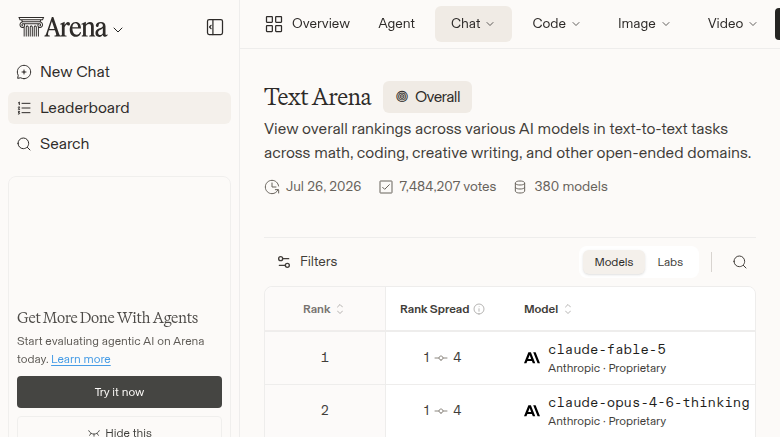
Arena AI’s top 20 did not move. Anthropic still owns four of the top six slots: claude-fable-5 leads at 1507 Elo, followed by claude-opus-4-6-thinking at 1505 and claude-opus-4-7-thinking at 1502. Hy3 is not present. Kimi K3 sits tenth at 1486, tied with Google’s Gemini 3.1 Pro Preview and Gemini 3 Pro on the displayed score.
OpenRouter shows a different market. Xiaomi is first, DeepSeek holds second and sixth, Z.ai is third, Tencent occupies fourth and fifth, Nvidia is seventh, MiniMax eighth, and StepFun ninth. Anthropic’s first entry is Claude Opus 4.8 at tenth. OpenAI’s GPT-5.6 Sol is nineteenth. Kimi K3 rose from twelfth to eleventh on 1.23 trillion tokens and 445% growth, passing Claude Opus 4.7.
This is not evidence that OpenRouter’s leaders are “better” than Arena’s favorites. Arena asks people which answer they prefer in paired comparisons. OpenRouter records tokens consumed through one routing platform. Neither metric directly captures completed software tasks, defect rates, retention, or margin. They reveal different buying criteria: preference tests reward polished answers, while routed workload volume also reflects price, availability, context limits, integrations, and the inertia of systems that already work.
The divergence is useful. It suggests the model market is not converging on one universal winner. Premium closed models can dominate preference while open-weight Chinese models absorb enormous production volume. That resembles databases more than search engines: the “best” system depends on the workload, operating model, and cost envelope. Brand matters less once the model becomes one replaceable component behind a router.
What engineering teams should test this week
Hy3’s movement justifies an evaluation, not a migration. Build a test set from real work: repository-scale changes, your actual tool schemas, long-running agent tasks, multilingual prompts if relevant, and known failure cases. Record successful task completion, wall-clock time, input and output tokens, tool-call validity, retries, human repair time, and total cost. Run the same cases against the model you already use and at least one price-adjacent alternative.
Pay special attention to long-context behavior. A 256K window is useful only if the model retrieves and obeys the right details near the middle, resists irrelevant repository noise, and does not turn extra context into extra latency. Test cache policy and repeated-prefix economics. For agentic systems, impose retry and token ceilings so a bad loop fails cheaply. Route a small percentage of noncritical traffic first, then examine failures rather than averaging them away.
Three signals will tell us whether Hy3’s climb is durable. The paid endpoint needs to remain above the free endpoint after promotional traffic fully clears the rolling window. Its rank needs to stabilize once four-digit launch growth becomes an ordinary comparison base. And independent preference or task-based evaluations need to show whether usage is driven by capability, economics, integration—or some combination of all three.
For now, the honest conclusion is narrower and more useful than “Hy3 won.” Developers tried a subsidized model, then routed trillions of paid tokens through it. That is a stronger adoption signal than another benchmark crown. Production systems do not buy the prettiest chart; they buy sufficient capability at a cost and failure rate the team can live with. Hy3 has made that shortlist. The next leaderboard will tell us whether it can stay there after the novelty—and the free tokens—are gone.
Sources: OpenRouter Rankings, Tencent’s Hy3 announcement, Arena AI Leaderboard, Simon Willison’s Hy3 hands-on note, OpenRouter Hy3/MiMo comparison, and r/opencodeCLI practitioner discussion