Jensen Huang’s Commencement Pitch Is NVIDIA’s AI Strategy in Graduation Robes

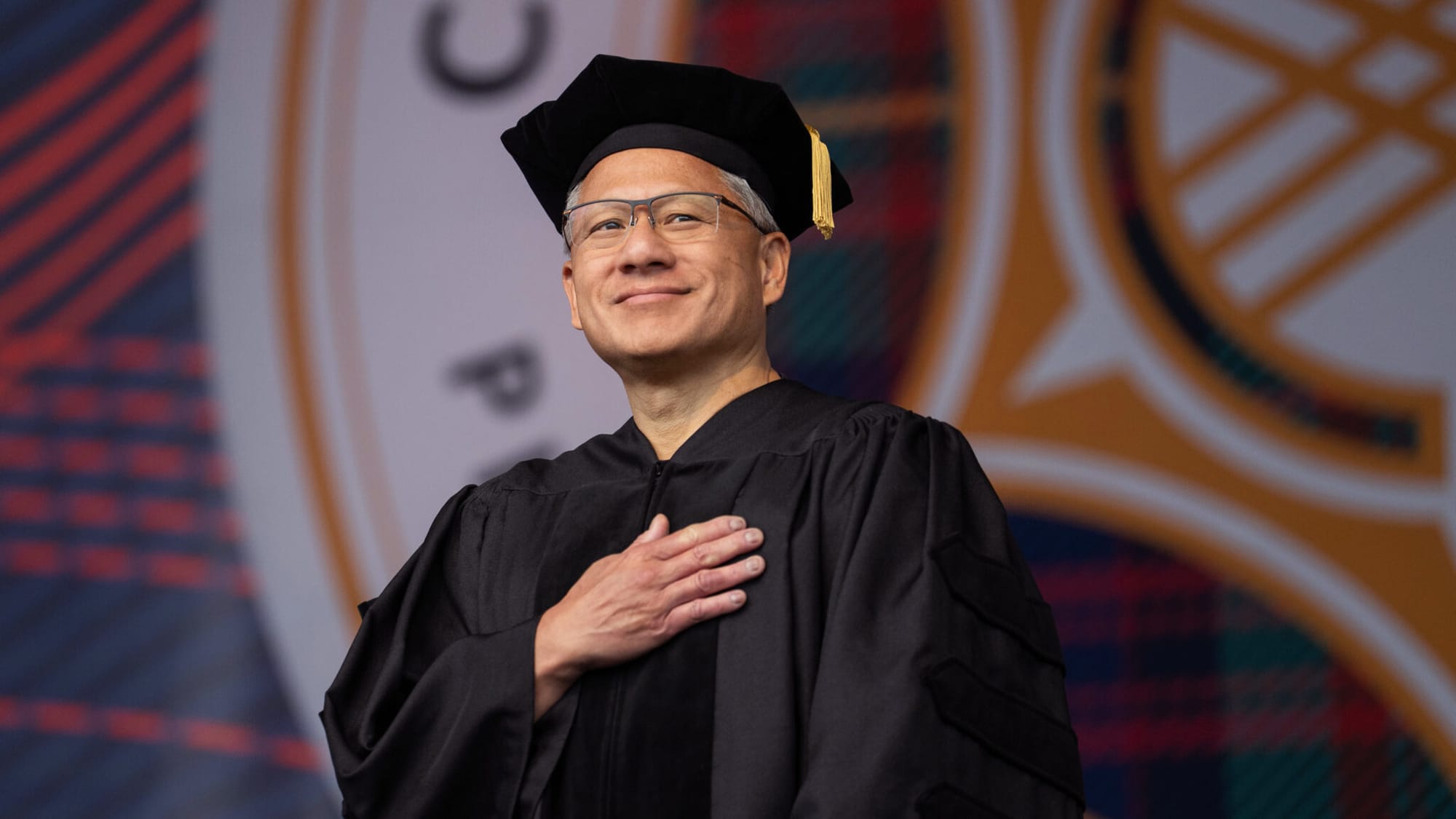
Jensen Huang’s Carnegie Mellon commencement speech was dressed as advice to graduates, but it read like NVIDIA’s current strategy memo with a cap and gown on. The NVIDIA CEO told CMU’s 128th graduating class that they are entering “the beginning of the AI revolution,” that “a new industry is being born,” and that AI is “the largest technology infrastructure buildout in human history.” That is not just optimism. It is the worldview behind NVIDIA’s entire product stack.
Commencement speeches usually sand every hard edge into motivational paste. This one is worth reading because Huang’s language maps cleanly onto how NVIDIA wants governments, enterprises, and developers to think about AI: not as a software feature, not as a chatbot market, and not as a passing productivity wave, but as industrial infrastructure. More data centers. More AI factories. More robotics. More accelerated computing. More developers learning the machinery around the model instead of treating the model as the product.
Huang delivered the keynote on May 10 and received an honorary Doctor of Science and Technology from Carnegie Mellon, which conferred more than 5,800 undergraduate and graduate degrees. He called CMU “one of the true birthplaces of artificial intelligence and robotics,” pointing back to Logic Theorist in the 1950s and the Robotics Institute in 1979. The setting mattered. This was not NVIDIA pitching AI to a general audience from a convention stage. It was NVIDIA’s founder telling a technical university that the next computing era needs builders, not spectators.
The reindustrialization line is the product roadmap
The phrase to pay attention to is “reindustrialize America.” Huang described AI as a “once-in-a-generation opportunity to reindustrialize America and restore the nation’s capacity to build.” That line connects several audiences that usually sit in different rooms: AI researchers, software engineers, electricians, plumbers, ironworkers, manufacturing teams, robotics companies, policymakers, cloud providers, and infrastructure investors.
It is politically smart, obviously. The AI boom needs power, land, cooling, skilled trades, grid upgrades, and a permission structure that makes trillion-dollar infrastructure expansion sound like national renewal rather than another round of tech-company capex. But it is also technically coherent. AI infrastructure is physical. GPUs sit in racks. Racks sit in buildings. Buildings need power. Models need networking, serving software, eval systems, security policy, data pipelines, and operators who understand how failure propagates through the stack.
That is the part practitioners should take seriously. NVIDIA’s recent message has been unusually consistent: AI factories, reference architectures, Blackwell and Rubin roadmaps, Dynamo for inference orchestration, NIM for model deployment, CUDA and TensorRT for acceleration, robotics and physical AI as the next workload class. Huang’s commencement speech turns that into a social argument: the countries and companies that build the infrastructure will shape the future; the ones that hesitate will consume someone else’s platform.
You do not have to accept the entire vendor narrative to recognize the directional truth. The teams that win with AI are not the ones that merely subscribe to a model API. They are the ones that understand the full system: data boundaries, inference cost, latency, observability, tool permissions, evals, rollback paths, governance, and the human workflow around the automation. NVIDIA benefits when that system needs more accelerated computing, but builders benefit from learning the system whether they buy NVIDIA’s full stack or not.
“AI elevates workers” is true until it is too neat
Huang’s labor-market framing was intentionally reassuring. NVIDIA’s blog quotes him saying that because intelligence is foundational to every industry, every industry will change. He argued that AI “automates tasks but elevates workers,” using radiology as the example: AI may automate scan reading, but the radiologist’s larger purpose is caring for patients. Business Insider highlighted the sharper formulation attached to the speech: “AI is not likely to replace you, but someone using AI better than you might.”
That is good career advice. It is also incomplete as labor analysis. Some jobs really do become more valuable when AI absorbs repetitive task work. A radiologist with better triage, image analysis, and reporting tools can spend more attention on clinical judgment and patient outcomes. A senior engineer with agentic coding tools can move faster if they already know architecture, testing, security, and review. A supply-chain planner with optimization agents can explore more scenarios if they understand the business constraints behind the objective function.
But not every role decomposes into “grunt task disappears, human purpose rises.” Some entry-level work exists because organizations need humans to do repeatable tasks while learning judgment. If AI removes too many of those rungs, the advice to “use AI better” is still correct for individuals and still insufficient for institutions. Engineering teams should be especially alert to this. If agents write the boilerplate, fix the easy bugs, generate first drafts, and answer the obvious tickets, where do juniors build the scar tissue that turns into senior judgment?
The answer cannot be “don’t use the tools.” That is nostalgia masquerading as ethics. The answer is to redesign apprenticeship deliberately: pair juniors with review-heavy AI workflows, make them explain agent output, give them ownership over tests and failure analysis, rotate them through debugging and incident response, and teach them to interrogate models rather than admire them. If AI changes the learning ladder, teams need to build a new ladder instead of pretending the old one still reaches the roof.
Safety needs to become implementation, not sentiment
Huang also gave the expected safety language, and to his credit it was not absent. “The responsibility of our generation is not only to advance AI — but to advance it wisely,” he said. He told graduates that scientists and engineers have a “profound responsibility to advance AI capabilities and AI safety together.” His prescription: “Advance safely. Create thoughtful policies. Make AI broadly accessible. And encourage everyone to engage.”
That is the right sentence. The problem is that the right sentence is cheap. The expensive part starts when a team has a launch deadline, a customer asking for agentic automation, and a backlog full of unglamorous controls nobody wants to prioritize.
For builders, “advance safely” should translate into concrete engineering work. Coding agents need scoped credentials, sandboxed execution, approval gates for destructive actions, prompt-injection tests, repo-trust boundaries, tool-call audit logs, and clear incident response. Customer-service agents need escalation paths, retention policy, data minimization, red-team prompts, abuse monitoring, and human accountability. Enterprise copilots need permissions that map to existing access controls instead of granting the model magical internal omniscience. Robotics systems need simulation, constraints, fail-safes, and boring physical-world validation before the demo leaves the lab.
A commencement speech cannot give teams that checklist. It can, however, remove the excuse that safety belongs to a different department. If NVIDIA’s CEO is publicly pairing capability and safety, then engineering managers have permission to make safety part of the shipping definition rather than a legal footnote after the model integration is done.
The more interesting tension is accessibility. Huang says AI should be broadly accessible. NVIDIA’s business model also depends on scarce, expensive infrastructure. Those can both be true, but builders should watch the gap. Open models, local inference stacks, smaller specialized models, quantization, and efficient serving matter because they keep AI participation from collapsing into “rent capacity from the few companies that own the racks.” If AI really is a new industrial base, access to the base layer becomes a policy and competition question, not just a developer-experience issue.
The practical takeaway from Huang’s speech is neither cheerleading nor doom. It is engagement with discipline. Learn the tools. Measure the gains. Understand the costs. Build safety into the workflow. Teach people how to use AI without letting the model become the accountable party. And do not mistake vendor optimism for an implementation plan.
NVIDIA is selling participation: run, don’t walk. Fine. But the builders who matter will not be the ones who merely run fastest toward the nearest API. They will be the ones who understand the machinery well enough to decide where AI belongs, where it does not, and what has to be true before it gets authority.
Sources: NVIDIA Blog, Carnegie Mellon University, Business Insider, Axios