LangGraph’s Tiny Checkpoint Fix Is a Big Reminder: Durable Agents Need Stable Identity

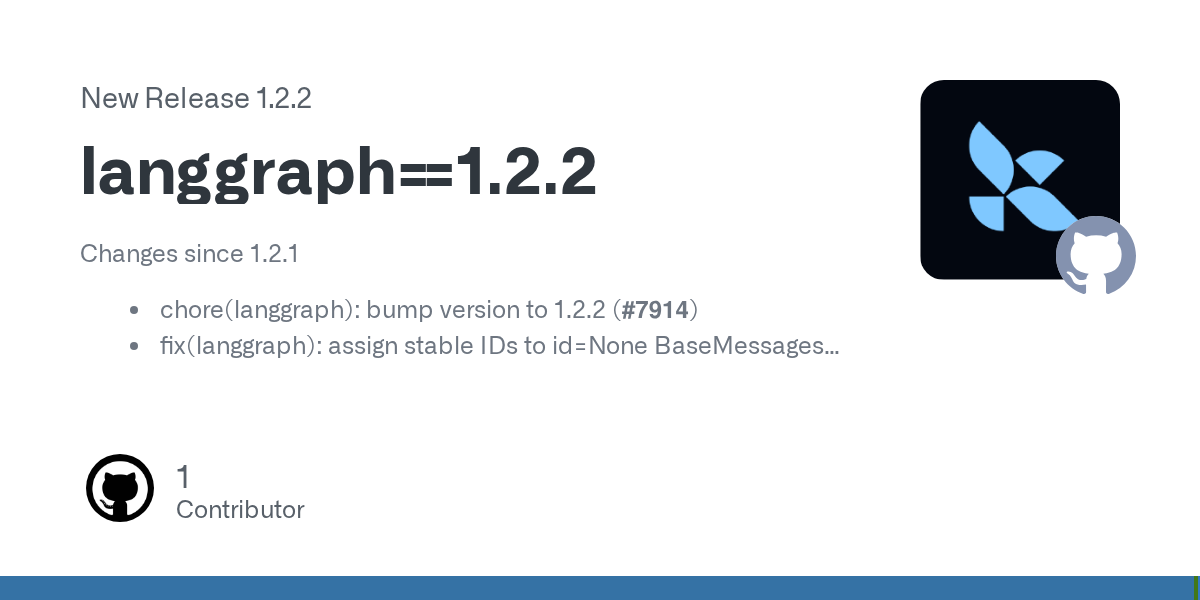
LangGraph 1.2.2 is a small release about a boring invariant. That is precisely why it matters.
The patch fixes unstable message IDs before DeltaChannel checkpoint writes are serialized. In plain English: under certain durability modes, a message with id=None could be written to the checkpoint before the reducer assigned it a stable ID. Later, every get_state() call or resumed invocation could replay that message and generate a fresh UUID. The content looked like the same message. The system identity did not.
That sounds tiny until you depend on replay, traces, evals, human approvals, summarization middleware, or audit logs. Then it becomes the kind of bug that makes a runtime feel haunted. If the same message appears with a different identity every time state is loaded, downstream systems cannot reliably answer whether the message was updated, duplicated, summarized, replayed, replaced, or merely renamed by accident. Stable identity is not polish. It is table stakes for durable execution.
The release note is short: fix(langgraph): assign stable IDs to id=None BaseMessages before DeltaChannel checkpoint writes, shipped via PR #7913. The checkpoint package also moved to 4.1.1, and LangChain 1.3.2 immediately raised its LangGraph minimum requirement from >=1.2.1 to >=1.2.2. That dependency bump is the tell. This was not a cosmetic cleanup that could wait for the next convenient upgrade window.
The race was between state mutation and persistence
The root cause sits in a familiar distributed-systems crack. In async and sync durability modes, put_writes() could submit checkpoint writes to a background thread before apply_writes() ran the reducer. If that background thread serialized a message before the reducer assigned an ID, the checkpoint stored id=None. On replay, the system would coerce the message and produce a new UUID. Repeat the process, get a new identity. Same semantic message, different durable reference.
LangGraph’s fix moves the invariant earlier. ensure_message_ids() now runs inside put_writes() before writes are submitted to the background executor, coercing message-like values into typed BaseMessage objects with stable UUIDs first. The implementation handles individual and list BaseMessage values as well as dict-style API inputs with known role or type values such as user, assistant, tool, system, function, human, and ai.
The tests tell the story better than the changelog: test_get_state_messages_have_ids, test_dict_style_invoke_messages_have_stable_ids, test_human_message_id_stable_across_invocations_sync, and test_human_message_id_stable_across_invocations_async. This is not “does the chatbot respond?” testing. It is runtime-invariant testing. Invoke, checkpoint, reload, resume, and prove identity stays put across the execution modes people actually use.
That is the part production teams should copy. If your agent application stores references to messages, approvals, tool calls, evaluator annotations, trace spans, or human review comments, you need a regression test for the resume path. Not just the happy-path conversation. Not just the graph compiling. The actual lifecycle: invoke, checkpoint, call get_state(), resume, inspect IDs, run again in async durability, and assert the objects you care about remain referentially stable.
Durable agents are database-shaped software
This bug is a useful reminder that agent frameworks are no longer just prompt orchestration libraries. LangGraph’s value proposition is graph execution with durable state. Once you make that promise, you inherit the responsibilities of stateful systems: identity, ordering, persistence timing, replay semantics, concurrency, serialization, and migration. The hard problems stop looking like “how do we make the model smarter?” and start looking like “what happens if a background writer serializes state before a reducer applies an invariant?”
That is not an insult. It is maturity. The agent stack is becoming real software infrastructure, which means its most important release notes will often be deeply unglamorous. Checkpoint fixes. Retry fixes. Stable IDs. Tool-call serialization. PII streaming. Middleware ordering. Trace correctness. These are the patches that determine whether an agent survives contact with long-running workflows, compliance review, and production debugging.
LangChain 1.3.2 reinforces that direction. Alongside the LangGraph floor bump, it shipped streamed redaction for PIIMiddleware, middleware stream transformers, a TodoListMiddleware final-answer fix, and a LangSmith bump to 0.8.0. Put those together and the pattern is clear: governance, streaming behavior, traceability, and data handling are moving into the framework path. They are not optional accessories added after the demo works.
The same timing shows up in AWS’s production LangGraph guidance for Bedrock AgentCore. AWS published a pattern using LangGraph as the orchestrator with AgentCore Memory and Observability, Step Functions, Lambda, API Gateway, DynamoDB, and CloudWatch. Its example includes a multi-agent campaign review system with persona review, compliance validation, and feedback synthesis. AWS explicitly points to observability around traces, session count, latency, duration, token usage, and error rates. In that architecture, message identity drift is not a funny edge case. It is an audit problem.
Imagine a compliance agent flags an output, a human reviewer attaches a decision to the message ID, the workflow resumes after approval, and a later replay gives the underlying message a new UUID. Now your trace viewer, approval record, and state store disagree about what was reviewed. Nobody wants to debug that during an incident bridge. Beautiful dashboards do not save you if the identifiers underneath them are sand.
For teams using LangGraph, the action is straightforward. Upgrade to LangGraph 1.2.2 or LangChain 1.3.2 if you rely on checkpointed message state, resumable threads, DeltaChannel writes, or LangSmith traces. Then add your own resume-path tests. If your application maps approvals, eval results, comments, summaries, or tool outputs to message IDs, verify those IDs across reloads before you expand autonomy. If your observability vendor shows message-level traces, ask whether IDs are stable across replay and whether the trace can distinguish update from duplicate from resumed state.
The broader lesson is about how to read framework releases in 2026. The headline feature is rarely the whole story. A tiny patch around stable IDs may tell you more about production readiness than a shiny new agent abstraction. Durable agents need memory, but not in the fuzzy “the model remembers my preferences” sense. They need stable, inspectable, replayable state with identities that do not drift when the runtime breathes.
LangGraph 1.2.2 is small. Good. Production infrastructure should make the important things boring. Stable identity is one of those things. If your agent cannot keep track of the same message across a checkpoint, it is not durable. It is a chatbot with a save button.
Sources: LangGraph 1.2.2 release, LangGraph PR #7913, LangChain 1.3.2 release, AWS Bedrock AgentCore LangGraph architecture