LLM Rankings Have Split Into Prestige Models and Workhorse Models

The useful question in LLM rankings is no longer “which model is best?” That question was always too vague, but now it is actively misleading. The leaderboard world has split into two markets: models that win judged preference tests, and models that developers route trillions of tokens through because they are cheap, available, fast enough, or conveniently sitting behind a free tier.
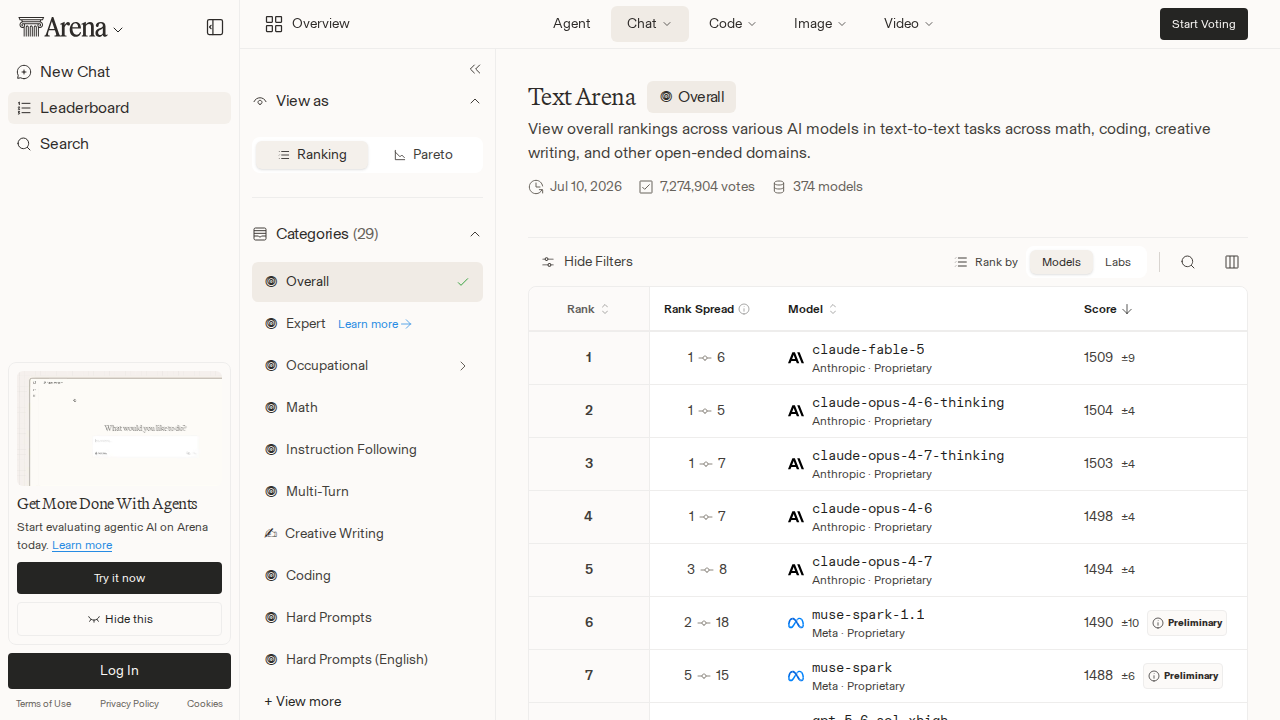
This week’s rankings make that split hard to ignore. On Arena’s Text leaderboard, Anthropic owns the top of the board: claude-fable-5 is ranked #1 with a 1509 Elo score, followed by claude-opus-4-6-thinking at 1504, claude-opus-4-7-thinking at 1503, claude-opus-4-6 at 1498, and claude-opus-4-7 at 1494. That is not a narrow brand win. It is a cluster, and clusters matter more than single leaderboard slots because they suggest repeatable strength rather than one lucky model card.
OpenRouter tells a very different story. Its weekly usage ranking is led by DeepSeek V4 Flash at 5.21 trillion tokens, MiMo-V2.5 at 4.93 trillion, MiniMax M3 at 4.31 trillion, Tencent’s Hy3 free tier at 3.93 trillion, and GLM 5.2 at 3.11 trillion. Anthropic appears in the OpenRouter top ten, but it does not dominate the way it does on Arena. Claude Opus 4.7 sits at #7 with 2.48 trillion weekly tokens, and Claude Opus 4.8 sits at #8 with 2.00 trillion.
That is the story: the models people prefer in evaluation are not necessarily the models people run in bulk. If you build systems with LLMs, that gap is not trivia. It is the architecture review.
The leaderboard is now two different instruments
Arena is closer to a taste test. It asks humans to compare model outputs, converts those preferences into Elo-style scores, and produces a quality signal that is most useful when you care about judgment: reasoning quality, helpfulness, code review, instruction following, and the slippery bundle of traits people call “capability.” Arena says: when users compare answers, these models tend to win.
OpenRouter is closer to production telemetry. Its ranking is not a claim about which model writes the best answer in isolation. It is a map of what developers and applications actually route, after cost, latency, availability, context needs, free quotas, integration defaults, and operational habits have all had their vote. OpenRouter says: when people are spending real traffic, these models get the calls.
Both signals are useful. Neither is the truth by itself. Arena can overstate the importance of peak answer quality for workloads where the model mostly extracts fields, rewrites snippets, tags content, classifies tickets, or performs one small step inside a larger agent loop. OpenRouter can overstate cheap throughput because heavy usage may reflect free tiers, experimentation, routing defaults, or batchy workloads rather than durable model love.
The mistake is treating one board as a replacement for the other. A serious engineering team should read them as different dashboards. Arena is a candidate list for high-stakes cognitive work. OpenRouter is a warning light for market behavior: which models are becoming economical enough, accessible enough, or “good enough” enough to absorb production volume.
Anthropic owns judged quality; everyone else is fighting for token gravity
The Arena Text top five is essentially an Anthropic wall. The next interesting signal is Meta’s muse-spark-1.1 entering at #6 with a 1490 Elo score, followed by muse-spark at #7 with 1488. OpenAI’s gpt-5.6-sol-xhigh enters at #8 with 1486, tied on score with Google’s gemini-3-pro at #9, while gemini-3.1-pro-preview slips to #10 at 1485. That is a tight band: ranks #8 through #10 are separated more by ordering than by a dramatic score gap.
For practitioners, that means a leaderboard rank should not be read as a procurement decision. If one model is #8 and another is #10 with nearly identical scores, the next question is not “which one ranked higher?” It is: which one has the right tool-calling behavior, fits your latency budget, has predictable pricing, and fails in ways your product can tolerate?
The WebDev board sharpens the point. Arena’s WebDev top five are claude-fable-5 at 1649, gpt-5.6-sol-xhigh running in a codex-harness at 1636, glm-5.2 max at 1580, grok-4.5 at 1566, and claude-opus-4-8-thinking at 1560. That board looks more competitive than Text at the very top, and the OpenAI codex-harness placement is especially worth watching because coding performance is increasingly a product of the harness around the model, not just the model weights.
This is one of the under-discussed shifts in model rankings. “The model” is becoming a blurry unit of evaluation. For coding and agentic work, scaffolding matters: file context selection, retry policies, test execution, tool definitions, diff presentation, patch application, and how the system recovers from bad intermediate states. A strong base model in a weak harness can look worse than a slightly weaker model in a disciplined one. The WebDev leaderboard is not just ranking intelligence; it is starting to rank integration quality.
Free tiers are not charity; they are distribution strategy
The OpenRouter movement is where the practical market signal lives this week. Nemotron 3 Ultra free moved up three slots to #10 with 1.33 trillion weekly tokens and +39% week-over-week growth. Hy3 free climbed to #4 with 3.93 trillion weekly tokens, while Hy3 preview fell three spots to #12 with 1.03 trillion tokens and a steep -71% week-over-week change. Gemini 2.5 Flash moved up to #16 with 592 billion tokens.
That pattern is not subtle. Free and low-friction models are absorbing volume, and some preview traffic is converting, rotating, or evaporating as newer packaging becomes available. “Free” in this context is not a side note. It is a go-to-market wedge. Developers will test anything that is one config change away and does not immediately punish them on cost. If the model is good enough for non-critical steps, it starts showing up in pipelines, scripts, experiments, internal tools, and agent loops.
This does not mean free-tier winners are automatically better products. It means they are winning the first mile of adoption. That matters because model choice is sticky in boring ways. Once a team has prompts tuned, evaluation fixtures written, error handling adjusted, and cost dashboards built around a model, switching requires a reason. Free tiers buy that initial integration time. If the quality clears the bar, inertia does the rest.
There is also a measurement trap here. A model can climb a usage board because it is loved, cheap, being tested, sitting behind a huge batch job, or benefiting from a temporary distribution push. Weekly token volume is not customer satisfaction. But it captures something benchmarks miss: whether the model can survive contact with the economics of real workloads.
What engineers should do with this
The practical answer is not to crown one model. It is to stop pretending one default model should handle every task.
Use Arena-style rankings to pick your shortlist for judgment-heavy work: high-ambiguity planning, code review, security-sensitive reasoning, failure recovery, product-facing assistants, and tasks where a subtly wrong answer is expensive. Anthropic’s Arena strength is a real signal there. Claude’s cluster at the top says it should be in the eval set for serious reasoning and writing workloads.
Use OpenRouter-style rankings to identify models worth testing for high-volume work: extraction, classification, summarization, transformation, enrichment, routing, moderation pre-checks, speculative agent steps, and background jobs where you can verify outputs downstream. The usage board shows which models developers are finding economically tolerable at scale. DeepSeek V4 Flash, MiMo-V2.5, MiniMax M3, Hy3 free, and GLM 5.2 should not automatically replace your frontier model, but they should be in your cost-reduction bake-off.
The pattern to implement is simple: route by task class. Keep a frontier model available for steps that require taste, synthesis, or recovery from uncertainty. Push repetitive structured work to cheaper models, but wrap them in validation. Measure pass rate, human escalation rate, latency, retry count, token cost, and how often a later stage has to clean up the mess. Public leaderboards should choose the candidates. Your evals should choose the production route.
There is one more uncomfortable lesson in these rankings: model providers are now competing on packaging as much as raw capability. A brilliant model that is expensive, slow, rate-limited, awkward to call, or unpredictable under load will lose volume to a merely good model that is easy to route. That is not the market being irrational. That is software engineering doing what it always does: optimizing the whole system, not the prettiest component.
So the LGTM read this week is clear. Arena says Anthropic is still the quality wall to beat, especially in judged text tasks. OpenRouter says the workhorse market is wide open, and free or cheap models from DeepSeek, Xiaomi, MiniMax, Tencent, Z.ai, and Nvidia are taking real token share. The teams that understand those as separate buying decisions will spend less, argue less, and ship systems that degrade more gracefully when model fashion changes next week.
The wrong conclusion is “leaderboards are useless.” The better conclusion is that leaderboards have finally become honest enough to disagree. That disagreement is the signal.
Sources: Arena Text Leaderboard, Arena Leaderboard, OpenRouter Rankings, OpenRouter weekly rankings API, OpenRouter model catalog API