Local Embeddings Should Not Be Able to Take Down the Agent Runtime

The local-agent story usually gets told as a hardware shopping guide. How much RAM do you need? Which quant fits? Is Metal fast enough? Can your Mac Studio run the embedding model without sounding like a leaf blower?
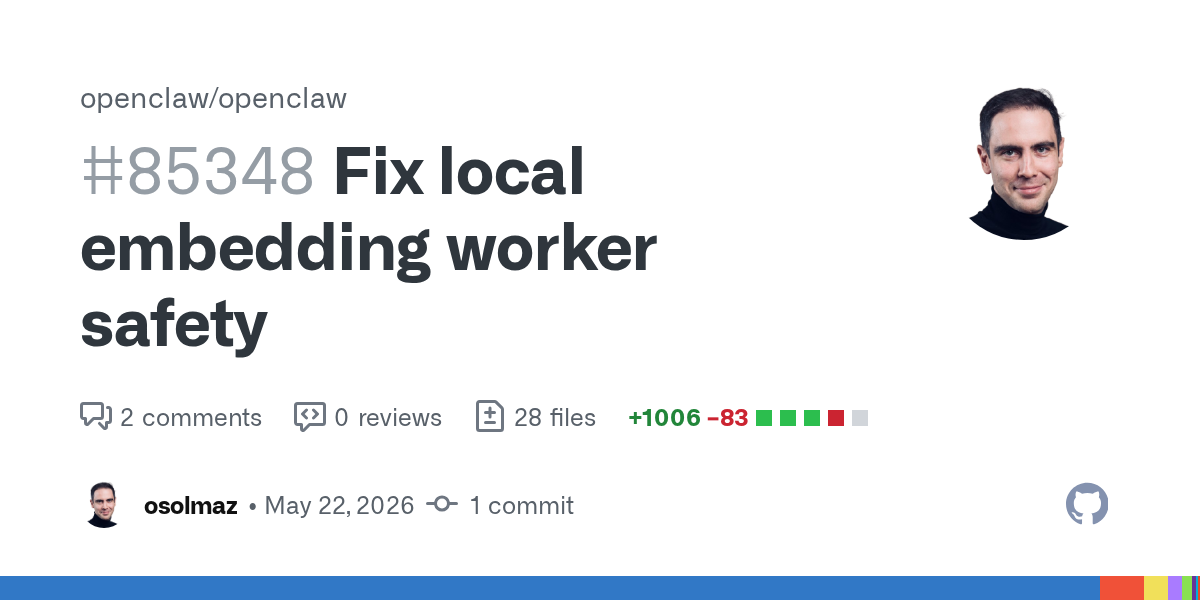
Useful questions. Incomplete questions. The more important production question is whether the agent runtime survives when the native local inference stack misbehaves. OpenClaw PR #85348 answers that question in the correct, deeply unsexy way: it isolates local memory embeddings in a worker process by default so native node-llama-cpp and Metal teardown failures do not take down the gateway.
The PR was opened on May 22 at 12:07 UTC and is labeled P1 with merge-risk flags for compatibility and availability. It changes 28 files with 1,006 additions and 83 deletions. That is not a tiny refactor. It is a reliability boundary being moved to where it should have been all along: between the orchestrator and the native embedding runtime.
Privacy is not enough if restart crashes the gateway
The source issue, #44202, is the kind of operator report that should make platform maintainers pay attention. A Mac Studio setup using local memory embeddings with hf:ggml-org/embeddinggemma-300m-qat-q8_0-GGUF/embeddinggemma-300m-qat-Q8_0.gguf hit crashes in ggml-metal / node-llama-cpp during restart or shutdown. The main model path was not the problem. The memory embedding path was. Recovery required forcing embeddings to CPU-only.
That distinction matters because local memory is sold, implicitly or explicitly, as the safe and private option. Keep the vectors on your machine. Avoid sending personal notes or internal docs to a hosted embedding API. Reduce data exposure. All good. But if the local embedding worker can crash the agent gateway, privacy has been traded for fragility. That is not a win; it is just a different failure mode.
PR #85348 adds the obvious-but-important containment layer. Local memory embeddings move into a worker process. If that process fails, OpenClaw can activate a configured embedding fallback and reindex. If no embedding fallback exists, keyword and full-text search stay available. That degradation path is the key product decision. The runtime should not pretend everything is fine, but it should keep the agent alive with a reduced capability set.
The new memorySearch.local.gpu policy accepts auto, metal, and cpu. That is the right knob because embeddings have a different risk profile than chat generation. A workstation doing heavy reindexing may want Metal. An always-on personal agent may prefer CPU-only for boring restart reliability. A production-ish deployment may want auto plus fallback. Those are policy choices, not folklore that should live in a GitHub issue comment.
Native libraries fail outside JavaScript’s comfort zone
The technical lesson is broader than OpenClaw. Native ML libraries and GPU runtimes fail in ways a TypeScript application cannot politely catch. Metal teardown crashes, GPU-driver weirdness, native allocator bugs, binary compatibility issues, and process-shutdown races do not care how clean the surrounding JavaScript is. A process boundary is one of the few reliable tools you get. If the sidecar dies, the supervisor can observe it, record it, fall back, and keep the higher-level runtime breathing.
That is why this patch is more important than another “supports model X” announcement. Model support expands the menu. Failure isolation keeps the restaurant open.
The verification list is appropriately broad: memory host SDK embedding tests, memory manager timeout/search/QMD/index tests, Mistral provider tests, config schema regressions, docs MDX checks, multiple TypeScript builds, tsdown, and git diff --check. The real-behavior proof says the built dist/memory-core-local-embedding-worker.js sidecar exists, focused tests passed, typechecks passed, build passed, and fallback/reindex behavior is covered. This is what platform work looks like when it is trying to reduce pages, not produce screenshots.
There is also a useful connection to PR #84947, which introduced the first plugin-layer contract for general embedding providers. That earlier work turns embeddings into a typed capability surface. This PR hardens the local runtime path. Together they suggest OpenClaw is slowly moving memory out of the “agent magic” bucket and into the “platform subsystem with contracts, policies, fallbacks, and tests” bucket. Good. Magic is hard to debug. Memory is worse because it affects every future turn.
For practitioners, the action items are concrete. If you run local embeddings, treat the embedding model as production infrastructure, not an accessory. Test restart and shutdown paths, not just search quality. Decide whether GPU acceleration is worth the operational risk for your workload. Configure a fallback if memory search matters. And verify that degraded mode still leaves the agent useful enough to communicate what happened.
For framework builders, the lesson is sharper: local-first does not mean single-process. If a component touches native inference, GPU resources, persistent indexes, or long-running background work, isolate it. The orchestrator should be boring and hard to kill. The experimental bits can live behind a boundary where failure is observable and recoverable.
The local-agent question is not just whether Qwen, Gemma, or some future tiny miracle model runs on your desk. It is whether the agent runtime keeps breathing when local embeddings, GPU cleanup, or native libraries misbehave. OpenClaw’s worker isolation is boring in exactly the right way.
Sources: OpenClaw PR #85348, OpenClaw issue #44202, OpenClaw v2026.5.20 release, OpenClaw PR #84947