Macaron-A2UI Says the Next Agent UI Is Not Another Chat Bubble

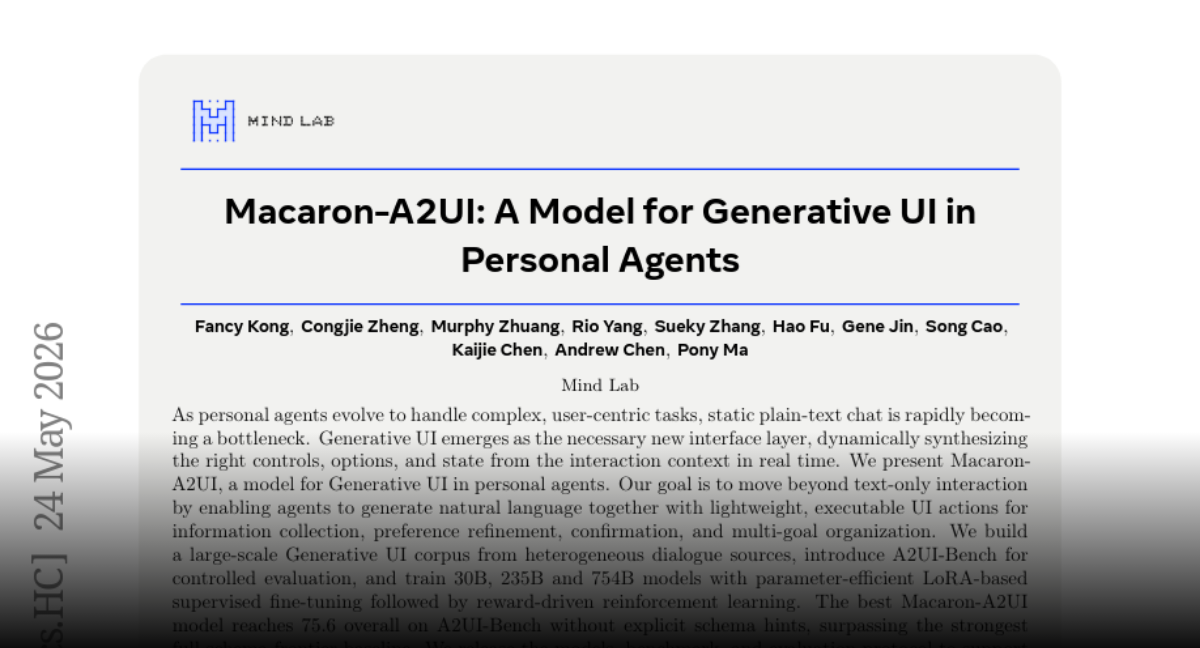
The next useful agent interface is probably not another blank chat box with better placeholder text. Macaron-A2UI, a new generative-UI model family from Mind Lab surfaced through Hugging Face Papers, is interesting because it treats interface generation as a model-output problem with an actual contract: the assistant can respond in natural language and emit structured UI actions, but the client remains responsible for validation, rendering, and safety.
That distinction matters. “LLM generates UI” usually sounds like either a toy demo or a security incident waiting for a component library. Macaron-A2UI is more restrained. Its required output is a JSON object with text_response and a2ui fields, no Markdown fences, no extra explanation, and a defined action vocabulary including beginRendering, surfaceUpdate, dataModelUpdate, and deleteSurface. In other words: the model proposes an interaction surface; the product decides what is allowed to appear and what it can do.
Chat is flexible. That is also the problem.
The boring secret of agent UX is that chat is a bad universal interface. It is excellent for ambiguous intent, exploration, and loosely specified requests. It is terrible for comparing options, entering constraints, confirming destructive actions, reviewing multi-step plans, tracking state, and making choices that should be visible rather than implied inside prose. Humans invented forms, cards, buttons, calendars, maps, sliders, tables, and confirmation dialogs because text is not always the right shape for thought.
Macaron-A2UI’s release is best read as a serious attempt to put that missing layer into the model loop. Mind Lab reports a training corpus of 14,245 assistant-turn samples, including 10,210 UI turns and 4,035 text-only turns — a 71.7% UI ratio. The sources are not only transactional booking data, either: MultiWOZ contributes 5,424 samples, Schema-Guided Dialogue contributes 4,757, ESConv contributes 1,098, and AnnoMI contributes 2,966. That mix is important because a good agent must learn when not to render a widget. The worst version of generative UI is a product that sprays chips, sliders, and cards into every conversation because the model can.
The model family spans 30B, 235B, and 754B variants trained with LoRA-based supervised fine-tuning followed by reward-driven RL/GRPO. Mind Lab says Qwen3-235B rises from 21.6 overall to 63.6 after SFT and 74.2 after GRPO, with the best model reaching 75.6 on A2UI-Bench without explicit schema hints. The public Tall release is a LoRA adapter on Qwen/Qwen3-30B-A3B-Instruct-2507, using LoRA rank 16, alpha 32, dropout 0.0, and targeting attention and MLP projections with a max response length of 4096. During research, Hugging Face showed 56 upvotes for the paper, and the linked Tall adapter had 83 downloads and 3 likes; Grande had 42 downloads, Venti had 6.
The security boundary is the product
The most useful thing here is not the benchmark number. It is the boundary. Arbitrary model-generated front-end code is a non-starter for serious products. Even “safe” HTML is a footgun once the assistant is connected to user data, accounts, payments, or internal tools. A constrained A2UI protocol is the deployable middle ground: the model can request a surface, but the trusted application owns the component set, action registry, state mutation rules, confirmation gates, and audit trail.
Builders should steal that architecture even if they ignore this exact protocol. Define which components exist. Define which actions require explicit confirmation. Reject unknown action names, stale IDs, hidden parameters, and mismatched labels. Do not let the model smuggle state changes into friendly copy. If a visible button says “save draft” but the payload books a flight, the validator should treat that as hostile output, not a quirky hallucination. If the assistant proposes “deleteSurface,” the client should know whether that is visual cleanup or state deletion. Those are product-security decisions, not prompt-writing preferences.
The model card’s caveats are therefore not boilerplate; they are the actual operating manual. Outputs require external validation, the model may hallucinate actions if the action space is underspecified, and irreversible or safety-critical actions need confirmation. That is exactly right. Dynamic UI only becomes trustworthy when the rendering layer is not the model. The model should be allowed to suggest an interaction. It should not be allowed to define the laws of the interface mid-flight.
There is also a product lesson hiding in the dataset. ESConv and AnnoMI, which contain more counseling and motivational-interviewing style interactions, have much lower UI ratios than the task-heavy corpora. That suggests the system is being trained on restraint: sometimes a user needs a sentence, not a control panel. Agent products routinely fail this test. They either hide everything behind a chat box or overcorrect into wizard UIs that feel like enterprise software discovered emojis. The right interface is contextual, temporary, and explainable.
What engineers should do with this
If you are building a personal assistant, a coding agent, or any workflow agent that needs user interaction, the practical move is to write your interaction contract before you chase model polish. List the recurring places where prose is doing too much: approvals, comparisons, preferences, schedules, ranked options, file selections, payment steps, credentials, environment choices, rollback plans. Those are candidates for structured surfaces. Then decide which of those surfaces can be generated dynamically and which should be hand-designed because the risk or complexity is too high.
For engineering teams, this also changes evaluation. A chat-only eval asks whether the model answered correctly. A generative-UI eval must ask whether the model selected the right surface, populated it with faithful data, avoided unnecessary controls, preserved state across updates, and respected action-policy boundaries. That means unit tests for validators, golden traces for UI actions, adversarial prompts that try to induce hidden mutations, and telemetry that distinguishes helpful UI from decorative noise.
Macaron-A2UI is not a plug-and-play production answer. Public evaluation is still early, and the Tall model card says benchmark numbers and reproduction details are being standardized. Treat it as a serious design direction, not a finished product. But the direction is right. The next generation of useful agents will not win by writing longer paragraphs. They will win by knowing when the answer should become a visible, validated interface — and when the safest, most useful UI is no UI at all.
Sources: Hugging Face Papers, arXiv, Mind Lab technical article, Macaron-A2UI Tall model card