MAI-Code-1-Flash Is Copilot’s Cost-Routing Story, Not Just Another Coding Model

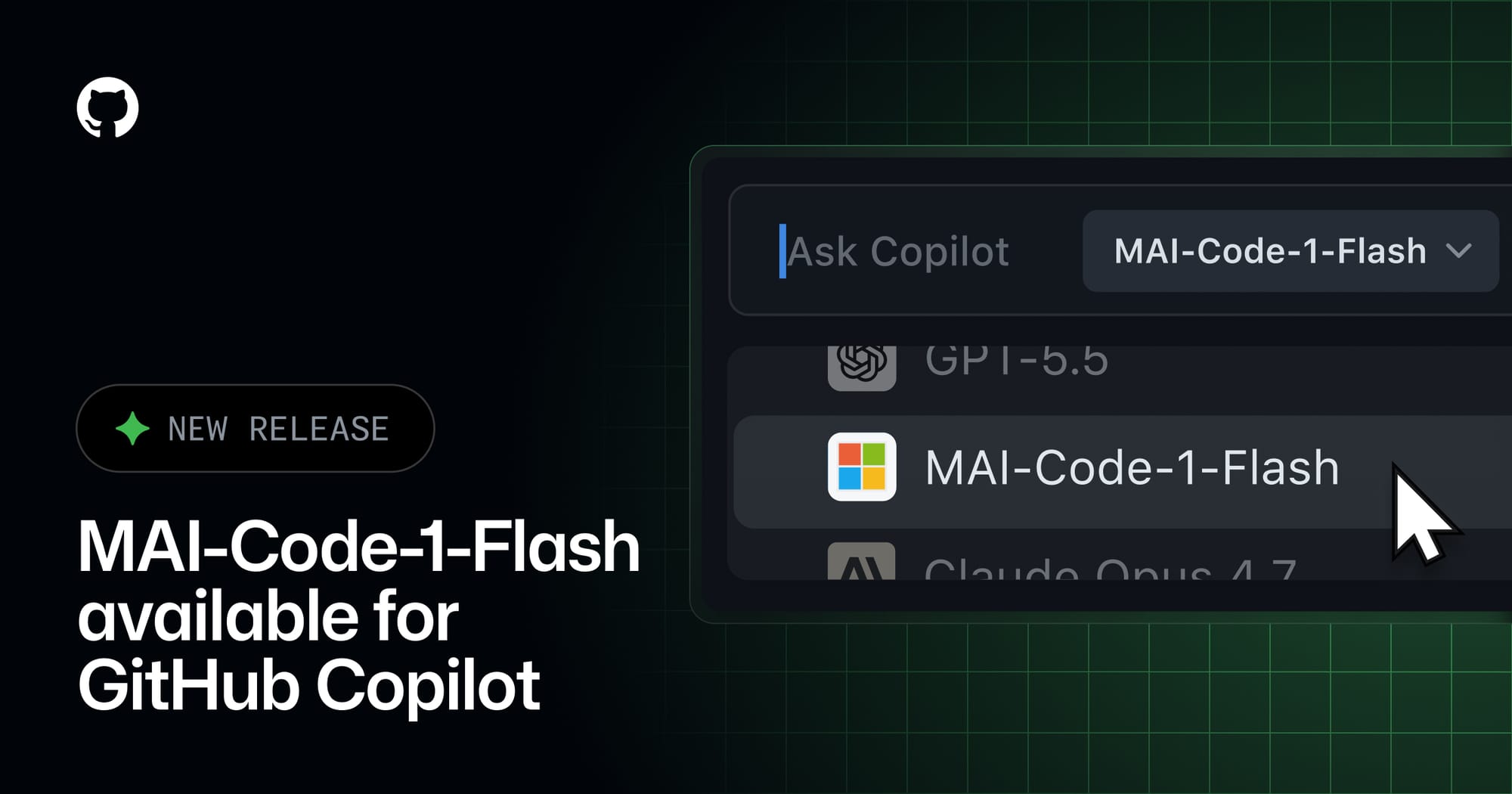
MAI-Code-1-Flash arriving in GitHub Copilot is easy to file under “another coding model.” That misses the timing. One day after Copilot’s usage-based billing became a practical concern for engineering teams, Microsoft is putting a smaller, cheaper, Copilot-tuned coding model into the product. This is not really a model announcement. It is a cost-routing announcement.
GitHub says MAI-Code-1-Flash is rolling out first in VS Code to a limited set of Free, Pro, Pro+, and Max users, with expansion over the coming weeks. It is described as Microsoft’s latest small-tier coding model and the first in a new wave of purpose-built coding models from Microsoft. Microsoft’s own model page lists coding-task reasoning, agentic execution across multi-step workflows, broad programming-language support, and native optimization for GitHub Copilot in VS Code.
The public page, however, did not provide useful benchmark numbers in the fetched content. It showed benchmark labels for SWE-Bench Pro, AIME 2026, and IFBench with 0% placeholders rather than real scores. So the sensible position is not excitement or dismissal. It is disciplined skepticism: small coding models can be valuable, but only when the platform routes work intelligently and the team measures actual review cost.
The cheap model can still be expensive
The case for a small coding model is obvious after the billing shift. Agentic coding burns tokens differently from autocomplete. A cloud agent may inspect a codebase, plan a task, call tools, retry after tests fail, ask for more context, and revise the patch. If every step uses the most expensive available model, the cost curve starts to look less like a subscription and more like cloud infrastructure with opinions.
A faster, cheaper model tuned for lightweight coding work could help. It might handle doc edits, small test generation, boilerplate, commit messages, simple refactors, formatting churn, code summaries, and low-risk implementation steps. If it saves premium requests while preserving developer time, that is real value. Most engineering organizations have plenty of work that does not require the strongest model in the catalog.
The trap is false economy. A cheap model that produces plausible wrong code is expensive in the only currency senior engineers actually care about: attention. If MAI-Code-1-Flash saves tokens but causes a reviewer to spend twenty minutes untangling a brittle abstraction, the spreadsheet lied. Coding is detail-sensitive. API contracts, authorization checks, migration ordering, build-system behavior, concurrency assumptions, and test fixtures are exactly where “good enough” models can be confidently wrong.
That is why the HN reaction was useful. One skeptical commenter argued that small coding models “waste your expensive time.” Another described a more nuanced orchestration setup where a larger model builds the task graph, smaller models handle routine subtasks, and a larger model evaluates and patches the result, with small models reportedly covering 30–40% of token use in major efforts. That second pattern is where the industry is headed. The question is not whether small models are good or bad. The question is who decides what they should touch.
Model routing is now part of engineering governance
Copilot’s supported-models docs already frame models along dimensions like speed, cost efficiency, accuracy, reasoning, multimodal support, plan availability, and surface. That is the right taxonomy, but it creates a product burden. Developers should not have to become model economists for every request. A healthy platform should infer task class, expose meaningful tradeoffs, respect budgets, and fall back or escalate when the cheaper route is failing.
The best architecture is tiered. Use a strong model for planning, decomposition, high-ambiguity reasoning, security-sensitive patches, architectural changes, and final review. Use a small coding model for bounded, reversible, testable steps. Then verify with tests, static analysis, linting, or a stronger review model before merging. The cheap model is not the reviewer. It is the throughput worker.
This is not theoretical. Microsoft’s own Build security announcement described MDASH using heavier state-of-the-art models for reasoning and cheaper models for high-volume operations. That same architecture belongs in coding workflows. The platform should spend expensive reasoning where it changes the outcome and spend cheaper inference where the task is constrained enough that verification catches mistakes.
For teams, the operational version is a routing policy. Which task types can use small models? Which repositories are excluded? Which files are security-sensitive? Which workflows require stronger review? How many retries can a small model burn before escalation? What happens when tests fail twice? If the answer is “the developer clicks whichever model is cheapest,” the policy is not ready.
Test on your repo, not on the launch page
The practical move is to build a tiny internal eval set before routing real work through MAI-Code-1-Flash or any other small coding model. Include a bug fix, a straightforward refactor, a test-generation task, a config edit, a documentation update, and one security-sensitive patch the model should handle conservatively. Measure pass rate, review time, retry count, token cost, failure severity, and whether the output was wrong in a way tests caught.
Review time is the metric most teams skip. A model that fails quickly and obviously is less dangerous than one that produces a beautiful wrong answer. Track how long it takes a developer to accept, reject, or repair the output. If the cheap model reduces token usage but increases human review by enough, it is not cheap.
Also test orchestration, not just single prompts. Small models often look fine on isolated tasks and degrade inside long agent loops where context accumulates, tool results get noisy, and earlier assumptions go stale. Try it on a realistic workflow: plan with a stronger model, execute bounded steps with the small model, run tests, then review with the stronger model or human. That tells you whether the model is useful in the system where it will actually run.
The editorial read is that MAI-Code-1-Flash is Copilot’s first visible answer to the post-billing cost problem. Microsoft and GitHub need smaller purpose-built models because not every agent turn should be premium-priced frontier reasoning. That is good. But small models only work when the routing layer has taste: task boundaries, escalation, verification, and failure accounting.
If MAI-Code-1-Flash becomes “the cheap button,” it will disappoint developers and make reviewers grumpy. If it becomes one component in a policy-driven Copilot runtime that knows when cheap is safe and when expensive is cheaper in the long run, it could matter. The future of coding agents is not one model to rule them all. It is model routing with receipts.
Sources: GitHub Changelog, Microsoft AI, GitHub Docs, Hacker News