Meta Bought Its Way Into the LLM Top 20—and Your Prompts Are Part of the Price

The most consequential number in this week’s model rankings is not an Elo score. It is $0.10 per million input tokens.
That is the advertised input price for Meta’s Muse Spark 1.3 Contributor tier, and it helps explain how a newly listed endpoint pushed 1.44 trillion tokens through OpenRouter in one trailing week and debuted at number 18. The standard version of Muse Spark 1.3 also registered 217 billion tokens in OpenRouter’s weekly trending data. Meta did not merely launch another capable model; it created an economic incentive strong enough to manufacture meaningful distribution almost immediately.
The catch is in the word “Contributor.” Independent pricing comparisons put the standard tier at $1.25 per million input tokens and $4.25 per million output tokens, while Contributor costs $0.10 and $0.20 respectively. In exchange, prompts and completions may be used to improve Meta’s products. The discount is therefore not just a promotional price. It is a data transaction, and engineering teams should evaluate it with the same care they apply to observability vendors, support tools, and any other system that receives production context.
Two leaderboards are measuring two different markets
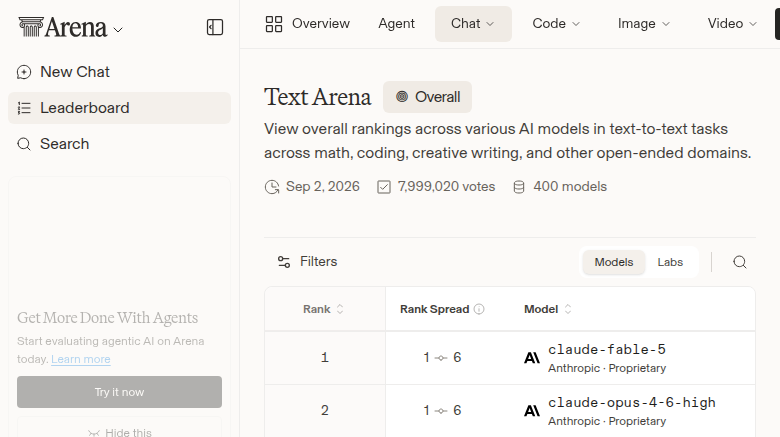
Arena’s Text leaderboard did not move. Claude Fable 5 remains first at 1507 Elo, followed by Claude Opus 4.6 High at 1505 and Claude Fable 5.1 Max at 1504. Anthropic occupies seven of the top 20 positions, including four of the top six. Meta’s Muse Spark 1.2 xHigh sits fifth at 1499, while Google’s Gemini 3.8 Flash High and OpenAI’s GPT-5.6 Sol xHigh appear eighth and seventeenth.
OpenRouter tells a different story because it ranks token volume, not pairwise preference. Its top four remain Tencent’s Hy4 preview, OpenAI’s GPT-5.6 Luna, DeepSeek V4 Flash 0731, and Z.ai’s GLM 5.3 Flash. Free versions of MiniMax M3 and Nvidia’s Nemotron 3 Ultra remain sixth and eighth. Gemini 3.8 Flash made the largest move, rising four places to number 13 on 1.91 trillion weekly tokens. Claude Sonnet 4.6 returned at number 20 with 1.33 trillion tokens and 72% week-over-week growth, while Claude Sonnet 5 and the free Laguna S 2.1 fell out.
It is tempting to call OpenRouter’s table a popularity ranking, but even that overstates what the data can prove. A token is not a user, a request, a dollar, or a completed task. A verbose agent carrying a million-token repository context can generate more traffic than thousands of concise chat sessions. OpenRouter also excludes traffic kept private by applications or users. The table is best understood as public routing telemetry: imperfect, commercially biased, but still useful evidence of where deployers are willing to spend—or conserve—their inference budget.
That distinction is the first practical lesson. Arena can help build a candidate list because it captures human preference in head-to-head comparisons. OpenRouter can expose ecosystem momentum, availability, and price sensitivity. Neither should select a production model. That decision belongs to an internal evaluation built from the tasks that actually cost your team time.
The cheapest token can still produce the most expensive task
Meta says Muse Spark 1.3 uses roughly 20% fewer tool calls and 25% fewer tokens than Muse Spark 1.2 in internal engineering comparisons. It supports parallel tool use, multimodal input, long-horizon agent work, and a 1,048,576-token context window. Meta also claims improvements in preserving constraints, asking clarifying questions, recognizing when it is stuck, and confirming consequential actions. Those are exactly the behaviors that determine whether an agent saves time or quietly creates a second debugging shift.
But the published material does not provide enough methodology to assume those efficiency gains transfer to every codebase. Early third-party reports place Muse Spark 1.3 at 75.4% on DeepSWE 1.1, ahead of Claude Opus 5 at 74.0% and GPT-5.6 Sol at 73.0%. Without fully reproducible evaluation details, those numbers justify adding the model to an evaluation queue, not rewriting a platform roadmap.
Teams testing the model should measure cost per accepted result rather than cost per token. Use a fixed suite of representative work: a contained bug fix, a cross-file refactor, a test failure requiring investigation, and an agent task involving documentation or an external tool. Record completion rate, wall-clock time, input and output tokens, tool calls, retries, test pass rate, and minutes of human cleanup. Run the same prompts across at least two incumbent models, then price the entire loop. A model that is 90% cheaper per token but needs repeated prompts, unnecessary searches, or extensive review can lose on the only metric that matters: engineering time per correct outcome.
The second original signal in this week’s rankings is that efficiency claims are becoming part of model quality, not merely procurement. Agent workloads compound waste. One unnecessary tool call can add network latency, another context block, another inference pass, and another chance for the model to drift. If Meta’s 20% and 25% reductions survive independent testing, they may matter more in production than a narrow benchmark lead.
Contributor pricing needs an architectural boundary
The Contributor bargain should not depend on developers remembering which prompt is safe at 2 a.m. Encode the distinction in infrastructure. Give the endpoint separate credentials and an explicit routing policy. Permit synthetic tasks, public repositories, open documentation, and sanitized evaluation data. Deny proprietary source code, customer records, credentials, security incidents, unreleased product plans, and internal communications. Add secret scanning before requests and log which policy allowed each call.
That boundary also makes the commercial experiment more honest. Compare the standard and Contributor tiers separately. If the standard endpoint wins on task economics, Meta has a competitive model. If adoption depends on a price available only when customers contribute their data, Meta has a competitive acquisition strategy. Both can be successful, but they are not the same claim.
Claude Sonnet 4.6 offers a useful control case. Anthropic launched it at $3 per million input tokens and $15 per million output tokens with a one-million-token context window. The company said Claude Code users preferred it to Sonnet 4.5 about 70% of the time and to Opus 4.5 about 59% of the time. Its return to OpenRouter’s top 20 with 72% weekly growth suggests developers will still pay substantially more when a model has earned trust on coding workflows. Price moves traffic quickly; reliability keeps it.
The model market is separating into a preference race and an operations race. Anthropic currently owns much of the first on Arena. Low-cost, free, and discounted endpoints increasingly shape the second on OpenRouter. Developers should resist collapsing either table into “best model.” Shortlist with public rankings, benchmark on your own work, calculate cost per accepted task, and treat data-use terms as a systems constraint rather than fine print.
Meta’s 1.44-trillion-token debut is real adoption, but it is not yet proof of technical supremacy. It proves something more immediately useful: at scale, model choice is becoming a routing and governance problem as much as an intelligence problem. The teams that win will not pledge allegiance to one leaderboard. They will build enough evaluation and policy machinery to exploit cheap inference without accidentally making their private context part of the subsidy.
Sources: OpenRouter rankings, Meta AI, OpenRouter model page, Anthropic, Arena AI leaderboard