Microsoft’s 2GW Pecos Datacenter Is the AI Capacity Story Builders Cannot Ignore

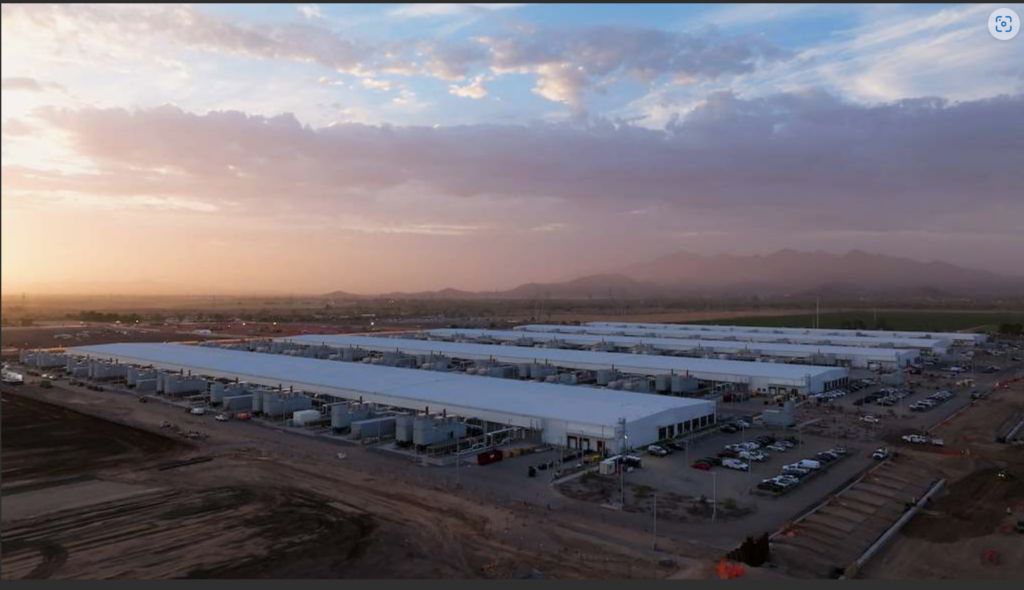
Microsoft’s newest Azure AI announcement is not a model, a benchmark, or another Copilot button in a product that already had three. It is a 2-gigawatt datacenter campus in Pecos, Texas — and that makes it one of the more honest AI stories of the month.
The AI stack has spent the last two years pretending to be weightless: API calls, model cards, agent frameworks, eval dashboards, context windows. Pecos is the correction. Microsoft says the new campus will add roughly 2GW of global datacenter capacity, one of the largest single capacity additions in company history, with a multibillion-dollar investment spread over the next five to seven years. That is the part builders should pay attention to. The future of Azure OpenAI, Microsoft Foundry, GitHub Copilot, Microsoft 365 Copilot, and every enterprise agent workflow does not just depend on better orchestration. It depends on whether Microsoft can site, power, cool, staff, and defend enormous amounts of physical infrastructure.
The cloud capacity bottleneck has a street address now
Microsoft frames Pecos as a response to “strong and sustained customer demand for AI and cloud services across industries and regions.” Translation: AI demand has moved from product-market-fit theater into infrastructure math. Every enterprise pilot that becomes production, every Copilot rollout that moves from a few champions to a whole department, every Foundry agent that graduates from demo to workflow, and every retrieval-heavy internal assistant consumes more of the same constrained substrate: GPUs, networking, power, cooling, operators, and regional availability.
The 2GW number matters because it puts scale back into the conversation. A company does not build a dedicated campus with onsite power because a few chatbot demos got popular. It does that because the normal cloud expansion playbook is not enough for the load curve it expects. For Azure customers, this is not “facilities news” off to the side. It is capacity risk management. If your product roadmap assumes low-latency inference, broader model-region availability, stable quotas, or cheaper agentic workflows, Microsoft’s power-and-datacenter roadmap is now upstream of your own.
That is uncomfortable, but useful. Cloud abstractions are still abstractions; they are just not magic. When a region lacks a model, a quota increase stalls, an agent run gets throttled, or premium inference remains expensive, the answer is not only software. It may be power interconnects, transformers, gas turbines, permits, construction labor, water claims, and local politics. Pecos is Microsoft making that dependency visible.
Behind-the-meter power is the real headline
The sharpest detail in Microsoft’s announcement is not the jobs number, though the company expects more than 6,000 construction jobs at peak build-out and hundreds of permanent operational jobs. It is the energy architecture. At launch, Microsoft says the Pecos campus will run with a co-located natural-gas power facility in a “behind the meter” arrangement, serving the datacenter directly rather than drawing that demand from the public grid. Reuters separately reported the energy-market angle as a Chevron power-supply deal with Microsoft for the Texas datacenter, which is exactly how this should be read: AI capacity is now energy procurement strategy.
Microsoft’s argument is straightforward. It says it is funding the new generation and supporting infrastructure required for its own operations, rather than dropping a giant new load onto local energy customers. The plant design will include air-emissions controls including Selective Catalytic Reduction systems to reduce nitrogen oxide emissions, and Microsoft says it expects the facility and datacenter to connect to the broader grid over time in coordination with utilities and local authorities.
Operationally, that is coherent. Strategically, it is revealing. The hyperscaler AI race is no longer just “who has the best model partner?” or “who has the cleanest agent SDK?” It is who can finance and operate AI factories without losing public trust, blowing up sustainability claims, or becoming a regional infrastructure villain. Microsoft has OpenAI, Foundry, Copilot, GitHub distribution, enterprise sales, and its own MAI model work. None of that matters if it cannot secure reliable capacity fast enough.
The sustainability tension is also real. Microsoft’s corporate commitments remain carbon negative, water positive, and zero waste by 2030, with historical-emissions removal by 2050. Pecos starts with natural gas because AI demand is arriving faster than clean capacity and grid buildout can conveniently accommodate. That does not make the project automatically irresponsible. It does make it a test case for whether Microsoft can publish enough operational data over time — emissions, water use, grid impact, renewable matching, community benefits — for the claims to be auditable rather than brochure-grade.
Closed-loop cooling is promising, but trust needs telemetry
Water is the other obvious pressure point. Microsoft says Pecos will use closed-loop cooling systems that require an initial charge but no additional water consumption during steady-state operation. The company claims total lifecycle water use should be only a fraction of what a typical fast-food restaurant consumes annually, and says it will use nonpotable water where possible to reduce pressure on shared freshwater resources.
That is a materially better claim than “we bought offsets somewhere else.” Closed-loop cooling matters, especially in West Texas. But the right reaction is neither applause nor cynicism. It is instrumentation. Pecos is not an abstract deployment target; it is a real community with water constraints, schools, roads, local services, tax politics, and land-use tradeoffs. Microsoft’s local letter to Pecos and Reeves County points to more than $4 billion in Texas economic activity, more than 450 students trained through Datacenter Academy programs, over 1,100 jobs supported through workforce initiatives, and more than $114 million in FY24 Texas charitable giving and technology donations. Good. Now publish the receipts as the project ramps.
Infrastructure trust is earned longitudinally. A launch post can promise listening sessions, STEM support, workforce development, and small-business engagement. The real scorecard comes later: local hiring rates, actual water consumption, outage behavior, grid contributions, tax arrangements, environmental reporting, and whether residents feel like partners or like scenery in a hyperscaler capacity plan.
What builders should change on Monday morning
The practical takeaway is not “AI uses energy, therefore stop using AI.” That is slogan engineering. The useful takeaway is to stop designing agent systems as if inference were free because the cost is hidden behind an API invoice and a cloud region name.
Agentic workloads multiply infrastructure demand. A single user request can become planning calls, retrieval calls, tool-selection calls, tool execution, guardrail checks, reflection steps, eval traces, retries, logging, and summary generation. Multiply that by thousands of users and suddenly your “assistant” is a distributed inference workload with a personality. Pecos is the physical consequence of that multiplication.
Teams building on Azure AI should make capacity and cost first-class design constraints. Use smaller models where they work. Cache aggressively. Batch background work. Put budget ceilings and kill switches around agents. Measure cost per successful outcome, not just tokens per prompt. Avoid blind retry loops. Prefer deterministic Graph calls, SQL queries, rules engines, and search indexes when those solve the problem. Do not route a workflow through a frontier model just because the roadmap slide says “agent.” The cheapest watt is the one your architecture did not need.
Azure customers should also treat regional capacity as an operational dependency. Document fallback regions, model alternatives, quota assumptions, and degraded-mode behavior. If a workflow is mission-critical, know what happens when your preferred model is unavailable, throttled, or too expensive under load. Track whether Microsoft’s new capacity actually shows up where practitioners can feel it: fewer quota fights, better model availability across regions, lower latency, more predictable Copilot and Foundry behavior under load, and eventually better price-performance.
The bigger editorial point is that Microsoft is spending like AI is not a feature wave but a new industrial load. That is probably correct. The companies that win the next phase will not merely have better demos; they will have the discipline to connect model architecture, cost controls, security telemetry, energy procurement, cooling design, and community legitimacy into one operating model.
Pecos is the physical layer of Microsoft AI. Builders can ignore that layer if they want. Their invoices, quotas, latency graphs, and sustainability reviews will not.
Sources: Microsoft Official Blog, Microsoft Local, Reuters, Microsoft sustainability commitments