NVIDIA FLARE Auto-FL Is an Agent Loop With Guardrails, Not a Lab Notebook With a Chatbot

The worst version of autonomous research looks like this: an agent gets access to a training run, makes changes, reports a better score, and nobody can tell whether the improvement came from the change or from accidentally changing the evaluation, the data split, the random seed, or the model capacity. This is not a hypothetical failure mode. It is a recurring problem in ML research workflows where automation outpaces governance. NVIDIA's new Auto-FL example for NVIDIA FLARE is an attempt to build the governance layer first and the automation second — and the design choices are worth studying even if you never touch FLARE.
Auto-FL starts with a control plane defined in program.md, a task profile that fixes the training budget, a bounded mutation surface, and a results ledger. The agent cannot wander into arbitrary hyperparameter space or quietly change the evaluation protocol. Every candidate run gets classified as discarded, active, kept, or literature — and the literature bucket is populated by a structured recovery loop that sends the agent back to source-backed papers when progress stalls. This is not just a workflow constraint. It is a statement about what autonomous research should look like: the experiment's contract must be preserved, or the result is not comparable to prior work.
The mutation surface is deliberately scoped. Teams can mutate the aggregation strategy — FedAvg, FedOpt-style server updates, FedAdam, SCAFFOLD, median aggregation, FedProx hooks — and bounded architecture search, but they cannot quietly change the evaluation protocol, the data site mapping, the model reference, or the runtime cap. A plateau watchdog fires after 32 scored non-crash candidates without material improvement, triggering the literature review loop. The literature proposals are scored with a formula that weights expected gain, contract safety, simplicity, evidence, novelty, and runtime cost. That scoring function is opinionated: it penalizes risky mutations that do not have strong backing and rewards proposals that are simple and well-grounded. It is not a perfect system, but it is a system, which is already better than the alternative of letting an agent optimize a score without any constraint on how the score is computed.
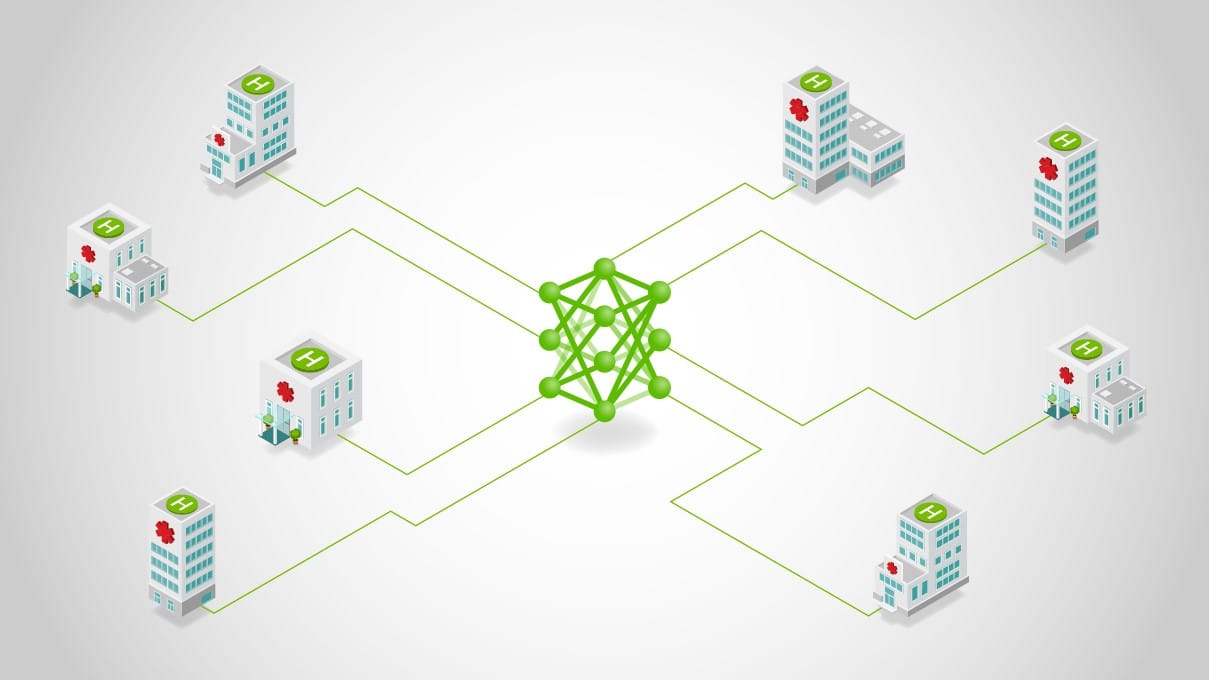
The CIFAR-10 simulation harness is the accessible entry point. Eight simulated FL clients, heterogeneous data split, FedAvg baseline, a ledger that tracks candidate history, and a progress plot showing best observed cross-site evaluation score over time. This is the right teaching example because it is reproducible: teams can clone the repo, read the harness, run the baseline, and understand exactly what the agent is and is not allowed to change before they try to apply the pattern to a real federated problem.
The medical VLM task is where the stakes get real. The harness simulates three medical data sites — VQA-RAD, SLAKE, and PathVQA — using federated Qwen3-VL LoRA training with token-level F1 evaluation. Federated learning in medical imaging is not a toy problem. Patient data cannot be centralized. Institutional review boards care about exactly how model updates are aggregated, what data leaves which site, and whether the evaluation protocol matches the intended clinical use case. Auto-FL's task profile fixes all of those things: site mapping, prompt semantics, model reference, adapter rank, data limits, rounds, seed policy, final evaluation clients, and runtime cap. The agent can propose aggregation strategies; humans own the research claim.
The borrow from autoresearch is well-chosen. Andrej Karpathy's autoresearch pattern — a control plane document, a bounded mutation surface, and a ledger — was designed for single-institution ML research. Auto-FL extends it to the federated setting where the governance problem is harder: multiple sites, data that cannot be pooled, heterogeneous local compute, and aggregation that must preserve privacy while producing comparable updates. FLARE's contract model is what makes this possible. The harness validates that mutations do not violate the FL contract before they are accepted, which means the agent cannot accidentally introduce a privacy leak or an aggregation incompatibility and have it look like a better score.
For practitioners, the pattern is more important than the framework. Any team using agents to accelerate ML research — not just FL, but hyperparameter search, architecture search, dataset curation, benchmark engineering, or pipeline automation — faces the same core problem: how do you know the agent improved the thing rather than the measurement? The answer is not to limit what the agent can do. It is to define the experiment contract so tightly that changes are comparable, log every candidate including failures, fix the evaluation protocol before the agent runs, require source backing for proposals when local search stalls, and separate kept changes from discarded evidence in a way that survives an audit. Auto-FL implements that discipline for federated learning. The same structure applies to any agentic research workflow.
The practical warning worth flagging: Auto-FL is an example and a pattern, not a product. The medical VLM harness uses Qwen3-VL LoRA training, which means the model is not at the frontier of medical VLM capability. The CIFAR-10 simulation is simplified. The literature recovery loop depends on having relevant papers to ground proposals. If you adopt this pattern for a real FL problem — especially a regulated one in healthcare, finance, or industrial settings — you need to own the task profile, the evaluation contract, the data versioning, the site permissions, and the kept/discarded evidence trail. NVIDIA provides the scaffolding. Your institution owns the research claim.
The Auto-FL GitHub repo is worth bookmarking if this problem space is yours. The README documents the harness, the candidate run scripts, the contract validation, the smoke tests, and the reporting utilities. Watch how the scoring formula evolves as NVIDIA and contributors encounter edge cases. That evolution will tell you more about what safe agentic research actually requires than any press release could.
Sources: NVIDIA Developer Blog | NVIDIA NVFlare Auto-FL GitHub | karpathy/autoresearch