OpenAI Bought Luna a Top-Three Ranking. DeepSeek Still Owns the Volume.

The most important change in this week’s model rankings is not that GPT-5.6 Luna moved up one place. It is that OpenAI bought that place with an 80% price cut—and the market responded almost immediately.
Luna reached third on OpenRouter’s weekly usage chart with 5.20 trillion routed tokens, edging past DeepSeek V4 Flash 0423 at 5.11 trillion. That 90 billion-token lead sounds large until it is put in context: it is a gap of roughly 1.8%, small enough to disappear with a busy customer migration, a promotion, or ordinary week-to-week churn. Treating this as evidence that Luna is “better” would confuse a market signal with a quality result.
The causal story is still hard to miss. OpenAI cut Luna’s API price by 80% on July 30, to $0.20 per million input tokens and $1.20 per million output tokens, while widening access by making it the default for ChatGPT Free and Go users. Two weeks later, usage is moving. Price and distribution did what benchmark charts often cannot: they changed which workloads engineers can afford to run.
A token leaderboard is an economics chart in disguise
OpenRouter measures routed tokens, not solved tasks. Those are very different units. A model can climb because it is cheap, because its free endpoint is popular, because it produces long reasoning traces, because users retry it more often, or because a handful of high-volume applications route batch jobs through it. The chart does not tell us whether the resulting answers were correct, whether users accepted them, or whether the model required three attempts to finish a tool call.
That limitation does not make the ranking useless. It makes it a view of adoption under real incentives. Luna’s jump suggests that an 80% cut crossed an operational threshold for buyers. At $0.20 per million input tokens, jobs that were marginal at frontier pricing—document classification, routine code edits, test generation, extraction, and multi-stage agents—become easier to justify. A team can run more candidates, add verification passes, or use the model as a first-line worker with an expensive fallback.
OpenAI says Luna delivers year-old frontier performance at roughly six cents per “task-dollar” and nearly nine times the speed. It also reports that Luna and Sol produced 62% and 68% fewer responses containing at least one factual error than GPT-5.5 Instant on internal financial, medical, and legal evaluations. Those claims are useful hypotheses, not procurement evidence. The test sets, error taxonomy, prompt scaffolding, and acceptance thresholds all matter, and the vendor has every incentive to choose a favorable frame.
The practical implication is more interesting than the marketing number: falling inference prices change architecture. When a model call is expensive, teams minimize calls. When it becomes cheap, they can afford ensembles, graders, retries, and specialized routing. Some of the savings will therefore appear as lower bills; some will be reinvested into more inference. OpenRouter’s token count captures both effects but cannot separate them.
DeepSeek still owns the volume story
Luna’s move should not obscure the board’s dominant result. DeepSeek V4 Flash 0731 remains first at 10.7 trillion weekly tokens, barely ahead of Tencent Hy3 at 10.6 trillion. Add the older V4 Flash 0423 checkpoint, still fourth at 5.11 trillion, and DeepSeek accounts for 15.81 trillion tokens across those two entries—more than three times Luna’s volume.
The persistence of the older checkpoint is itself valuable data. Production systems do not migrate at leaderboard speed. Teams pin model versions because prompts, tool schemas, safety controls, and regression suites have been tuned around particular behavior. The old model’s remaining volume may reflect provider availability, better cache economics, a behavioral regression in 0731, or simple operational inertia. All four explanations are more plausible than “users forgot a newer model exists.”
DeepSeek V4 Flash 0731 is also technically designed for efficiency: a sparse mixture-of-experts model with 284 billion total parameters but 13 billion active per token. Its published results include 82.7 on Terminal Bench 2.1, 54.2 on NL2Repo, 76.7 on Cybergym, 54.4 on DeepSWE, and 70.3 on Toolathlon-Verified. DeepSeek’s table shows the release beating its V4 Pro preview on several agent tasks despite activating far fewer parameters, although two DSBench results rely on internal sets and deserve the usual skepticism.
There is an integration catch hiding behind those benchmark scores. The model uses a dedicated Python encoding package rather than a conventional Jinja chat template. That is not fatal, but it is exactly the kind of wrinkle that makes a “drop-in replacement” fail in production. Tokenization, role formatting, tool-call serialization, stop conditions, and cache keys need explicit validation. A cheap model that loses state or repeatedly emits malformed calls is expensive in the only unit that matters: completed work.
The unchanged Arena chart is the control group
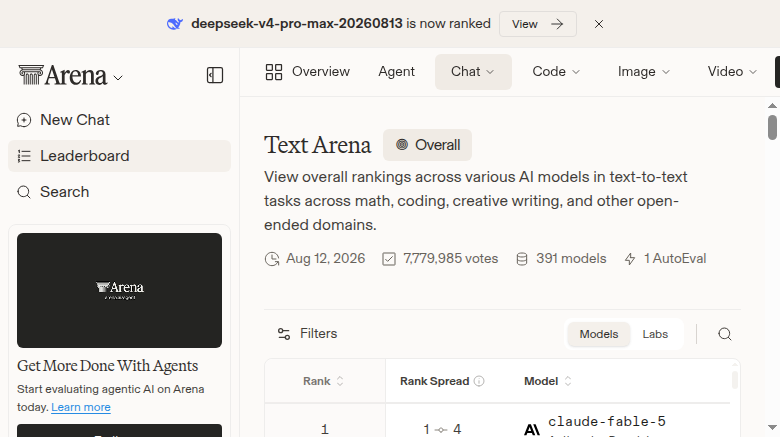
Arena’s overall preference order did not change. Claude Fable 5 remains first, and Anthropic occupies six of the top ten positions. OpenAI’s highest entry in the extracted top 20 is GPT-5.5 High at number 16; Luna does not appear there. The live Arena page exposed ordering but not trustworthy Elo values in the extracted data, so inventing a numerical quality gap would be false precision.
The split between the two charts is the story. Arena asks which anonymous answer people prefer under its comparison protocol. OpenRouter counts tokens routed through a commercial marketplace. One is influenced by presentation, prompt mix, voter population, and pairwise sampling. The other is influenced by price, free access, context length, retries, and customer workload concentration. Neither is “the model leaderboard,” because no single ranking can collapse preference, reliability, latency, cost, and operational fit into one honest number.
Community reports reinforce that point. A Hacker News discussion of the Luna and Sol update had 315 points and 283 comments when captured, with users split between enthusiasm for cheap coding throughput and skepticism that Luna is more than the next Instant-tier model. DeepSeek reports are similarly workload-dependent: one practitioner described roughly 99% prompt-cache hit rates and about $1 per day of spending with a minimalist harness, while others reported instruction-following failures on large codebases. The disagreement is not noise to average away. It is evidence that harness design and workload shape can outweigh a model’s global rank.
Run the bake-off your invoice actually cares about
Engineering teams should use this ranking change to update a candidate list, not a production route. Put Luna and DeepSeek V4 Flash 0731 through the same internal evaluation with prompts, tools, context, reasoning settings, and stopping rules held constant. Include at least one long-context repository task and one tool-heavy workflow, because those are where formatting and instruction-following differences become operational incidents.
Measure total input, cached input, reasoning, and output tokens per accepted task. Record p50 and p95 latency, tool-call completion rate, retry count, human correction time, and the percentage of outputs that pass an automated or human acceptance check. Then compute cost per accepted result. Dollars per million tokens is a component price; dollars per correct outcome is the system metric.
Canary the winner on low-risk traffic, preserve a fallback, and examine failures by category rather than averaging them into a single score. A model that is excellent at extraction but brittle at multi-step tools may still be the right specialist. A model with a slightly higher list price may win because its cache behavior or shorter outputs reduce end-to-end cost. Recheck the public chart in a week: if Luna holds third after launch effects settle, the adoption signal becomes more durable. If it falls back, the 90 billion-token lead was a moment, not a migration.
Luna’s rise is real, but the lesson is not that OpenAI has beaten DeepSeek on quality. It is that pricing can move production usage faster than prestige, while DeepSeek’s combined volume shows how sticky efficient infrastructure becomes once teams build around it. Popularity, preference, and fitness for a workload remain three separate columns. Any engineering organization that merges them is outsourcing architecture to a chart.
Sources: OpenRouter LLM Rankings, Arena AI Text Leaderboard, OpenAI GPT-5.6 price-performance update, OpenAI Luna access expansion, DeepSeek V4 Flash 0731 documentation, Hacker News discussion