OpenAI’s Codex Page Says the Quiet Part: The Coding Agent Is Becoming a Command Center

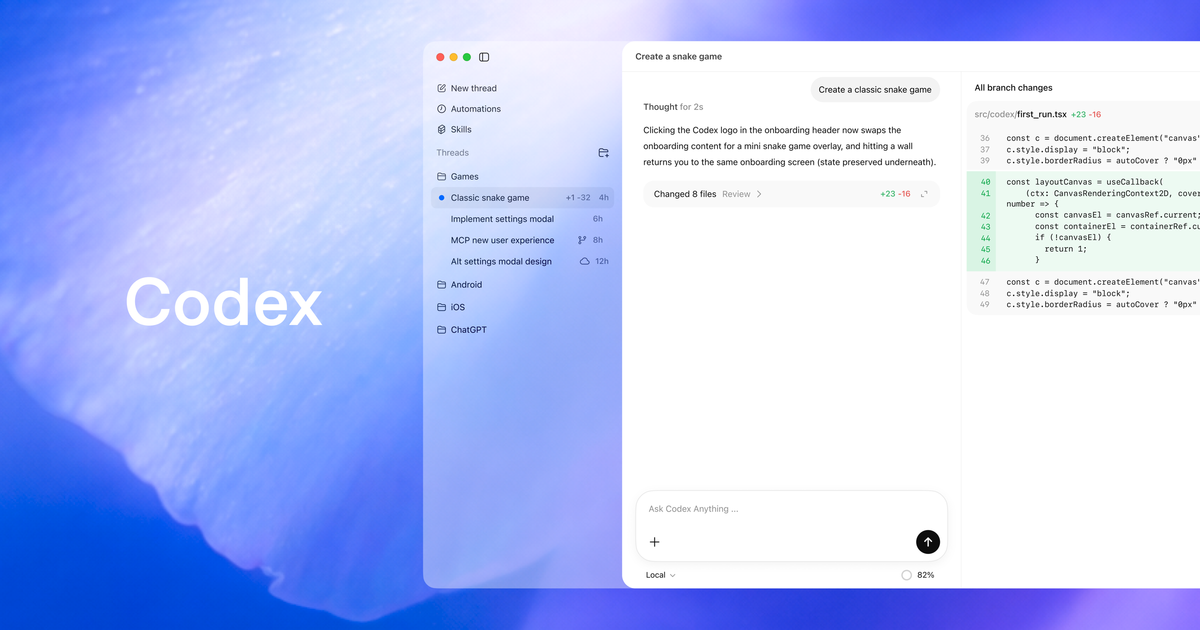
OpenAI is no longer selling Codex as a smarter autocomplete box. The updated pitch is more ambitious, and more operationally demanding: Codex is becoming the control plane for agentic engineering work.
That distinction matters. A tool that edits one file in an IDE can be evaluated like a productivity feature. A system that spans the Codex app, editor, terminal, web, cloud environments, worktrees, skills, automations, code review, and connected ChatGPT account has to be evaluated like infrastructure. The question is not just “does it write good code?” It is “can the team understand, constrain, replay, and trust what happened after the agent touched the work?”
OpenAI’s own language says the quiet part. The Codex app is described as “a command center for agentic coding,” with built-in worktrees and cloud environments so agents can work in parallel across projects. Codex is positioned across multiple surfaces — app, editor, terminal, and web — all connected by a ChatGPT account. It adds Skills for code understanding, prototyping, documentation, and team standards; Automations for issue triage, alert monitoring, CI/CD, and other routine work; and code review that OpenAI says can catch high-signal bugs before shipping.
That is a credible direction. It is also a much larger blast radius than the old mental model of “AI assistant in my editor.”
The agent is becoming a workflow owner
The important shift is from generation to orchestration. Worktrees are not a landing-page flourish; they are the primitive that lets multiple agents attempt work without trampling the same checkout. Cloud environments are not just convenience; they make background work possible when the laptop is closed. Skills are not just prompt snippets; they are repo- and team-specific behavior packages. Automations are not just reminders; they are recurring agent entry points into production workflows.
Put together, Codex starts to look less like a coding companion and more like an engineering operations surface. It can pick up tasks, branch work, apply project conventions, generate tests, review changes, and hand work back to humans. Customer quotes on the page claim early iteration time reductions of 30–50% at Harvey, weekend delivery replacing quarter-scale work at Sierra, and backend Python code-review benchmark wins at Duolingo. Treat those as marketing until reproduced in your environment, but the pattern is still useful: the value is moving from “write this function” to “move this work item through the system.”
The runtime details behind the product direction are more interesting than the quotes. Recent Codex releases have been adding the boring pieces serious agents require: richer diagnostics through codex doctor, remote connection status, named permission profiles, sandbox presets for the Python SDK, non-interactive install mode, resume-flow fixes, dedicated SQLite memory runtime state, central Responses retry handling, and MCP tool naming cleanup. None of that demos as well as a generated pull request. All of it is what keeps generated pull requests from becoming forensic puzzles.
Multi-surface agents need one policy model
The hardest problem for Codex is not model quality. It is policy continuity.
If the same agentic workflow can start in the app, continue in an editor, run in a terminal, and delegate to a cloud environment, the permission model has to follow the session. A worktree created from the web UI should not silently gain different file, network, MCP, or connected-app privileges when resumed in a terminal. An approval granted for one run should not become a standing license for a different class of side effect. A skill loaded for documentation should not implicitly authorize dependency upgrades, repository rewrites, or ticket edits.
This is where OpenAI’s business and enterprise controls matter. Codex is included across Free, Go, Plus, Pro, Business, Edu, and Enterprise plans, with usage counting toward “agentic usage” alongside other ChatGPT agent surfaces. For Business, Enterprise, and Edu, plugin access follows workspace app controls; Enterprise and Edu can use RBAC; and Codex usage from local clients, IDE extensions, web, and cloud-delegated tasks is available through the Compliance API. That is not a nice-to-have. It is the minimum viable audit trail for a tool that can perform work across surfaces.
But teams should read those controls as a starting point, not a finished governance model. A ChatGPT account may have connected services. The help materials describe context and data controls around Memories, Automations, in-app browser, and Computer Use, including screenshots under ChatGPT training-data controls. The practical implication is simple: do not assume a Codex session sees only a Git repository. Depending on workspace configuration, it may be adjacent to documents, browser context, connected services, and persistent memory. That is useful when the agent needs project context. It is risky when the agent did not need that context but got it anyway.
Agentic usage is the new build minutes
The other operational shift is cost. OpenAI notes that large codebases, long-running tasks, and extended sessions consume significantly more per message. That puts Codex in the same category as CI minutes, cloud builds, preview environments, and hosted test runners: a productivity accelerator that becomes wasteful when no one owns the budget.
This is where many teams will get the first surprise. Autocomplete trained developers to think of AI as a fixed-seat productivity feature. Agentic coding behaves more like a workload. A vague request over a large monorepo can spend more context and time than a scoped request against a narrow module. Background agents can burn budget while humans are not watching. Code review bots can rerun against noisy diffs. Automations can quietly become recurring spend. If Codex is the command center, someone needs the dashboard.
The actionable move is to classify tasks before launching agents. Use local or lightweight runs for narrow edits, documentation drafts, and explainers. Use cloud background work for bounded branches with clear acceptance criteria and tests. Use high-context models only when repository comprehension actually matters. Require issue links for long-running tasks. Tag worktrees by ticket. Retain traces. Review outlier runs the same way you would review unusually expensive CI jobs.
More importantly, decompose work before handing it to Codex. “Modernize the auth service” is not a task; it is a liability generator. “Replace deprecated JWT library in the token verifier, update tests, do not touch login UI, open a PR” is a task. The agent may be powerful, but the human still owns the spec.
What engineering teams should do now
If your team is evaluating Codex, do not start with a bake-off over which agent writes prettier code. Start with a surface matrix. What is allowed in the app, IDE, CLI, web, and cloud? Which surfaces can call MCP tools? Which can access connected services? Which can open pull requests? Which can run shell commands? Which can create or modify tickets? Which actions require explicit human approval every time?
Then define permission profiles by repo class. A sandboxed library repo does not need the same policy as a payments service. A documentation repo can permit broader write access than production infrastructure. A code-review automation should probably read broadly but write narrowly. A migration agent may need shell access but should be locked to a branch, a test command, and a strict PR target.
Finally, treat Skills as code. Review them. Version them. Keep them close to the repo. Require ownership. A skill that encodes team conventions is valuable; a skill that silently expands what the agent is expected to do is a supply-chain surface with nicer syntax.
Codex’s direction is right because the future of coding agents is not a chat window with better vibes. It is a managed workflow system with agents as workers, worktrees as isolation, skills as policy-carrying behavior, automations as scheduled entry points, and compliance logs as the thing you read when the robot was confidently wrong. OpenAI appears to understand that. The market will now find out whether teams do.
Sources: OpenAI Codex, OpenAI Developers — Codex, OpenAI Help — Using Codex with your ChatGPT plan, Codex 0.135.0 release notes, Codex 0.136.0-alpha.2 release notes