OpenClaw’s Control-Plane Registry PR Is Early, But the Direction Is Right

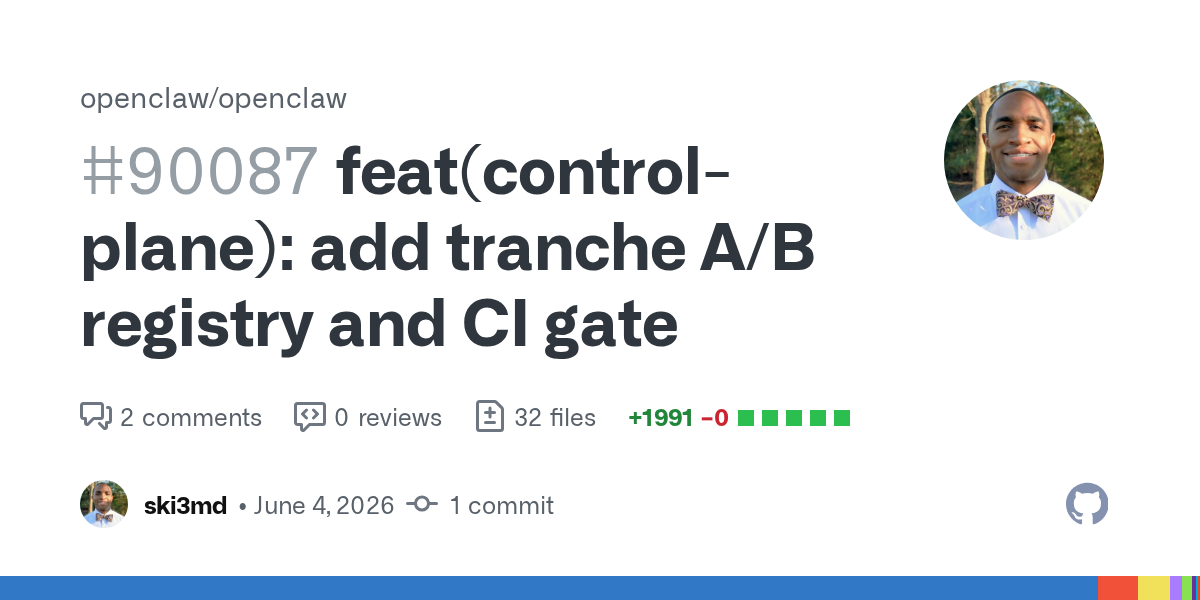
OpenClaw PR #90087 is not the kind of change that makes a good launch tweet. It adds contracts, schemas, registries, queues, reports, artifacts, dashboards, ledgers, and a read-only CI validator. In other words, it adds paperwork. For agent platforms, that paperwork is the product surface everyone pretends they will add later.
The PR was opened June 4 at 2026-06-04T00:59:08Z and was still open at research time, with ClawSweeper review just starting around 2026-06-04T01:05:38Z. That means this is not a shipped-feature victory lap. It is an early direction-of-travel story. The direction matters because OpenClaw is running into the same governance problem every serious agent stack eventually hits: chat logs are not enough to explain what an agent system did.
A transcript can tell you what the assistant said. It might show which tool was called. It will not reliably tell you which policy version applied, which schema an artifact was supposed to satisfy, which validator approved a report, which queue owned the work, whether a PHI marker check ran, or whether a workflow referenced a control-plane file that no longer exists. Once an agent platform has plugins, skills, install decisions, MCP servers, Workboards, generated artifacts, reports, approvals, and delegated runs, the transcript becomes only one view of the system. The control plane needs its own source of truth.
Registries beat archaeology
PR #90087 adds Tranche A/B control-plane scaffolding and three concrete Tranche B registries: registries/schemas.registry.json, registries/validators.registry.json, and registries/policies.registry.json. It also adds a read-only CI gate at .github/workflows/control-plane-validate.yml that runs node scripts/validate_openclaw_control_plane.cjs on pull requests and pushes to main.
The validator checks the kind of boring details that become expensive when skipped: registry existence, path resolution, workflow contract and validator registration, policy required fields, allowed status values, secret-like config checks, and PHI marker checks for artifacts. Policies need id, version, status, decision, applies_to, and reason. Status values are constrained to active, deprecated, experimental, and blocked. The author’s verification says node scripts/validate_openclaw_control_plane.cjs returned PASS with findings: [].
None of that is glamorous. It is also exactly how you stop governance from turning into archaeology. Without registries, every incident review becomes a grep exercise through transcripts, generated files, config fragments, Slack messages, and whatever the agent remembered to say. With registries, at least the platform can ask structured questions: does this policy exist, what version is active, does this workflow reference a known validator, does this artifact path resolve, and did we accidentally check in something that looks like a secret or protected health information marker?
The read-only gate is the right amount of power
The best detail in the PR may be that the CI gate is read-only. Early governance systems often fail because they try to enforce too much before the taxonomy has stabilized. Teams add a policy engine, wire it directly into runtime behavior, and then discover that half the schema is wrong, the validator is noisy, and everybody is now trying to bypass the compliance robot just to ship a fix.
A read-only validation gate is a better starting point. It detects drift without pretending the new registry model is already mature enough to control everything. Maintainers can see missing references, malformed policy rows, suspicious config, and artifact marker issues while still refining the vocabulary. Once the registry proves useful, enforcement can tighten. That is how good platform governance grows: observe first, block later, and only after the signal is trustworthy.
This is especially important in OpenClaw’s current context. The same nightly research window surfaced v2026.6.2-beta.1, which moves plugin and skill installs from a built-in dangerous-code scanner toward operator install policy, plus a cluster of plugin metadata hardening PRs around provider discovery, owner maps, captured capabilities, model pricing, and runtime boundary manifests. Those are all control-plane concerns. They decide what can be installed, what metadata is trusted, what provider routes are eligible, what policies apply, and what evidence the runtime can produce.
Agent governance is not a dashboard you bolt on after the model works. It is the scaffolding that lets the platform explain itself. The more OpenClaw becomes a host for plugins, local nodes, MCP servers, Codex app-server paths, Workboards, channel integrations, and generated artifacts, the more it needs explicit registries rather than implicit assumptions buried in code and chat history.
Compliance hygiene without compliance theater
The PHI and secret-like config checks are crude by necessity, but they are still worth noticing. Agent systems create artifacts quickly: reports, screenshots, logs, summaries, code patches, exported files, and evidence bundles. If those artifacts can move between queues, dashboards, ledgers, and reports, sensitive-data checks need to happen before publication, not after someone finds the leak.
The trick is avoiding compliance theater. A marker check does not prove an artifact is safe. A validator registry does not prove every validator is good. A policy row with a reason field does not prove the decision was wise. But these structures make the absence visible. They create places where better checks can live. They let CI ask whether the control-plane graph is internally coherent. That is a meaningful improvement over hoping the agent mentioned the important part in its final answer.
For builders outside OpenClaw, the takeaway is practical. If your agents do work that survives beyond a single chat turn, create registries early: policies, validators, schemas, artifacts, queues, reports, and ledgers. Give every policy an id, version, status, decision, scope, and reason. Make workflows reference named validators instead of ad-hoc scripts. Add CI that checks path resolution and required fields. Add sensitive-data heuristics knowing they are incomplete, then improve them with real findings. Most importantly, treat the registry as a product artifact, not an internal compliance folder nobody reads.
PR #90087 may change shape in review. It may get narrowed, renamed, or split. That is fine. The important point is the architectural direction: control plane over conversation. Agents that execute tools, install plugins, delegate work, and produce durable artifacts need audit surfaces that are more reliable than chat logs. Otherwise “what happened?” becomes a transcript-mining exercise, and the answer arrives too late to be useful.
Sources: OpenClaw PR #90087, OpenClaw v2026.6.2-beta.1 release, OpenClaw PR #89516, OpenClaw PR #90085