OpenClaw's Dependency Gate Treats Agent Skills Like a Supply Chain

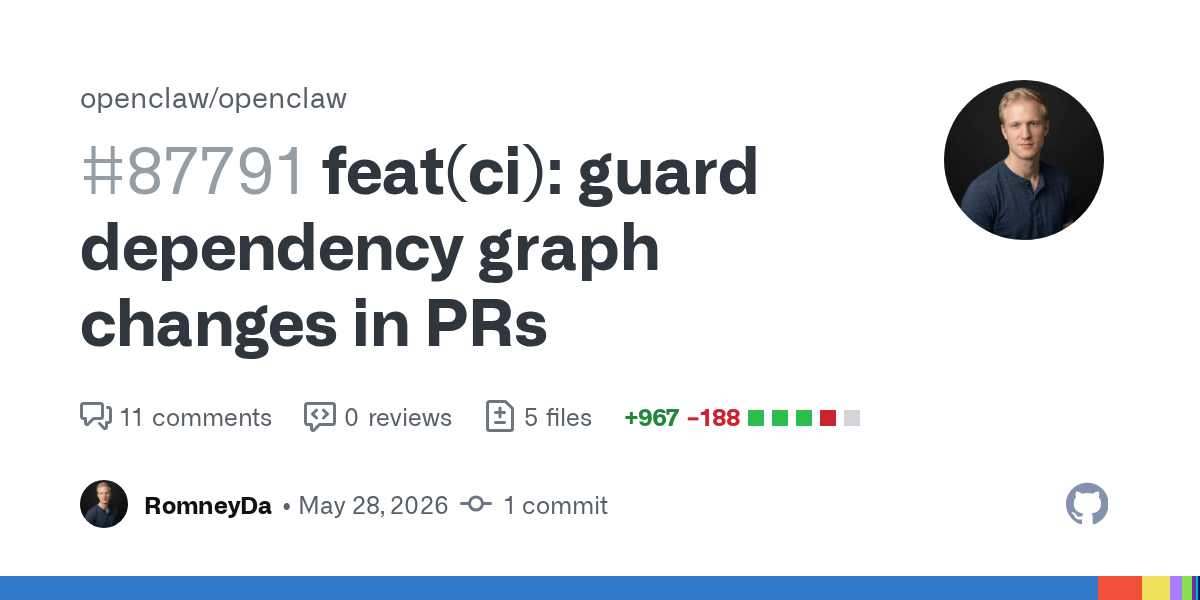
OpenClaw PR #87791 is the kind of security work that will not trend, will not demo well, and will probably annoy contributors the first time it blocks a pull request. Good. Agent platforms need more friction in exactly these places. The PR turns dependency graph changes from a polite advisory into a hard-failing gate unless a named security approver explicitly authorizes the exact pull-request head.
That sounds like ordinary CI hygiene until you remember what OpenClaw is. This is not a static website where a dependency bump mostly changes bundle size and maybe a transitive vulnerability score. OpenClaw’s dependency graph sits under a runtime that loads skills, plugins, MCP bridges, providers, channel integrations, sandbox helpers, parsers, transport adapters, and tool-facing code that may sit near credentials. In that world, dependency review is not paperwork. It is part of the runtime trust boundary.
The patch replaces inline workflow logic with a checked-in trusted-base Node guard, scripts/github/dependency-change-awareness.mjs, and focuses on dependency-affecting surfaces: lockfiles, workspace and patch dependency policy files, and package manifest fields that can influence resolution or install behavior. Script-only package.json changes are intentionally excluded from the dependency label and block, which is a useful sign that this is not a blanket “make CI meaner” exercise. The point is to gate graph-changing behavior, not punish every maintenance edit.
Skills are packages with better marketing
The broader reason this matters is simple: agent skills and plugins are supply chain. The industry still likes to describe them as “instructions,” “capabilities,” or “integrations,” because those words feel softer than “code that changes what an autonomous system may do.” But the operational reality is harsher. A skill can alter tool choice. A plugin can expose a new network path. An MCP server can surface structured data and callable actions. A model adapter can change payload shape, retry behavior, or auth routing. A parser dependency can become the difference between safe text handling and prompt-visible garbage.
Once those pieces become installable, versioned, and shared, dependency governance becomes agent governance. PR #87791 does not solve plugin provenance or skill marketplace abuse by itself. It does something more foundational: it establishes the habit that dependency-affecting changes deserve explicit ownership. That habit is boring until the first malicious package, compromised maintainer account, or “minor lockfile update” changes production behavior.
The mechanics are intentionally strict. The guard runs under pull_request_target from a trusted base checkout, labels and comments on dependency graph surfaces, and fails the check unless an allowlisted member of OPENCLAW_SECURITY_APPROVERS authorizes the current guard state with /allow-dependencies-change. The approval is tied to the current head SHA. If a contributor pushes more commits, the old approval does not silently carry forward. The guard comment acts as a freshness barrier so stale permission cannot bless a later, different graph change.
That SHA-bound approval detail is not bureaucracy; it is the whole point. Dependency changes are often smuggled in through update churn. A reviewer sees a green check, a familiar author, a lockfile diff too large to inspect manually, and a previous comment that says “approved.” Binding the override to the current head forces the human decision to match the artifact being merged. If you want supply-chain controls that mean anything, this is the kind of small annoyance you accept.
The pull_request_target tradeoff is real
ClawSweeper’s caution is justified. pull_request_target with write permissions is powerful and easy to misuse. It exists because a workflow sometimes needs to comment, label, or inspect PR metadata with repository authority while avoiding execution of untrusted PR code. The safe pattern is to run trusted base code, not checked-out attacker code, and to keep the privileged script narrow. #87791 leans into that pattern with a checked-in guard script, CODEOWNERS coverage, focused tests, an explicit approver list, and SHA-bound authorization.
Still, this will require a branch-protection or ruleset rollout before it becomes a real merge gate. A failing check that nobody requires is a dashboard decoration. A hard gate without a clear owner is a contributor-hostile landmine. The maintainers need to decide who is on the security approver list, how emergency dependency updates are handled, and what review standard applies to graph-affecting PRs. The technology can enforce the boundary; the project has to own the policy.
GitHub’s own dependency graph documentation frames dependency metadata as manifests, lockfiles, submitted dependencies, versions, licenses, transitive paths, and known vulnerabilities. That maps cleanly to what an agent platform should care about. Lockfiles describe the actual code that arrives. Manifests describe intent. Patch policies and workspace files describe where resolution can be bent. Generated clients and install-time scripts deserve similar scrutiny in adjacent systems, even if this PR draws its boundary at the core graph surfaces.
For practitioners building agent systems, the actionable lesson is to define your protected dependency surfaces before your ecosystem grows large enough to make governance politically expensive. Decide which files require owner approval. Make approvals specific to the artifact being merged. Avoid executing untrusted PR code in privileged workflows. Require explicit review for plugin manifests, MCP server definitions, package lockfiles, sandbox images, and provider adapters. If the agent can act with real authority, the supply chain that feeds it is part of the authority model.
The most useful thing about #87791 is that it treats “dependency changed” as a security event, not a chore label. That is the right posture for 2026 agent platforms. Skills and plugins are packages. Packages can be compromised. A runtime that can browse, message, execute, fetch, and remember should not casually accept behavior-changing graph edits because the diff looked like maintenance. The boring gate is the product here.
Sources: OpenClaw PR #87791, GitHub dependency graph documentation, GitHub Actions event documentation, OpenClaw PR #87141