OpenClaw's Discord Moderation Fix Is Really About Not Letting the Client Choose the Cop

OpenClaw’s latest Discord moderation patch is not interesting because Discord is special. It is interesting because Discord makes the failure mode visible: a chat client should not get to decide who is authorized to kick, ban, delete, or otherwise mutate a community surface. That sounds like web-security kindergarten until an agent runtime routes the same action through a CLI, an MCP loopback server, a gateway tool path, and a model-visible message action. By the time a field named requester arrives at the final handler, it can look official even if it started life as client-controlled metadata.
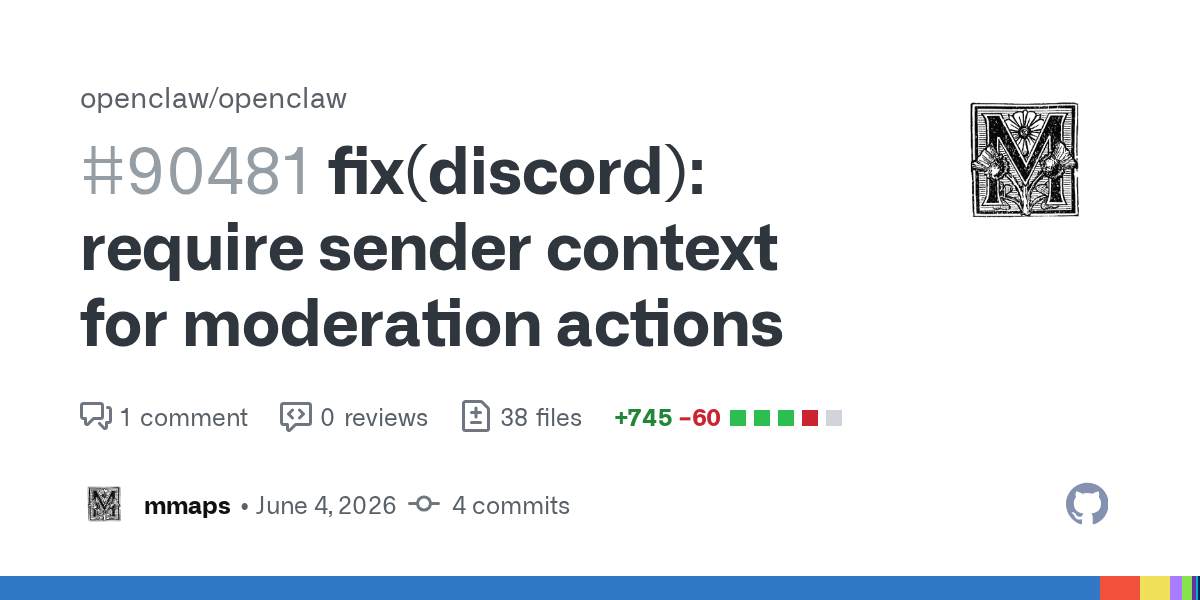
PR #90481, opened June 4 at 23:55 UTC, tries to close that gap. The change requires trusted Discord requester context before privileged Discord moderation and guild-admin message actions can use requester identity. The PR body is explicit about the design goal: carry requester identity through CLI, MCP loopback, and gateway message-action paths without relying on client-controlled sender headers, while keeping deliverable routing separate from non-deliverable requester provenance.
That distinction is the whole story. Delivery asks, “where should this action go?” Provenance asks, “who asked for it, and is that claim trusted?” Agent platforms keep getting hurt when those questions are collapsed into one convenient envelope. A tool call may correctly know which Discord guild or channel to target while still being wrong — or lied to — about the user identity that should authorize the operation.
The local-agent version of trusting X-User-Id
The patch is not tiny. GitHub’s file API showed 38 changed files and a +745/-60 diff at capture time, touching Discord action handlers, channel actions, trusted-requester-source.ts, gateway MCP HTTP runtime code, agent tools, CLI runner preparation, message-action security tests, and outbound dispatch tests. That is the right amount of surface area for a provenance fix, because the bug class is not one bad conditional. It is authority metadata moving across layers that were not originally designed as a single security boundary.
The author listed a broad verification pass: oxfmt, Discord action tests, voice manager E2E tests, message-action security tests, CLI execution and preparation tests, OpenClaw message-tool tests, gateway MCP HTTP tests, gateway tool resolution, server-method sends, websocket post-connect health, and outbound plugin dispatch. ClawSweeper reviewed the PR almost immediately, but its review failed before producing a substantive verdict and labeled the item 🌊 off-meta tidepool. Translation: the change is security-sensitive, the direction is plausible, and nobody should merge it solely because the shape looks obvious.
This is where the broader industry context matters. Microsoft’s June 2 Windows agent-security post framed local agent safety around containment, identity, manageability, and policy-based controls, explicitly in the same Windows/OpenClaw/Agent 365 neighborhood. The point is not that every local agent needs a Discord moderation module. The point is that every local agent with tools eventually needs to answer the same question: which requests are human-authorized, which are agent-initiated, which are bridged through a local loopback path, and which are just metadata wearing a badge?
Normal web applications solved this with server-stamped identity, session validation, CSRF protections, signed tokens, and a long institutional memory of why “the client said it was Alice” is not authorization. Agent systems are relearning that lesson under weirder conditions. The “client” might be a Discord event, an MCP caller, a gateway request, a local CLI invocation, a plugin, or a model-generated tool call. The authorization decision may happen several abstractions after the original event. If the runtime does not preserve a trusted provenance chain, the tool handler receives a story, not a fact.
Moderation tools are not just chat tools with sharper verbs
Discord moderation is a useful stress test because the authority is easy to reason about. Sending a reply is noisy but usually reversible. Deleting messages, banning users, editing guild state, or invoking admin-flavored message actions is different. Those operations affect other people and can be abused as governance bypasses, social-engineering payloads, or simply as accidental damage from an over-helpful agent.
For operators, the practical work starts before this PR lands. Inventory which OpenClaw agents have Discord moderation tools enabled. Check whether those tools can be invoked through gateway or MCP paths as well as direct channel events. Confirm whether policies distinguish a human moderator’s explicit action from an autonomous agent’s inferred action. If your current answer is “the route says Discord, so it must be fine,” that is the bug in sentence form.
Teams should also treat identity-shaped input as hostile unless the server stamped it after authentication. That includes sender, requester, author, userId, and any convenience field copied through internal request bodies. The safe pattern is boring: authenticate at the edge, stamp trusted requester context in a server-owned structure, carry that context across internal boundaries, and make privileged tools reject calls when provenance is absent or ambiguous. If a model-visible tool needs to explain the failure, it should say the request lacks trusted requester context — not silently downgrade into best-effort moderation.
The more subtle lesson is product design. Agent platforms should not make privileged chat actions feel like ordinary message sends. A moderation tool needs stronger affordances: explicit policy, audit logs, clear human-vs-agent origin, and preferably a confirmation path for destructive actions. The runtime should make the safe path easy and the ambiguous path impossible, not merely discouraged by documentation.
OpenClaw has been tightening related trust boundaries all week: install policy in v2026.6.2-beta.1, tool/schema resilience in earlier June patches, and now requester provenance for Discord moderation. That pattern is the healthy one. Agent security is becoming less about prompt cleverness and more about refusing to let authority drift through convenient metadata.
The editorial read is simple: this is not a Discord niche fix. It is the local-agent version of “never trust X-User-Id from the browser.” Agent platforms need signed, server-owned requester context before tools can do moderator-shaped things. Anything less is just letting the client choose the cop.
Sources: OpenClaw PR #90481, OpenClaw v2026.6.2-beta.1, Microsoft Windows Developer Blog