OpenClaw’s New Skill Router Is the Missing ‘What Tool Should I Read?’ Layer

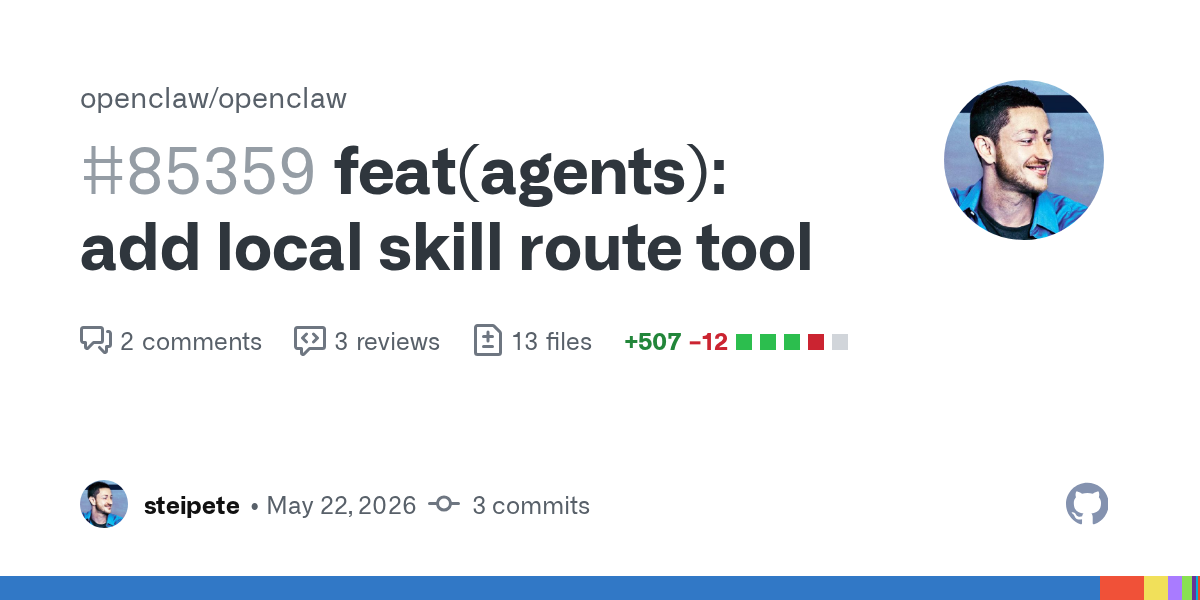
OpenClaw just added the kind of feature that does not look impressive in a demo and absolutely matters once the demo becomes a workstation you depend on: a local router for deciding which skill the agent should read before it starts acting.
PR #85359 introduces local_skill_route, a read-only tool that ranks the available local skills for the current task and returns whether there is a match, an ambiguous match, or no match at all. That sounds like housekeeping. It is actually a governance primitive hiding in plain sight.
The patch was opened by Peter Steinberger on May 22 at 12:52 UTC and changes nine files with 351 additions and three deletions. The implementation wires the route tool through createOpenClawTools from the per-run skillsSnapshot, so the tool only appears when the runtime actually has a skills snapshot. The system prompt guidance is also gated on tool availability: OpenClaw only tells the agent to use the router if the router is registered. Small detail, right instinct. Prompt instructions that describe nonexistent tools are how agent platforms manufacture confusion.
A bigger toolbox needs a map, not a pep talk
OpenClaw skills are not just documentation. They are capability entry points: Slack workflows, GitHub issue routines, browser automation rules, ACP harness routing, health checks, tmux control, video tooling, weather lookup, and whatever else operators install locally. In a fresh setup, the model can scan a handful of descriptions and pick the obvious one. In a mature deployment, the skill catalog becomes a local operating manual with overlapping responsibilities and different risk profiles.
That is where the old approach starts to fray. If the agent reads too many skill files up front, every turn pays extra prompt cost and exposes more operational surface than necessary. If it reads too few, it guesses. If two skills overlap — say a general GitHub skill and a GitHub-issues workflow skill — the difference between “read the most specific one” and “read the familiar one” can change whether the agent merely fetches issue metadata or starts delegating fixes and opening pull requests.
local_skill_route keeps the decision on the safer side of the boundary. It does not execute the skill. It does not authenticate to an external service. It does not run a second model to make the call. It ranks a local snapshot and returns guidance. That matters because the router gives the agent a better map without expanding its authority.
The PR’s own proof is appropriately platform-heavy rather than screenshot-heavy: format checks, tool-display snapshot checks, git diff --check, focused Testbox runs, and $autoreview clean output. One Testbox run passed 84 system-prompt tests and five skill-router tests; another passed typecheck, lint, import-cycle, tool-display, and changed-file guards. This is not glamorous validation, but for a prompt-facing routing surface, boring validation is the right validation.
Tool choice is becoming runtime policy
The interesting context is PR #85354, which adds complementary skill-usage telemetry for exec-to-skill CLI invocation. That telemetry writes per-skill usage data shaped around counts, last-used timestamps, total duration, failures, and sessions. Put the two together and the direction is obvious: OpenClaw is moving from “the model read some prose and chose a tool” toward “the platform can route, observe, and eventually improve capability selection.”
That is the right direction for agent frameworks generally. LangChain, CrewAI, Google ADK, OpenAI’s Agents SDK, Microsoft Agent Framework, and OpenClaw can all expose tools. That part is table stakes. The harder production question is whether a runtime can help an agent choose among dozens of local capabilities without dumping the whole toolbox into context and hoping the model does not grab the wrong wrench.
There is also an enterprise angle that should not be hand-waved. A skill catalog is effectively a capability catalog. Some skills are read-only. Some can send messages, mutate repos, control browsers, invoke ACP coding agents, or talk to external APIs. A deterministic router that can say “matched,” “ambiguous,” or “no match” gives operators and auditors a better object to inspect than the usual black box of “the model decided.” It is not a full policy engine, but it is a foothold for one.
The caveat is equally important: deterministic routing is a floor, not a ceiling. The PR explicitly says live LLM routing behavior with a real 90-plus-skill deployment was not tested, nor were external rerankers or LLM-judge scoring. That is fine for this patch, but it defines the next hill. A router that works in tests still needs to survive messy operator reality: stale skills, renamed CLIs, broken auth, duplicate descriptions, and skills whose names are less helpful than their maintainers think.
The next useful layer would combine routing with observed reliability. If a skill exists but fails every time because its external CLI is missing, the router should eventually learn to downrank it or surface a warning. If two skills match equally but one is more specific and recently successful, that signal should matter. Skill routing starts as UX, but it becomes operations once the agent is doing real work.
For developers running OpenClaw, the practical takeaway is simple: treat skill selection as part of runtime design, not prompt decoration. Keep skill descriptions precise. Avoid overlapping names unless the distinction is explicit. Watch for telemetry once it lands. And when this router ships, test it with the tasks your agent actually performs, not just toy prompts.
The story here is not that OpenClaw added another tool. It is that OpenClaw is starting to treat tool choice as a runtime problem instead of a prompt-writing problem. That is what agent platforms have to do once the toolbox gets bigger than the model’s attention span.
Sources: OpenClaw PR #85359, OpenClaw PR #85354, OpenClaw issue #85263, OpenClaw v2026.5.20 release