Qwen Code 0.17.1 Shows Local Coding Agents Win on Memory, Auth, and Provider Plumbing

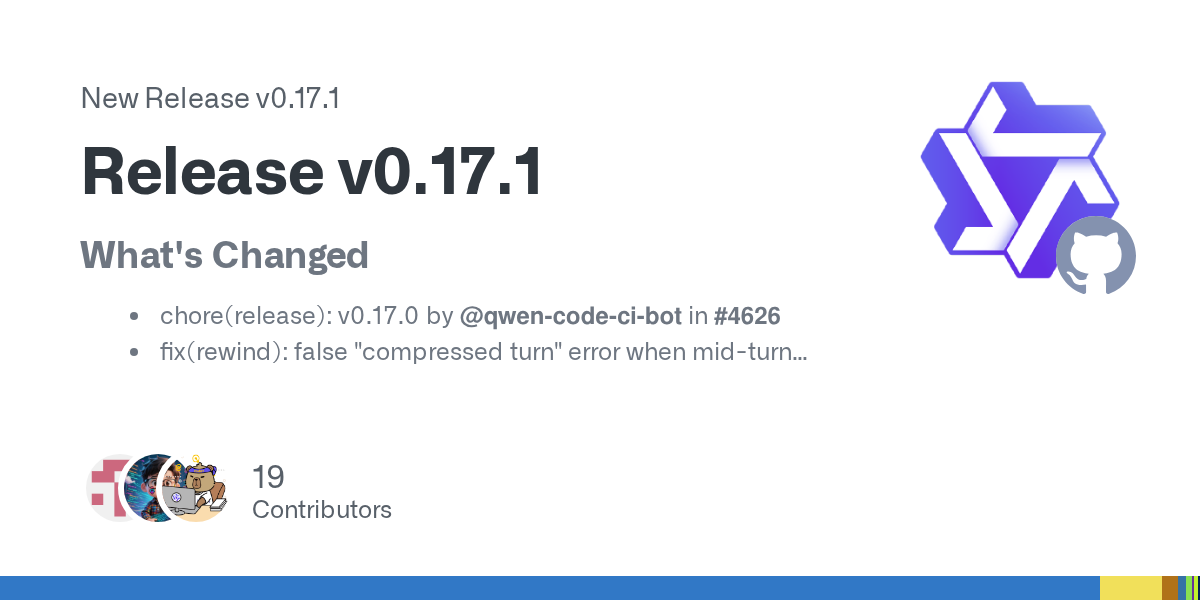
Qwen Code 0.17.1 is not a glamorous release. Good. Glamour is usually where coding-agent reliability goes to hide.
The June 3 release, followed by a June 4 nightly, is a clean snapshot of what local and bring-your-own-key coding agents are actually wrestling with in 2026: memory pressure, resumed-session bloat, provider-specific stream failures, auth migration, corrupted settings, sandbox edge cases, and CI environments that accidentally make an interactive tool behave like a bot. This is the local-agent stack moving out of the “look, it edited a file” phase and into the much less forgiving world of long-running developer workflows.
The headline changes are operational rather than cinematic. Qwen Code v0.17.1 adds a memory pressure monitor, guards oversized resumed history sends, replaces full-history structuredClone behavior with shallow and tail variants to prevent out-of-memory failures on resume, stabilizes statusline ordering, warns on corrupted settings JSON, hides completed sticky todos, persists the memory toggle, and fixes side-query output-language behavior. Provider and auth changes include dropping the discontinued Qwen OAuth method, surfacing Anthropic empty-stream provider errors, emitting enable_thinking on DashScope when reasoning is disabled, loading home .env variables before settings variable resolution, and tolerating unsupported Streamable HTTP GET SSE behavior.
That list is not random. It is a map of where terminal coding agents break when people actually use them.
Local agents win or lose on session durability
The most important fixes in this release are the memory ones. Coding agents accumulate history like a build server accumulates cache directories: repo summaries, shell output, file diffs, tool traces, failed attempts, compressed turns, side queries, todo state, and resumed conversations. A fresh prompt against a small repo tells you almost nothing about whether the tool survives the third hour of a refactor.
That is why the move away from cloning full history matters. A terminal agent that tries to duplicate and resend too much conversation state may work beautifully in a benchmark and then fall over when a developer resumes a large session after lunch. Memory pressure monitoring and tail-oriented history handling are not nice-to-have polish. They are table stakes for any agent expected to live in a real repository for more than a demo.
Teams evaluating Qwen Code, Codex, Claude Code, Gemini CLI, or any local harness should test long-session behavior explicitly. Start a session, let it inspect a moderately large repo, run tools that produce noisy output, make it revise its plan, interrupt it, resume it, and ask it to continue with context. Watch memory use. Watch what gets resent. Watch whether it preserves the right state or drags the entire transcript through every turn like a suitcase full of logs.
The failure mode is not just inconvenience. When an agent loses the useful tail of a session, over-compresses the wrong parts, or crashes on resume, developers start doing the unsafe thing: pasting giant logs back into a new session, disabling safeguards, or granting broader permissions because the tool “just needs to get unstuck.” Reliability and security are not separate tracks here. Bad ergonomics creates bad operational behavior.
Provider freedom creates provider plumbing
Qwen Code’s strategic lane is different from Codex or Claude Code. It is a terminal-first, IDE-friendly open-source coding agent optimized for Qwen models while supporting multiple protocols and providers: OpenAI-compatible endpoints, Anthropic, Google GenAI, Alibaba Cloud Coding Plan, OpenRouter, Fireworks AI, and bring-your-own-key workflows. That flexibility is the pitch. It is also the source of half the pain.
Every additional provider adds a slightly different version of streaming, auth, model settings, error reporting, rate limits, reasoning toggles, and credential handling. Surfacing Anthropic empty-stream provider errors sounds small until you are the developer staring at a silent agent and wondering whether the model failed, the network failed, or the tool swallowed the exception. Emitting enable_thinking correctly on DashScope when reasoning is disabled is the kind of provider-specific knob that determines whether the agent behaves predictably across models. Loading home .env variables before settings interpolation is boring, until it is the difference between a working setup and a phantom auth bug.
This is the hidden cost of local/BYOK agents. You get model choice, better cost control, and sometimes stronger privacy. In exchange, your team owns more of the runtime contract. Hosted proprietary agents hide provider plumbing behind a product surface. Open terminal agents expose it because they have to.
That does not make Qwen Code worse. It makes the evaluation more concrete. If you are considering it for a team, do not run only the default happy path. Test the provider matrix you actually plan to use: Alibaba Coding Plan, local or self-hosted endpoints, OpenRouter or Fireworks, Anthropic fallback, and whatever your developers will quietly configure at 11 p.m. behind a corporate proxy. Confirm error messages are actionable. Confirm settings resolution is deterministic. Confirm the tool exits with useful codes in automation instead of becoming a haunted TTY.
The OAuth shutdown is a forcing function
The auth story is another useful signal. Qwen’s docs state that the Qwen OAuth free tier was discontinued on April 15, 2026, and users should move to Alibaba Cloud Coding Plan or API-key providers. Qwen Code 0.17.1 drops the discontinued OAuth method accordingly.
That is annoying for free-tier users, but healthier for production. Browser OAuth flows and shifting quota policies are fine for experimentation; they are weak foundations for a team coding-agent rollout. Predictable monthly plans, explicit API-key providers, and settings-managed model configuration are easier to reason about, budget, rotate, and audit.
The tradeoff is secrets hygiene. Qwen’s docs allow API keys in ~/.qwen/settings.json as a fallback, while recommending shell exports or .env files. Teams should treat those configs as sensitive infrastructure. That means excluding them from sync tools, backing up only intentionally, documenting rotation, using separate keys for experimentation and production-like work, and avoiding one shared “team key” that ends up in screenshots, dotfiles, and Slack snippets.
The troubleshooting docs expose more production-shaped edges: corporate TLS inspection may require NODE_EXTRA_CA_CERTS; sandbox restrictions can produce permission errors; Qwen Code uses exit codes such as 41 for fatal auth, 42 for fatal input, 44 for fatal sandbox, 52 for fatal config, and 53 for turn limits; CI-prefixed environment variables can accidentally force non-interactive behavior. That is exactly the kind of documentation a serious terminal tool needs. It tells you where the bodies are buried before you step on the shovel.
For practitioners, the playbook is straightforward. Pin the Qwen Code version before rolling it out broadly. Standardize provider configuration instead of letting every developer invent a local snowflake. Test long-session resume behavior. Decide whether sandboxing is mandatory or advisory. Put API keys somewhere defensible. Validate behavior behind your proxy. Teach CI jobs to distinguish interactive and non-interactive runs. And if you are using local models through Ollama, vLLM, or OpenAI-compatible endpoints, test latency and context behavior under the same repo workloads developers will actually run.
The bigger lesson is that open coding agents do not win by being free. They win when they are boring in exactly the right places: memory, auth, provider errors, sandboxing, configuration recovery, and resumed work. Qwen Code 0.17.1 is a useful release because it shows the maintainers fighting those boring battles.
That is what maturity looks like in this category. The agent that survives the messy fourth hour of a refactor is more valuable than the one that wins the first five minutes of a demo.
Sources: Qwen Code v0.17.1 release, Qwen Code June 4 nightly, Qwen Code repository, Qwen Code authentication docs, Qwen Code troubleshooting docs