Qwen Code’s May 10 Nightly Turns Memory Into the Next Agent Battleground

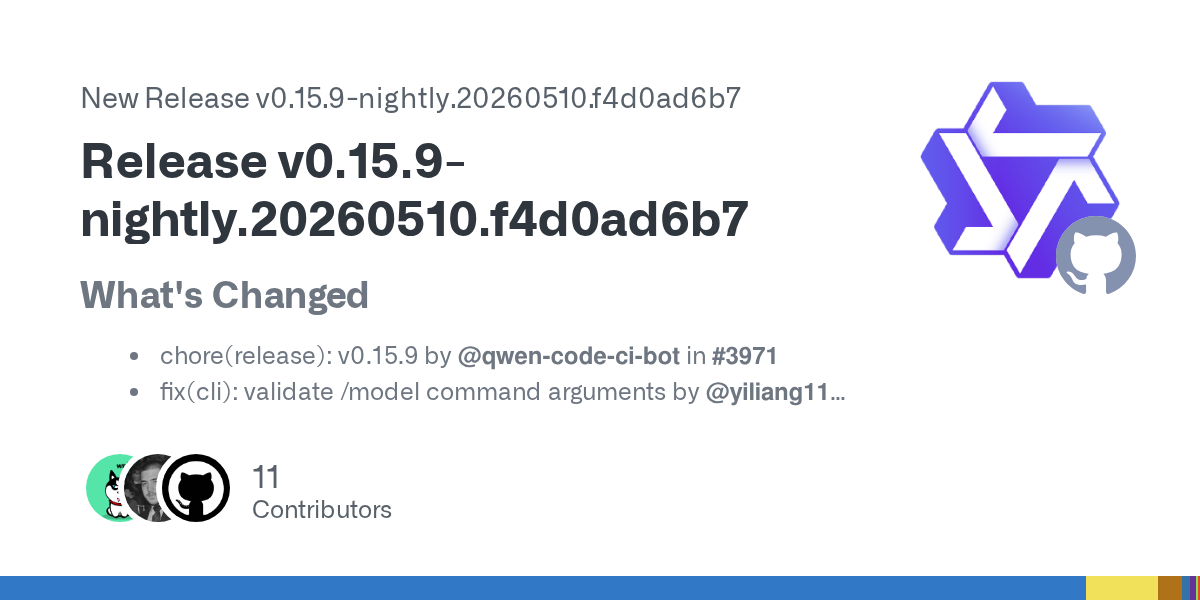
Qwen Code’s May 10 nightly is not the kind of release that should make a sane engineering team smash the upgrade button. It is a prerelease build, published as v0.15.9-nightly.20260510.f4d0ad6b7, and it arrives in the middle of an extremely active Qwen Code release stream. But it is worth paying attention to because two features point directly at the next hard problem for local coding agents: keeping long-running sessions coherent, and turning repeated project knowledge into reusable skills without creating a new supply-chain mess.
The release notes list reactive compression on context overflow and background project skill extraction as headline-adjacent changes. Around them are the usual signs of a tool maturing under real use: /model argument validation, OpenAI wire-request logging, disabled MCP server filtering, Mistral reasoning-content filtering, preservation of comments and formatting during settings.json migrations, QWEN_HOME for custom config directories, VS Code message edit/rewind UI, telemetry diagnostic suppression, and throttled shell live-text updates. That is not benchmark theater. That is a terminal agent team discovering all the ways state leaks, drifts, overflows, or becomes impossible to debug.
Context compression is the agent feature nobody notices until it fails
Coding agents do not fail like chatbots. A chatbot forgets your question and gives a vague answer. A coding agent accumulates repo context, tool output, diffs, test logs, shell transcripts, prior instructions, failed plans, partial summaries, and subagent chatter until the working memory becomes a landfill. At that point, the model either forgets constraints, edits the wrong file, repeats work, or starts sounding confident about context it no longer truly has. Anyone running local agents through Qwen Code, Claude Code, Codex-style CLIs, OpenClaw, Ollama, vLLM, or LM Studio has seen some version of this movie.
Manual compaction helps, but it is a bad long-term interface. Developers should not have to babysit the context window during a bugfix. Reactive compression is the right primitive if it can preserve the state that matters: current task, changed files, failing tests, user constraints, tool permissions, architectural decisions, and unresolved questions. The test is not whether the summary reads well. The test is whether the compressed session can still finish the work without re-reading half the repository or violating earlier instructions.
This is especially important for local Qwen workflows. The community has been pushing Qwen-family models into increasingly practical coding setups: OpenAI-compatible local endpoints, LM Studio, vLLM, Ollama, oMLX, long-context MacBook Pro runs, and GPU-constrained desktop servers. In those environments, context is both a quality lever and a cost/latency lever. Compress too aggressively and the agent gets dumb. Compress too late and it stalls or loops. Compression policy becomes part of the runtime, not a cosmetic summarization feature.
Auto-generated skills are useful. They are also executable memory.
The second feature to watch is autoSkill background project skill extraction. Qwen Code’s Skills system already treats skills as folders containing SKILL.md plus optional scripts and resources, with personal, project-scoped, extension-provided, model-invoked, explicitly invoked, and path-gated variants. In the happy path, automatic project skill extraction is exactly what teams want. The agent notices repeated project patterns — how tests run, how migrations are named, what release steps require, which generated files not to touch, which internal APIs have footguns — and turns that knowledge into reusable behavior.
That is powerful because project onboarding is one of the hidden costs of coding agents. A generic agent can read files, but a useful repo agent learns conventions. It knows that frontend tests require a specific environment variable, that database migrations must include rollback notes, that one package is legacy and should not be reformatted, or that the release branch requires a particular changelog pattern. Encoding those lessons as project skills could make local agents dramatically more useful over time.
But skills are not innocent notes. They are instruction supply chain. A durable SKILL.md can steer future tool use, file access, command execution, code style, and review behavior. If a system automatically extracts skills from project history, teams need review gates, provenance, diffs, path boundaries, and a way to prevent accidental or malicious instructions from becoming persistent agent policy. The same industry that is finally learning to ask whether MCP servers are trustworthy now has to ask whether auto-generated skills are trustworthy too.
The practical advice is simple: if you evaluate this nightly or any future stable build that includes automatic skill extraction, treat generated skills like code. Review them in pull requests. Keep project skills in version control only when the team has approved them. Watch for instructions that broaden permissions, hide output, skip tests, rewrite security-sensitive files, or override human review. Restrict path scopes where possible. Make it easy to disable or delete a bad skill. Convenience is not worth durable prompt injection with a nicer folder structure.
The release says Qwen Code is becoming a runtime, not a wrapper
The rest of the nightly reinforces the same pattern. Logging the actual OpenAI request sent on the wire helps when provider abstractions lie or mutate parameters. Dropping disabled MCP servers from the health registry reduces false operational signals. Preserving comments in settings migrations matters because config files are how teams communicate policy to future humans. QWEN_HOME matters because real deployments need isolated config roots across workstations, CI, containers, and test environments. VS Code rewind and message metadata matter because agent work is not linear; developers need to inspect and recover from bad turns.
None of this is glamorous. That is the point. The coding-agent market is moving past “which model writes the best toy function?” and into runtime engineering: permissions, memory, provider routing, compression, observability, resumability, skill governance, and local/cloud portability. Qwen Code is interesting because it is building that machinery in the open while staying connected to Alibaba’s Qwen model ecosystem and to generic providers such as OpenAI-compatible APIs, Anthropic, Gemini, Ollama, vLLM, LM Studio, OpenRouter, and Alibaba Cloud Coding Plan.
The caveat should be printed in bold: this is a nightly. Do not deploy it casually against valuable repositories. Pin versions, test on disposable projects, compare behavior against stable v0.15.9, and specifically evaluate compression recovery, generated skill contents, MCP health behavior, provider request logging, and config migration behavior. The right posture is not “upgrade now.” It is “this is the roadmap area to scrutinize.”
Qwen Code’s May 10 nightly is a useful signal because it targets the parts of coding agents that decide whether they can run longer than a demo. Reactive compression and auto-generated skills are exactly the right primitives for local coding agents — and exactly the places where engineering teams need security review before productivity turns into supply-chain debt.
Sources: QwenLM/qwen-code GitHub release, Qwen Code Skills docs, Qwen Code model provider docs, Hacker News practitioner thread