SkillOpt Treats Agent Skills Like Trainable Infrastructure, Not Prompt Folklore

Agent skills are about to have their dependency-lockfile moment.
For the last two years, most teams have treated agent instructions as artisanal prompt craft: a little policy in the system prompt, a little tool advice in a README, a few tribal rules buried in Slack, and one engineer who knows which incantation keeps the agent from eating the repo. SkillOpt, a new paper surfaced on Hugging Face Papers, is useful because it pushes that mess into a more honest category. Skills are not vibes. They are runtime infrastructure, and infrastructure needs versioning, validation, rollback, and ownership.
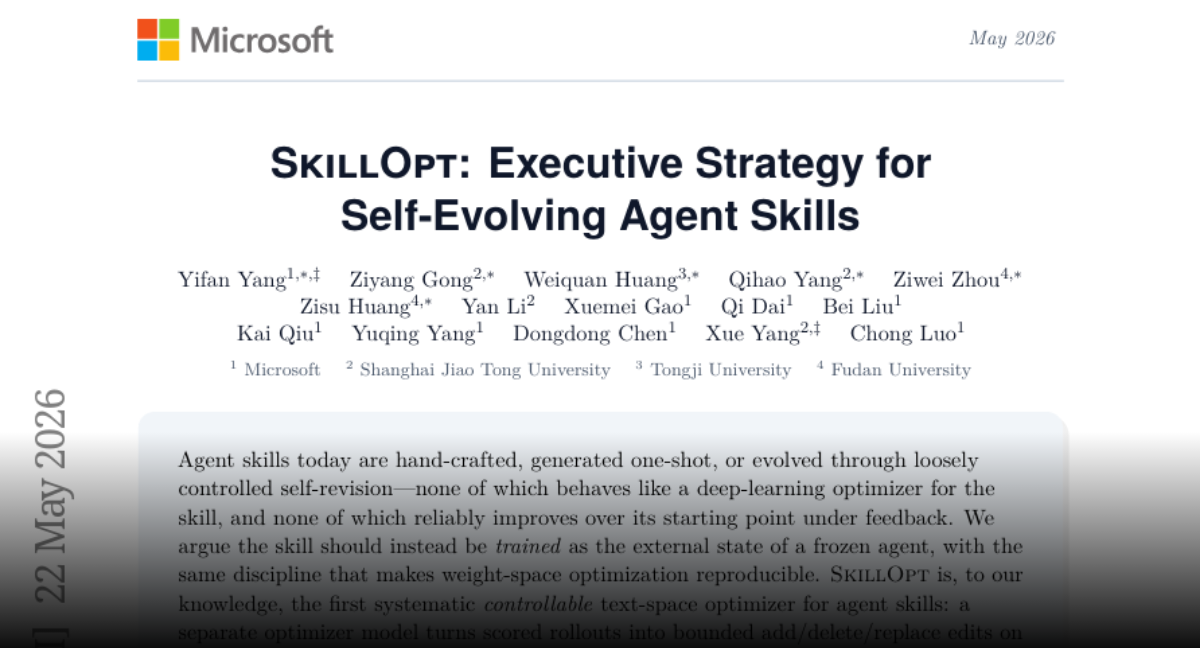
The paper, from Microsoft and academic collaborators, describes SkillOpt as a text-space optimizer for frozen LLM agents. Instead of changing model weights, it trains reusable natural-language skill documents from scored execution trajectories. A separate frontier optimizer model proposes bounded add, delete, and replace edits to a single skill file; candidate skills are accepted only when they improve a held-out validation split; rejected edits are retained as negative feedback. The deployed artifact is intentionally small: a best_skill.md file of roughly 300 to 2,000 tokens.
That framing matters more than the benchmark table. The target model and harness stay fixed. The thing being improved is the procedural layer around the agent: what to check, how to use tools, when to revise, which failures imply which next action, and how to avoid repeating mistakes. In other words, SkillOpt is optimizing the part of agent systems that many production teams already rely on but rarely test with anything resembling discipline.
The benchmark result is strong; the lifecycle idea is stronger
SkillOpt reports results across six benchmarks, seven target models, and three execution harnesses: direct chat, a Codex-style agentic loop, and a Claude Code-style agentic loop. The paper says SkillOpt is best or tied-best on all 52 evaluated model, benchmark, and harness cells. On GPT-5.5 direct chat, it lifts average no-skill accuracy by 23.5 points. In Codex-style execution, the lift is 24.8 points. In Claude Code-style execution, it is 19.1 points.
The per-task numbers are the kind that make benchmark readers sit up: SearchQA moves from 77.7 to 87.3, SpreadsheetBench from 41.8 to 80.7, OfficeQA from 33.1 to 72.1, DocVQA from 78.8 to 91.2, LiveMathematicianBench from 37.6 to 66.9, and ALFWorld from 83.6 to 95.5 in the cited GPT-5.5 direct-chat setting. SkillOpt also beats the strongest per-cell baseline drawn from human-written skills, one-shot LLM skills, Trace2Skill, TextGrad, GEPA, and EvoSkill by 5.4 points on average in that setting.
Those claims deserve independent replication, especially because skill optimization can overfit to benchmark conventions just as models can. But the interesting part is not merely that the optimized prompt-like artifact performs better. The interesting part is that the paper treats skill evolution like a software process. There are rollout batches, edit budgets, validation gates, rejected-edit buffers, and a deployable artifact. That is the beginning of a lifecycle.
The GitHub repo makes the analogy explicit: train agent skills with epochs, mini-batch size, learning rates, and validation gates, but without touching model weights. That should be a familiar shape to teams that already know how to ship code and ML systems. The difference is that the artifact is readable prose instead of a binary model checkpoint.
Skills are supply chain, not stationery
Here is the practitioner problem SkillOpt is quietly pointing at: every agent platform is growing a procedural supply chain.
Codex, Claude Code, Cursor-style tools, Gemini CLI/Antigravity-style systems, local Qwen setups, browser agents, spreadsheet agents, and internal support agents all need operating instructions. Those instructions can alter behavior as meaningfully as code. A skill can tell an agent to run a command, trust a file, ignore a warning, call a tool, summarize an output, or escalate to a human. If that skill is wrong, stale, overbroad, or malicious, the model’s competence only makes the blast radius larger.
That is why the portability result is important. SkillOpt reports that a Codex-trained spreadsheet skill transfers to Claude Code with a 59.7 point gain, along with other cross-model and nearby-benchmark transfer results. If that holds up outside the paper, skills become more than tool-specific prompt patches. They become portable runtime artifacts: inspectable, testable, reusable across agents, and potentially governed by the same controls that apply to code, CI configuration, or deployment scripts.
That does not make them automatically safe. Natural language is inspectable, but it is also ambiguous. A skill can encode brittle heuristics in perfectly readable prose. It can pass a validation set while teaching the agent a shortcut that fails in production. It can optimize for benchmark accuracy while increasing review burden, command risk, or false confidence. The validation gate protects only against the distribution it sees.
Still, “not automatically safe” is not an argument for prompt folklore. It is an argument for better process. Teams should put skills under version control, review skill diffs, attach tests to skill changes, record which model and harness produced a skill, keep rejected edits and failure cases, and measure both task success and human review burden. If a skill changes how an agent uses tools, credentials, files, or external services, it deserves the same scrutiny as code that changes a deployment pipeline.
The right abstraction for enterprise agents
SkillOpt also lands in the middle of a larger market shift. Coding-agent comparisons are moving beyond “which model writes the prettiest function?” The serious questions now are about operating surfaces: permissions, sandboxes, audit logs, hooks, approvals, scoped tokens, observability, cost routing, and procedural memory. A platform that can manage agent skills cleanly may matter as much as a platform with a slightly stronger base model.
For engineering leaders, the immediate takeaway is boring in the best way. Inventory the instructions your agents already depend on. Split them into policy, domain procedure, workflow preference, and temporary workaround. Move durable instructions into versioned files. Give them owners. Test them against representative tasks. Track regressions. Make it easy to roll back. Do not let “the prompt” become an unreviewed production dependency because it happens to be written in English.
For tool vendors, SkillOpt is a warning shot. The next durable agent feature may not be another chat surface. It may be skill lifecycle management: authoring, training, validation, sharing, permissions, provenance, diff review, environment targeting, and revocation. That is the layer enterprises will ask for once agents start operating across real repos and workflows.
There is a nice irony here. The model stays frozen, and the thing that learns is a text file. That sounds primitive until you remember how much of software engineering is disciplined text files wrapped in tooling. SkillOpt’s bet is that agent behavior can improve the same way: not through magic prompts, but through artifacts that can be trained, reviewed, shipped, and reverted.
That is the right direction. If agents are going to become part of the engineering runtime, their skills cannot remain folklore. They need to become infrastructure.
Sources: Hugging Face Papers, arXiv, Microsoft SkillOpt GitHub repo