Slack Is Becoming the Agent Runtime Surface, Which Means Context Is Now a Product Decision

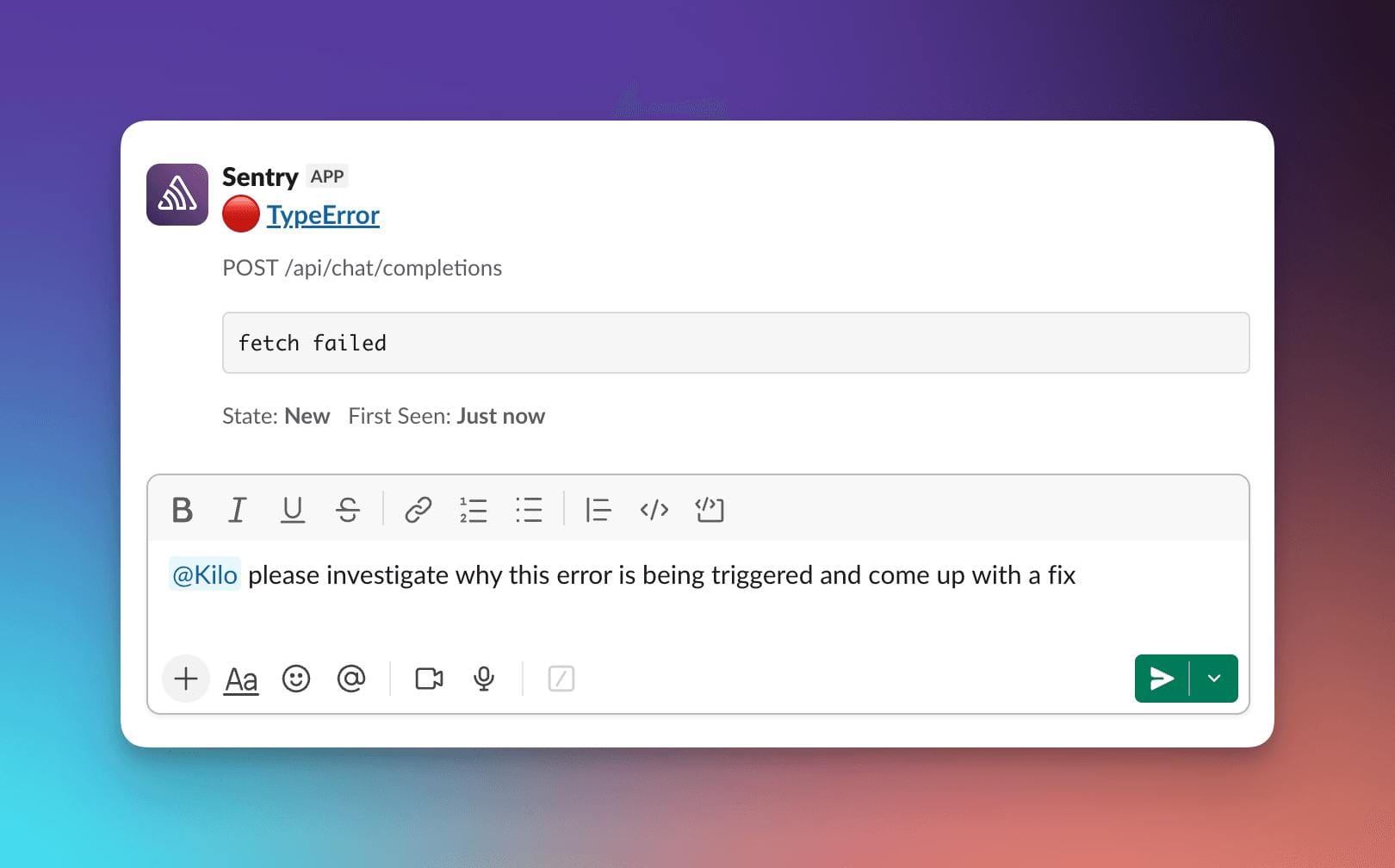
The least interesting version of “AI in Slack” is a chatbot that answers questions where coworkers happen to be talking. The interesting version is a runtime boundary: a place where product context, incident context, customer context, repo permissions, agent identity, and audit trails collide. Kilo for Slack is worth covering because it points at that second version. The agent is not just joining a chat. It is moving the starting line of software work out of the IDE and into the conversation where the work was born.
The HackerNoon piece from Kilo describes a simple interface: mention @Kilo in a Slack thread. The bot reads the full thread, uses connected GitHub or GitLab repos, answers questions, or spins up a Cloud Agent that creates a branch, pushes commits, and opens a pull request. Kilo says this uses the same workspace, credits, billing, GitHub/GitLab integration, model settings, and agentic infrastructure as its IDE and CLI surfaces, with “500+ models” selectable through integration settings. Sessions are positioned as continuous across surfaces, so a job that starts in Slack can continue later in VS Code rather than becoming yet another orphaned AI chat.
That is the pitch. The production question is whether chat is being treated as a convenience layer or as an execution surface with real policy.
Slack is where the requirements actually leak out
Most engineering organizations already know the real bug report rarely arrives as a clean ticket. It shows up as a stack trace in #engineering, a PM asking whether a flow is feature-flagged, a support note from an angry enterprise customer, or an incident thread where three people have partial context and nobody has opened the editor yet. The developer becomes the bridge: copy the trace, paste it into an IDE assistant, explain what the thread already said, ask for analysis, paste the answer back, then repeat when someone asks a follow-up.
That “context shuttle” work is invisible in most productivity discussions because it is not a dramatic failure. It is just ten minutes here, twelve minutes there, and a steady tax on focus. Kilo’s argument is that the agent should go to the conversation instead of making the conversation move to the agent. That is directionally correct. Context switching is not just about clicks; it is about decisions. Which interface do I use? Which repo matters? Is this worth interrupting my work? What did the PM mean by “checkout bug”? Where do I paste the answer so the next person sees it?
A Slack-native agent can remove some of that overhead. A teammate posts an error trace; the bot can inspect the relevant file and explain the failure in-thread. A product manager asks whether a feature flag exists; the bot can check config and answer without pulling a developer into a half-hour detour. A repetitive change needs to land in three repos; the bot can open three PRs and let humans review them like ordinary work. None of this is cinematic. That is the point. Good workflow infrastructure usually looks boring when it works.
The dangerous part is that Slack feels informal
The same property that makes Slack attractive makes it risky. Slack is conversational, fast, and socially lightweight. People say “can someone fix this?” in a thread without thinking they just initiated a code-change request. If an agent can read that thread, inspect repos, create branches, push commits, and open PRs, the organization has turned a chat message into a workflow trigger. That is useful. It is also a permission boundary, whether the product admits it or not.
Teams evaluating Slack agents should start with scoping. Which channels may invoke the agent? Which repositories are connected? Can a product channel ask questions but not trigger writes? Can an incident channel trigger branches only in specific repos? Are private channels excluded by default? Can admins revoke a channel’s access without breaking every existing workspace integration? If the tool’s answer is “trust the Slack workspace,” it is not mature enough for serious engineering use.
Identity needs the same treatment. A thread mention should not become ambient authorization. The agent needs to know who asked, what role they hold, which repo permissions they have, whether the request maps to code-writing authority, and whether a human must approve the transition from explanation to modification. “Answer this question” and “ship this patch” are different verbs. A good Slack agent should preserve that distinction instead of hiding it behind one cute bot mention.
Auditability is the other hard requirement. If a PR appears because someone tagged @Kilo, the PR should link back to the Slack thread, the Slack thread should link to the PR, and the session should record which messages were used as context. The agent should be able to cite the specific thread statements that informed the change. It should also record the model, files inspected, files modified, tests run, assumptions made, and places where it refused or asked for clarification. Without that, Slack-native coding becomes very efficient folklore.
Session continuity is the actual product moat
The most promising claim in Kilo’s piece is not that the agent can open a PR from Slack. Plenty of tools can bolt a cloud runner onto chat. The stronger claim is continuity: the same Kilo workspace, same credits, same billing, same repo integrations, same model settings, and sessions that can move between Slack and VS Code.
That matters because the industry has enough AI sidecars already. A separate Slack bot with separate memory, separate permissions, separate model selection, and separate billing line creates a new context silo while pretending to solve context switching. The durable version is a shared session graph: the conversation that started the task, the code state the agent saw, the decisions it made, the PR it opened, the review feedback it received, and the follow-up question that came two days later. That graph is where governance, observability, and developer experience meet.
For AI-framework builders, Slack is a test of whether “agent runtime” means anything beyond a prompt loop. The runtime needs channel policy, repo policy, user identity, tool permissions, model routing, session storage, cost attribution, and a reviewable audit trail. It also needs good refusal behavior. The bot should say “I can answer this, but I cannot modify that repo from this channel” without making the user decode an admin console.
Practitioners should run evaluation tasks before letting a Slack agent loose. Ask it to answer a question from a thread with ambiguous requirements. Ask it to explain which messages it used. Ask it to open a small PR and inspect branch naming, commit attribution, test output, and review links. Ask whether it can operate in read-only mode. Ask what happens when a non-engineer tags it. Ask how billing is attributed when a thread involves ten people but one bot mention triggers an expensive model run.
The editorial take is simple: Slack-native agents are not a novelty category. They are the next integration battle for AI frameworks because the most valuable context is increasingly conversational, not textual in the repo. The winners will not be the bots that make Slack feel like sudo with GIFs. They will be the systems that treat chat as an audited runtime surface and still make the workflow feel lightweight.
Sources: HackerNoon / Kilo, Kilo Blog