StepAudio 2.5 Is a Reminder That Voice Agents Need Foundation Models, Not Three Glued-Together Demos

Voice agents keep failing the same product review: they can talk, but they still do not quite listen.
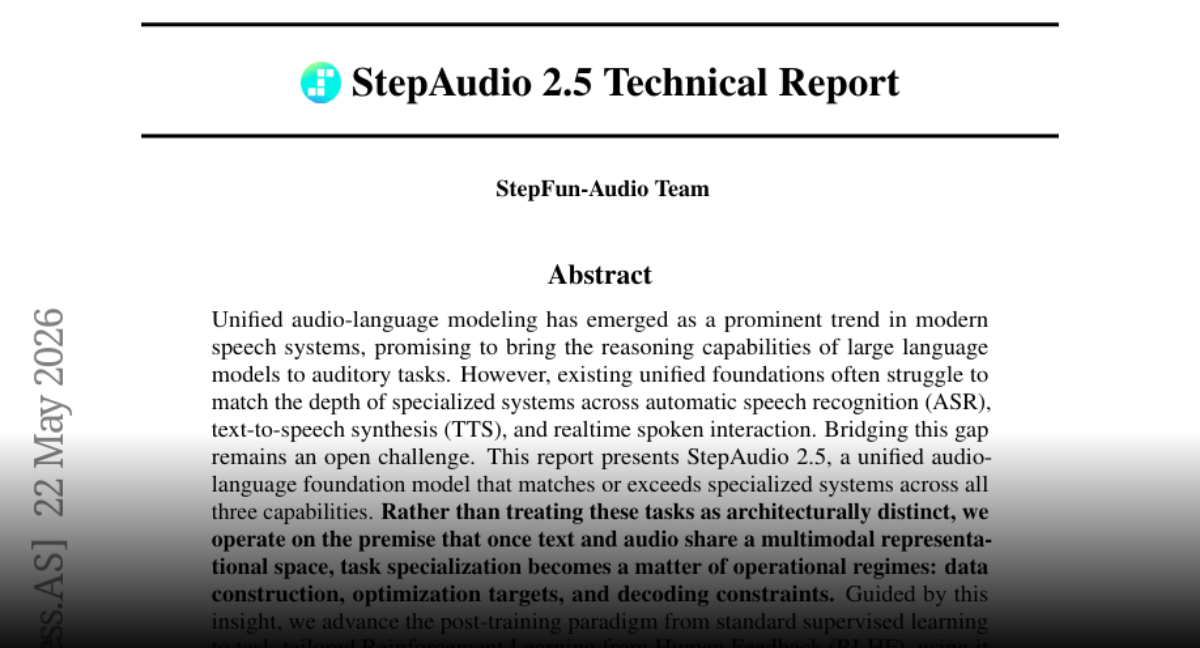
That is the useful lens for StepFun’s StepAudio 2.5 technical report, which surfaced on Hugging Face Daily today after an arXiv v1 posted on May 22. The paper is not interesting because it adds another line to the speech benchmark spreadsheet. It is interesting because it argues, correctly, that automatic speech recognition, text-to-speech, and realtime spoken interaction are not three separate demos to be duct-taped together with a chat model in the middle. They are different operating modes of the same audio-language system.
Most production voice stacks still look like a relay race: audio goes into ASR, text goes into an LLM, text comes out, TTS turns it back into audio, and the orchestration layer tries to hide the seams. That architecture is understandable. It is modular, observable, and lets teams swap vendors when one component gets better. But it also throws away signal at exactly the points where spoken interaction gets hard: hesitation, timing, interruption, emphasis, emotion, speaker changes, and whether a pause means “I am done” or “do not interrupt me yet.”
StepAudio 2.5 is a technical report, not a shipping platform, so the right response is not to rip out your voice stack tomorrow. The right response is to update the evaluation checklist. If you are building voice agents, component accuracy is no longer enough. You need to measure whether the whole loop preserves conversational context.
The architecture is the argument
The paper describes StepAudio 2.5 as a unified audio-language foundation model spanning ASR, TTS, and realtime spoken interaction. Architecturally, it follows an audio-encoder → adaptor → LLM-decoder pattern, initialized from a textual MoE LLM and continually pretrained on a mix of text and audio. The training numbers are not small: StepFun reports 2.2T tokens of text and audio data, including 3B tokens of ASR data for initial speech-text alignment, a main multimodal mix of 800B text tokens and 800B speech tokens, a 128B-token warmup, and a 600B-token cooldown that increases sequence length to 32K.
That 32K context matters because long-form audio is where naive segmentation quietly breaks products. Meeting transcripts, interviews, lectures, support calls, and agent conversations do not naturally arrive as clean 30-second benchmark clips. They contain callbacks, corrections, overlapping context, and domain-specific terms introduced earlier. StepAudio 2.5 reports a 3.70% average error rate on long-form transcription and argues that native long context reduces boundary errors that appear when systems slice audio into chunks and hope the stitching works. Anyone who has debugged a transcript where the first half of an acronym got separated from the second half knows this is not academic.
The model’s ASR benchmark claims are strong: Chinese average CER of 2.97%, including 0.71% on AISHELL-1 and 2.63% on FLEURS zh; English average WER of 3.68%, including 1.38% on LibriSpeech clean and 2.76% on VoxPopuli cleaned AA. But the more practical number is the reported real-time factor of 0.0053 on 100 clips of 30 seconds each. Accuracy is only deployable if latency stays out of the user’s way. A voice agent that is “nearly human” after a pregnant pause is still a bad phone tree with better branding.
MTP-5 is the kind of boring trick that makes systems ship
The most builder-relevant detail is StepAudio 2.5’s MTP-5 decoding head for ASR. Instead of generating transcript tokens strictly one at a time, one decoding step proposes six transcript tokens and then accepts only the verified prefix. In the paper’s framing, MTP-5 is the sweet spot: moving from MTP-3 to MTP-5 gives a 39% gain in average accepted length, while MTP-7 adds only about 22% and creates more rollback overhead.
This is the part that should make engineers pay attention. The frontier in AI products is increasingly not “bigger model wins.” It is speculative execution, cache behavior, routing, context management, tool boundaries, and decoding constraints. MTP-5 is a systems decision wearing a model-paper jacket. It trades complexity against latency and accuracy in a way that resembles real product engineering, not leaderboard decoration.
For teams building speech products, that distinction matters. A cascaded stack can still be the better choice if it is cheaper, easier to observe, easier to constrain, and easier to debug. But if a unified model can preserve enough acoustic and conversational signal while staying fast, it starts to solve problems that modular pipelines create for themselves. The question is not “unified versus cascaded” as ideology. The question is where your product loses information, and whether that lost information is actually important to the task.
Voice alignment is not just politeness with a better microphone
The report also leans into task-specific post-training and RLHF. That deserves more scrutiny than the usual alignment paragraph gets. For chat models, preference tuning often means helpfulness, harmlessness, refusal style, and instruction following. For voice agents, “good” also includes interruption behavior, timing, emotional appropriateness, expressiveness, speaker adaptation, and whether the assistant sounds attentive without drifting into uncanny customer-service theater.
That means voice-agent evaluation has to be more product-shaped than ASR WER plus TTS MOS. Teams should test full-loop latency, barge-in behavior, noisy rooms, multilingual switching, speaker changes, long meetings, domain vocabulary, transcript repair hallucinations, and whether the generated voice preserves the intended persona after a long context. They should measure task success, not just component metrics. If the agent transcribes perfectly but responds at the wrong moment, the product still failed.
There is also a governance angle. Unified audio-language systems may reduce handoff loss, but they can make failures harder to inspect. In a modular pipeline, you can often tell whether ASR, retrieval, reasoning, or TTS caused the problem. In a more unified architecture, teams need stronger tracing, intermediate representations, confidence signals, replay tooling, and policy controls. Otherwise you trade brittle seams for a black box with better demos.
The useful takeaway is not “switch models”; it is “change the test”
StepAudio 2.5 enters a crowded field that includes Whisper-style ASR, commercial TTS systems such as ElevenLabs-v3, Minimax Speech-2.8-hd, and Gemini-Flash-TTS, plus realtime systems such as GPT-realtime, Gemini Live, Doubao Realtime, Step-Audio 2, and Qwen3-Omni. The paper’s comparisons are useful, but they are still author-reported. Hugging Face showed 30 upvotes during research, and there was no visible Hacker News debate yet, which is probably healthy. This is not a mass-market hype launch. It is a technical report that matters most to people currently discovering how hard voice products are after the demo works.
So what should practitioners do?
First, stop evaluating voice stacks as independent boxes. Run end-to-end tasks: book an appointment, summarize a noisy meeting, handle an interrupted support call, translate a multilingual conversation, control an app by voice, or maintain a long spoken tutoring session. Compare cascaded and unified systems on completion rate, latency, recoverability, observability, and cost per successful task.
Second, treat paralinguistic signal as product data. If your use case depends on urgency, uncertainty, emotion, speaker identity, turn-taking, or long context, a text-only middle layer may be throwing away the thing you need. If your use case is command-and-control with narrow vocabulary, the boring modular stack may still win. Complexity has to earn rent.
Third, demand deployment facts before betting the roadmap: licensing, model availability, streaming APIs, hardware requirements, privacy posture, multilingual behavior under real noise, and independent evaluations. A 2.2T-token training recipe and strong benchmark table are not the same thing as a maintainable production system.
The broader signal is that specialized foundation models are becoming runtime architecture. Coding agents, browser agents, security agents, robotics models, and now voice systems all point in the same direction: the model has to internalize more of the environment instead of treating the world as text with attachments. StepAudio 2.5 is worth reading because it makes that argument in a domain where the seams are easy to hear. The next good voice agent will not just have better speech-to-text and nicer speech synthesis. It will preserve enough of the conversation that users stop noticing the plumbing.
Sources: Hugging Face Papers, arXiv, arXiv HTML