Tencent's Hy3 Shows the Free-Tier Leaderboard Effect Is Real

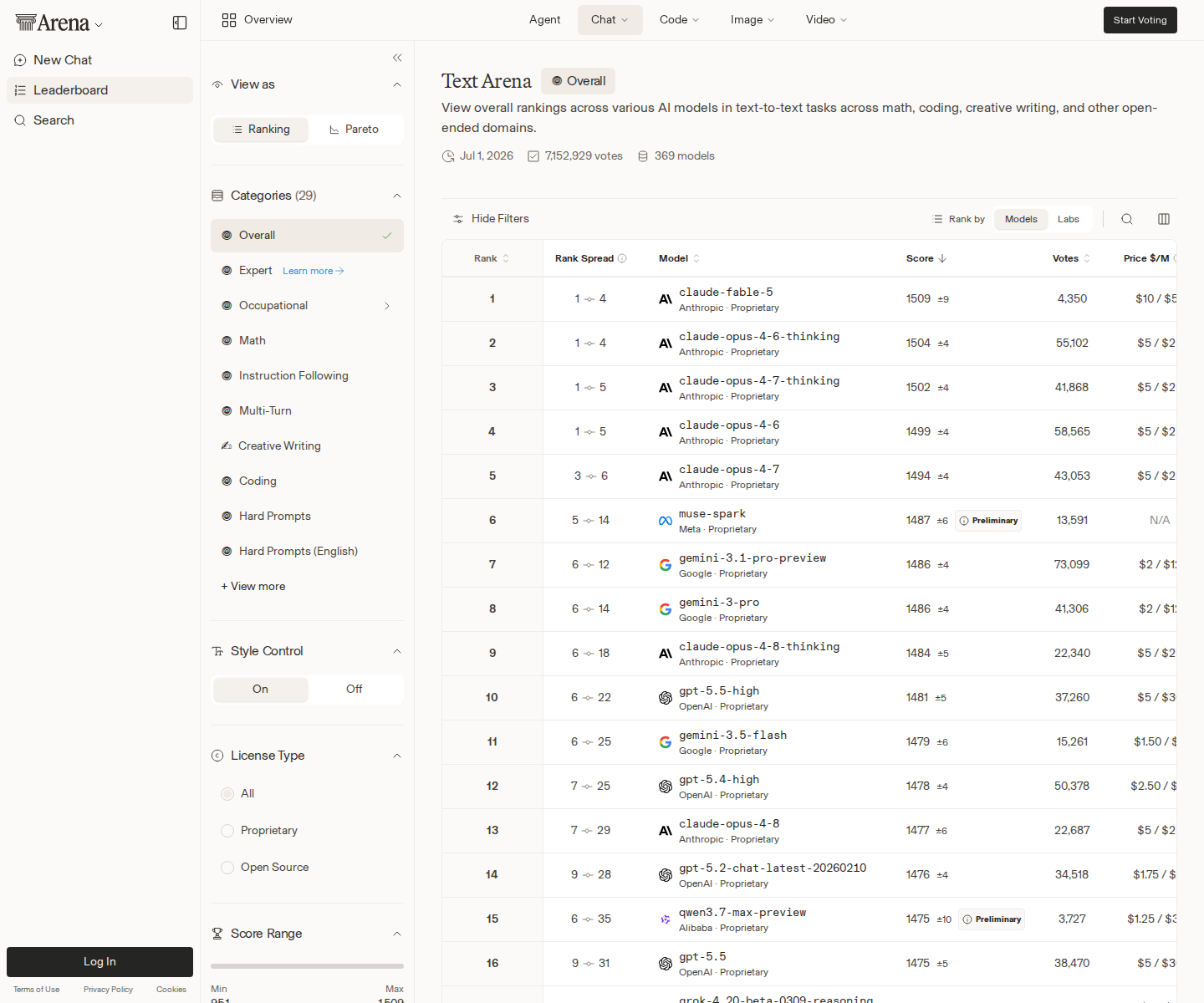
The interesting LLM ranking this week is not on the board everyone argues about. Arena AI's text leaderboard was basically frozen: Anthropic still owns the top cluster, Google and OpenAI are still bunched close behind, and nobody broke into the top 20. The real movement came from OpenRouter, where Tencent's Hy3 free route jumped six places to rank 8 with 1.90 trillion weekly tokens.
That is the kind of signal builders should pay attention to, because it is closer to production behavior than prestige benchmarking. Arena tells you which models win blind preference battles. OpenRouter tells you what developers are actually routing tokens through when cost, latency, availability, context length, and API convenience all collide. This week, the answer was simple: free capable inference moves fast.
Hy3's paid or preview route did not collapse, which matters. OpenRouter showed Hy3 preview at rank 9 with 1.82 trillion weekly tokens and 51% week-over-week growth. The free route moving ahead of it looks less like cannibalization and more like expansion: Tencent added a cheaper door and a lot more people walked into the building.
A usage leaderboard is not an Elo leaderboard
Arena's top 20 remained unchanged in the captured snapshot. The top five were all Anthropic-branded: claude-fable-5 at 1509 Elo, claude-opus-4-6-thinking at 1504, claude-opus-4-7-thinking at 1502, claude-opus-4-6 at 1499, and claude-opus-4-7 at 1494. Meta's muse-spark, Google's Gemini 3 family, OpenAI's GPT-5.5 and GPT-5.4 variants, Alibaba's qwen3.7-max-preview, and xAI's grok-4.20 beta models filled out the rest of the visible pack.
That leaderboard still says something useful: Anthropic's high-end models remain hard to beat in preference testing, especially when reasoning variants are allowed to show their work. But the absence of Arena movement is the point. A model does not need to become the new blind-eval champion to become operationally relevant. It only needs to become good enough, cheap enough, and easy enough to try.
OpenRouter's ranking is a different instrument. Its top 20 mixed DeepSeek, Xiaomi, MiniMax, Z.ai, Anthropic, Tencent, Stepfun, OpenAI, Nvidia, Google, Poolside, and others. That is not a clean map of model quality. It is a messy map of developer demand under real constraints. In practice, that mess is valuable. Most teams do not buy models the way benchmark spectators rank them; they buy capacity to solve a workload at an acceptable failure rate.
Hy3 is now sitting directly inside that buying conversation. OpenRouter lists the free route at $0 per million input tokens and $0 per million output tokens, with a 262,144-token context window. Even if the route is capacity-limited or temporary, the incentive is obvious. Teams can run evaluation sets, agent experiments, long-context retrieval tests, and batchy exploratory workloads without watching the meter spin.
Tencent is selling reach before loyalty
Tencent describes Hy3 as a 295-billion-parameter Mixture-of-Experts model with 21 billion active parameters, 3.8 billion MTP layer parameters, 80 layers, 192 experts, and top-8 routing. The company says the release followed a late-April preview and incorporated feedback from more than 50 products. That detail is worth more than the usual benchmark slide because it implies the model has been pushed through product-shaped failure modes, not just contest-shaped prompts.
The model card claims a 270-expert blind evaluation score of 2.67 out of 4, ahead of GLM-5.1 at 2.51. Tencent says the largest advantages appeared in frontend development, data and storage, and CI/CD tasks. It also reports internal reliability improvements: hallucination rate down from 12.5% to 5.4%, commonsense error rate down from 25.4% to 12.7%, and multi-turn issue rate down from 17.4% to 7.9%.
Those numbers should not be swallowed whole. Vendor reliability metrics are usually defined around the vendor's own test harness, and the gap between "lower hallucination rate" and "safe in your production agent" is still a canyon with a nice benchmark sign in front of it. But the direction is credible enough to justify hands-on testing, especially because the OpenRouter usage data says developers are already doing exactly that.
The GitHub repo is young, created on July 2 and updated July 9, and had 377 stars and 55 forks when checked. That is not a mass-adoption event. It is enough to show early developer curiosity, and the token volume is the better signal anyway. Stars are applause; 1.90 trillion weekly tokens is people kicking the tires with actual workloads.
The strategic read is that Tencent is using price and distribution to buy evaluation surface area. That is a smart move in a market where model loyalty is thin. Developers have spent the last two years learning to swap providers behind compatibility layers, routers, and eval harnesses. If a model is OpenAI-compatible, reasonably strong at coding and tool use, and free to test at scale, it can enter the shortlist before the procurement conversation even begins.
What engineers should do while the route is cheap
The correct response is not to migrate production traffic because a leaderboard moved. The correct response is to add Hy3 to your evaluation matrix now, while the marginal cost of learning is unusually low. Start with workloads where price normally suppresses experimentation: large-context document analysis, repository-wide coding assistance, synthetic test generation, log summarization, and agent loops that burn tokens during planning or retries.
Measure the boring things. Does Hy3 produce valid structured output under your schemas? Does it call tools with stable arguments? Does it follow refusal and data-handling policies? Does it degrade gracefully when retrieval context is noisy? Does it keep multi-turn state straight after ten or twenty tool calls? A 262K context window is only useful if the model can reliably use what you put inside it. Otherwise you have built an expensive, or in this case subsidized, junk drawer.
Compare the free route against the preview route and against your incumbent models. Free provider routes can change behavior, throttling, latency, and availability without much ceremony. If Hy3 performs well, pin exact model identifiers, log route metadata, capture latency percentiles, and keep a fallback path to paid Hy3, GLM, DeepSeek, Claude Sonnet or Opus, Gemini Flash, or whatever your current baseline is. Cheap inference is only cheap if retries, human review, and incident risk do not quietly move the bill somewhere else.
There is also a self-hosting caveat. "Open weights" does not mean "cheap to operate." Tencent's deployment notes point toward serious infrastructure, recommending eight large-memory GPUs in the H20-3e class for self-hosting. For most teams, the free OpenRouter route and the model artifact are different products. One is a distribution wedge. The other is an infrastructure project.
The broader market lesson is sharper than the model-specific one. Usage leaderboards are becoming price/performance leaderboards with social proof attached. They surface the models builders actually test when the economic friction falls away. That makes them noisier than Elo boards, but arguably more useful for engineering leaders who have to decide where to spend evaluation time.
Hy3's jump does not prove Tencent has the best model. It proves a capable model with a free, easy route can bend developer behavior before it wins the prestige contest. That is the race to watch: not just who has the highest score, but who can make serious evaluation feel cheap enough that teams do it by default.
Sources: OpenRouter rankings, Tencent Hy3 model card, Tencent-Hunyuan Hy3 GitHub repo, OpenRouter Hy3 free model page, OpenRouter model catalog API, Arena AI leaderboard