The LLM Quality Table Froze. Developer Traffic Went Shopping

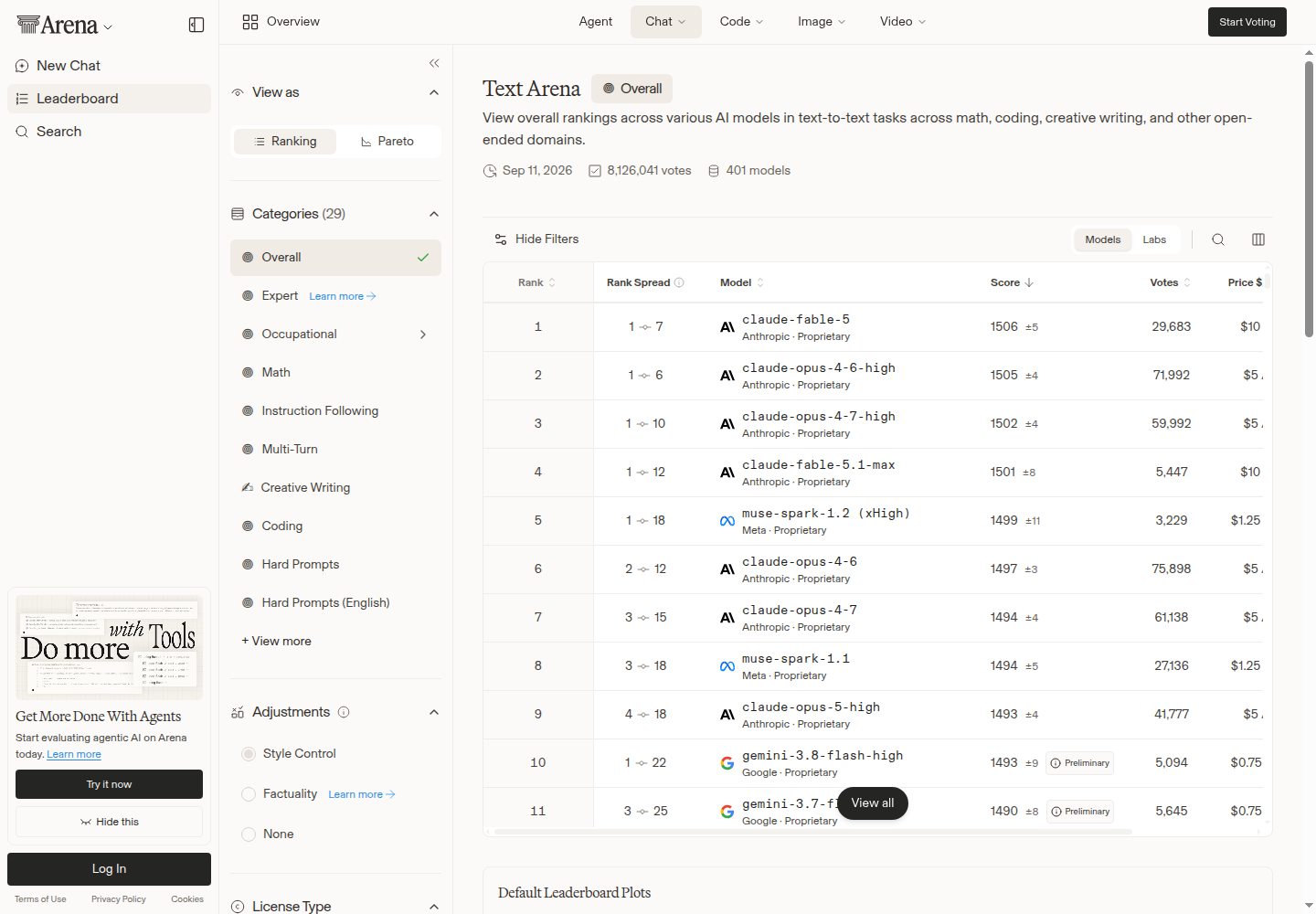
The most useful LLM leaderboard result this week is the one that did not move. Arena's text top 20 was frozen, with Anthropic holding seven of the first nine positions and the first four outright. At the same time, OpenRouter's usage chart reshuffled at the top, promoted two fast-growing models, and admitted a free coding model at the cutoff. Quality preference looks stable; developer traffic emphatically does not.
That split matters more than another model horse race. Arena asks people to compare outputs in blind battles. OpenRouter counts prompt and completion tokens routed through its marketplace. One is a noisy measure of human preference; the other is a noisy measure of deployment behavior. Neither answers “what is the best model?” But read together, they expose how engineering teams actually choose: capability sets the shortlist, while price, availability, context length, release timing, and free access decide where a surprising amount of production traffic lands.
A stable quality hierarchy meets a volatile routing market
Arena's leaders remained claude-fable-5 at 1507 Elo, claude-opus-4-6-high at 1505, claude-fable-5.1-max at 1504, and claude-opus-4-7-high at 1502. Meta's muse-spark-1.2 (xHigh) followed at 1499. Four Elo points separate first from fourth, and only eight separate first from fifth. Those are rankings worth watching, not cleanly separated performance tiers. Small score gaps should make procurement teams more curious, not more certain.
OpenRouter tells a different story. Tencent's Hy4 preview stayed first with 19.1 trillion weekly tokens, down slightly from 19.7 trillion in the previous rolling window but still 34% ahead of GPT-5.6 Luna's 14.2 trillion. DeepSeek V4 Flash 0731 moved into third at 12.4 trillion tokens, barely passing GLM 5.3 Flash at 12.3 trillion. MiMo-V2.5 also climbed one place into fifth, ahead of the older DeepSeek V4 Flash 0423.
The 0.1 trillion-token difference between DeepSeek and GLM sounds large until it is divided by the totals involved: it is roughly 0.8%. Because this is a trailing seven-day window, the ordering can reverse simply as an unusually busy day falls out of the calculation. A rank badge gives false precision to what is effectively a tie. Teams should resist turning a one-day chart change into an architecture decision.
Hy4 is nevertheless an interesting candidate. Tencent describes the preview as a 770-billion-parameter mixture-of-experts model that activates 49 billion parameters per token, supports more than one million tokens of context, and costs $0.834 per million input tokens, $2.501 per million output tokens, and $0.042 per million cache-hit tokens. Tencent also reports a 31.8% end-to-end throughput improvement from operator fusion and communication optimization.
Those details explain why builders might try it, but they do not close the evaluation. Tencent's own blind study used 163 experts across 203 engineering tasks and gave Hy4 an average 2.99 out of 4, versus 2.94 for Kimi K3 and 2.92 for GLM-5.3. Vendor tests are useful hypotheses. They are not procurement evidence, especially when reproduction details are incomplete and the measured gaps are narrow.
Free tiers are distribution, not proof
The biggest percentage movers deserve the same skepticism. Gemini 3.8 Flash rose to tenth with 2.6 trillion weekly tokens and 691% growth against the prior seven-day period. Meta's Muse Spark 1.3 Contributor jumped three places to thirteenth with 1.89 trillion tokens and growth above 999%. Those numbers show a surge in attention, but explosive percentages often reveal a small or partial comparison base as much as durable adoption. The next two snapshots will be more informative than this one.
Poolside's Laguna S 2.1 free variant entered at number 20 with 1.17 trillion tokens, displacing Claude Sonnet 4.6. This is arguably the most actionable movement in the table. Laguna exposes streaming, reasoning, tools, and tool choice through OpenRouter, so it can participate in agentic coding workflows instead of serving only as a chat demo. A free, tool-capable coding model is an obvious canary candidate for test generation, repository indexing, first-pass issue triage, and draft refactors guarded by deterministic checks.
It is not yet an obvious production default. Free traffic measures willingness to experiment, not willingness to pay. It says nothing by itself about rate-limit stability, support, data governance, capacity under sustained demand, or what happens when the subsidy ends. The recurring mistake in AI infrastructure is to treat distribution as capability and introductory economics as permanent economics. A chart can reveal where developers are looking; it cannot tell you whether the floor will still be there next quarter.
The mismatch is starkest around Anthropic. The company owns most of Arena's top tier but has only two entries in OpenRouter's top 20, at numbers 15 and 19. That does not mean developers dislike Claude, nor that Tencent has overtaken Anthropic in overall adoption. Direct provider traffic is invisible to OpenRouter, and marketplace users are unusually sensitive to price and cross-provider availability. The defensible conclusion is narrower: small quality advantages do not automatically win routing volume when alternatives are cheaper, newer, easier to access, or temporarily free.
Turn rankings into a test queue, not a migration plan
Engineers should use the usage chart as a candidate generator. Put Hy4, Gemini 3.8 Flash, Muse Spark 1.3, and Laguna S 2.1 into a private evaluation built from representative traces. Measure task success, tool-call correctness, p50 and p95 latency, tokens per successful task, and total cost after retries. For coding agents, add patch acceptance rate, test-pass rate, recovery from failed tool calls, and context degradation over long sessions.
That “per successful task” denominator is the important part. OpenRouter counts prompt and completion tokens, and upstream providers supply their own tokenizers, so raw totals are not perfectly comparable. Tokens are not requests, users, spend, or completed work. A model that costs half as much per token but emits twice as many tokens, retries more often, or needs human cleanup is not cheaper. Conversely, a pricier model that reliably finishes a tool-heavy workflow may win on total engineering cost.
Teams also need a persistence rule. Require a model to hold its movement for three consecutive daily snapshots, or to establish a material gap, before changing default routing. New entrants can receive a small canary allocation immediately, with explicit rollback thresholds. That approach captures emerging value without converting leaderboard churn into operational churn.
Long context deserves its own test rather than a checkmark in a feature matrix. Hy4's million-token window makes it plausible for large codebases and extended agent sessions, but capacity is not accuracy. Evaluate retrieval at the context lengths your workloads actually reach, seed facts at different depths, measure tool selection after long histories, and track whether completion quality falls as the window fills. Buying a million-token context window is pointless if the model reliably uses only the last fraction of it.
The broader lesson is that LLM selection has become a routing discipline. Preference leaderboards can establish a capability prior; marketplace usage can surface new candidates and economic pressure; neither can replace workload-specific evidence. Anthropic's Arena dominance and Tencent's OpenRouter lead can both be true because they measure different layers of the stack.
So watch the charts, but do not salute them. This week's movement says developers are aggressively testing newly available and low-cost models beneath a stable quality ceiling. The right response is a canary and an eval suite, not a migration announcement. The leaderboard is a git diff, not an approval.
Sources: OpenRouter LLM Rankings, Tencent Hy4 preview announcement, OpenRouter Laguna S 2.1 model page, OpenRouter rankings dataset documentation, and Arena Text Leaderboard. OpenRouter ranking data as of September 10, 2026; licensed CC BY 4.0.