The Model Market Is Splitting: Open Weights Own Volume While GPT-5.6 Buys Speed

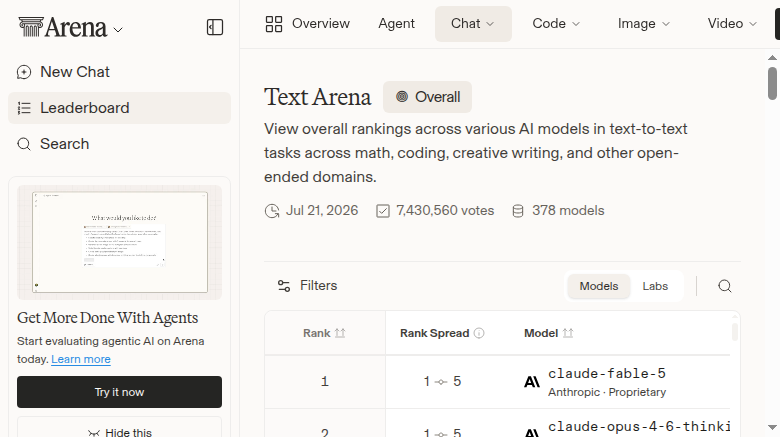
The most useful model leaderboard this week is the one that refuses to crown a winner.
Arena AI’s preference board did not move at all: Anthropic still holds six of the first seven positions, led by Claude Fable 5 at 1507 Elo, with Claude Opus 4.6 Thinking two points behind. OpenRouter’s usage chart, meanwhile, is behaving like a market in price discovery. DeepSeek V4 Pro climbed into fifth place, paid Hy3 jumped from tenth to eighth, and GPT-5.6 Sol entered at number 20. Those results are not contradictory. They expose the split that engineering teams are already building into production: cheap models process the bulk of the work, while expensive frontier models are reserved for moments where better reasoning, lower latency, or fewer failed attempts can justify the bill.
That distinction matters because “most used” and “best” are being flattened into the same claim far too often. Arena asks people which answer they prefer in a head-to-head comparison. OpenRouter counts deployed tokens. A token is not a completed task, a correct patch, or a dollar of value, and free endpoints can produce oceans of tokens through experiments and disposable agent loops. Ranking models by token volume is roughly like ranking databases by query count: interesting operational evidence, terrible as a universal quality score.
The center of gravity is outside the familiar three vendors
OpenRouter’s top three make the shift hard to dismiss. Xiaomi’s MiMo-V2.5 leads with 9.81 trillion weekly tokens. Tencent’s free Hy3 follows with 6.79 trillion, and DeepSeek V4 Flash sits third with 5.59 trillion. None comes from OpenAI, Anthropic, or Google. DeepSeek V4 Pro then rose from sixth to fifth on 3 trillion tokens, passing MiniMax M3.
DeepSeek’s economics explain why the move deserves more attention than its single-place gain. OpenRouter describes V4 Pro as a 1.6-trillion-parameter mixture-of-experts model that activates 49 billion parameters per token, supports a one-million-token context window, and costs $0.435 per million input tokens and $0.87 per million output tokens. Its smaller Flash sibling is reportedly a 284-billion-parameter model with only 13 billion active parameters. The architecture is doing what mixture-of-experts systems are supposed to do: offer enormous nominal capacity without paying dense-model inference costs on every token.
GPT-5.6 Sol arrived at number 20 with 543 billion weekly tokens and 32% displayed growth. OpenAI charges $5 per million input tokens and $30 per million output tokens—about 11.5 times V4 Pro’s input price and 34.5 times its output price before caching and provider-specific details. Sol does not have to be 34 times smarter to earn a place in a stack. It has to save enough engineer time, avoid enough repair loops, or solve a sufficiently expensive class of failure. But that is a much narrower argument than “the newest frontier model should be the default.”
Hy3’s rise is adoption evidence, not a production certificate
Paid Hy3 made the largest move in OpenRouter’s top 20, climbing two places to eighth with 2.06 trillion tokens and displayed weekly growth above 999%. Its free sibling remains number two, although its absolute volume fell from 8.54 trillion tokens in the prior capture to 6.79 trillion. One plausible reading is that developers sampled the free endpoint and some are now paying for capacity or more dependable production access. That is a meaningful distribution win.
It is not the same thing as a reliability win. One practitioner testing Hy3 in a Next.js, TypeScript, and React repository reported that it repeatedly broke the project and could not repair its own changes, while several MiniMax, GLM, DeepSeek, and MiMo models performed acceptably on the same codebase. Other users praise Hy3 and MiMo for their value, and one small prompt comparison gave DeepSeek V4 Flash five wins in seven trials against MiMo-V2.5. These are anecdotes, not controlled evaluations, but the negative report identifies the metric that model charts omit: recovery behavior after the first bad change.
A cheap coding model that generates a plausible diff, fails tests, and then spends four turns rearranging the damage can cost more than a premium model that lands a clean patch. The invoice includes tokens, engineer review time, CI occupancy, context lost to retries, and rollback risk. Hy3’s surge should therefore trigger an evaluation, not an automatic routing change.
Kimi K3 presents a similar early signal. It rose one place to thirteenth with 1.1 trillion tokens and growth displayed above 999%. Moonshot describes it as a 2.8-trillion-parameter mixture-of-experts model and has promised weights on July 27. Current API demand shows curiosity and perhaps product-market fit; the more consequential test begins when teams can inspect deployment constraints, quantization tradeoffs, and real self-hosted throughput rather than evaluating a managed endpoint alone.
Sol’s strongest benchmark may be the clock
OpenAI says GPT-5.6 Sol sets a new state of the art on Terminal-Bench 2.1, adds a maximum reasoning setting, and introduces an “ultra” mode that coordinates subagents. The company also says Sol is competitive with Mythos Preview on ExploitBench while producing about one-third as many output tokens, and that it spent more than 700,000 A100-equivalent GPU hours on automated jailbreak red-teaming. Those are substantial claims, but the specification practitioners reacted to most strongly was simpler: the Cerebras-hosted version can run at up to 750 tokens per second.
Developers on Hacker News compared that figure with roughly 55 tokens per second for Claude Opus 4.8 and argued that wall-clock speed changes the economics of agentic codebase search. They have a point. An agent that can explore several hypotheses while a human is still reconstructing subsystem boundaries becomes a different tool, even if its final answer is only incrementally better. Fast generation also makes parallel exploration and verification less painful.
But throughput is only one stage of the pipeline. A 750-token-per-second model waiting for a six-minute test suite is still waiting six minutes. An “ultra” orchestration mode that launches more agents can multiply tool calls, duplicate searches, and increase the surface area reviewers must inspect. Teams buying Sol for speed should profile the entire loop: repository indexing, tool latency, test selection, sandbox startup, review time, and the number of corrective passes. Otherwise, premium inference merely reaches the bottleneck sooner.
Build a router, then benchmark the handoff
The practical response is a barbell architecture, not another company-wide model migration. Keep at least two tiers. Route classification, extraction, test generation, bulk transformations, first-pass code changes, and parallel research through a lower-cost model. Escalate when tests fail, confidence is low, a diff touches security-sensitive code, or repeated repair turns erase the price advantage. Premium models should be an explicit policy decision, not the accidental consequence of whichever vendor won the last benchmark screenshot.
Measure cost per accepted result. For code agents, track clean-patch rate, test-pass rate, human edit distance, time to acceptance, rollback rate, and recovery after a deliberately induced failure. Put a hard cap on repair loops. Replay a representative set of tasks from your own repositories every week, because today’s models and prices are changing faster than most procurement cycles. Version the routing policy alongside application code, log why escalation occurred, and preserve a deterministic rollback path.
Also separate latency-sensitive work from throughput work. A premium, extremely fast model may be rational for an engineer waiting interactively, while a cheap model is better for overnight migrations or background indexing. Conversely, a model with a low token price but poor first-pass accuracy can be the expensive choice in an interactive workflow. “Which model is cheapest?” is incomplete until the team specifies the task, failure cost, and human waiting on the other side.
Arena’s frozen top 20 and OpenRouter’s moving usage board tell the same story from opposite ends. Anthropic remains the preference leader, while open and open-adjacent models own enormous workload volume; GPT-5.6 Sol can still enter the chart at premium pricing because some jobs reward speed and high-end reasoning. There is no universal champion here. The durable advantage belongs to teams that measure the handoff between cheap scale and expensive judgment—and can change that handoff without rewriting the product.
Sources: OpenRouter Rankings, Arena AI Leaderboard, OpenAI’s GPT-5.6 Sol announcement, Interconnects, Hacker News discussion, Hy3 practitioner report