WBench Is a Better World-Model Gut Check Than Another Pretty Video Leaderboard

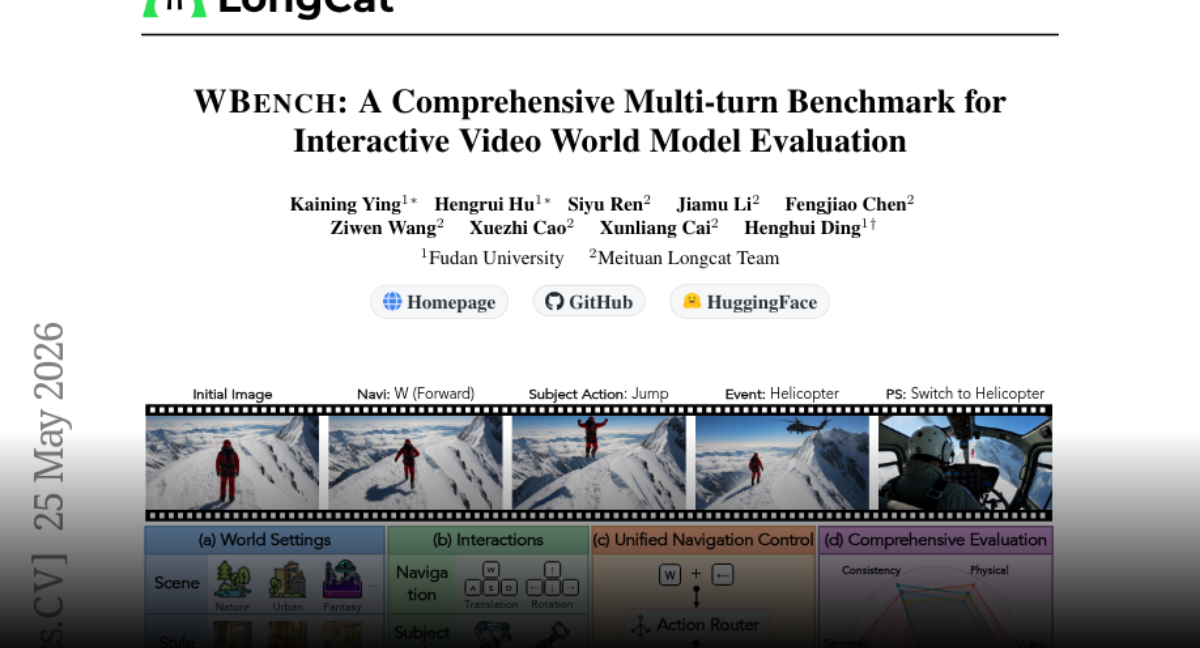
Video generation has had a beauty-contest problem for years: show the best five seconds, crop out the failure, call it a world model. WBench, a new benchmark from Meituan LongCat, is useful because it asks a less flattering question: can the model preserve a world after the user starts interacting with it?
That is the right test. A model that can render one polished clip from a prompt is not automatically a simulator, a planning substrate, a robotics environment, or a game engine. It may just be very good at plausible motion under limited pressure. WBench pushes harder by evaluating interactive video world models across 289 test cases and 1,058 interaction turns, covering navigation, subject action, event editing, and perspective switching. The headline result is not that one model won. It is that no model is strong across all five evaluated dimensions.
A world model should survive the second turn
WBench evaluates 20 video world models across video quality, setting adherence, interaction adherence, consistency, and physics compliance. That breakdown is much more useful than a single “looks good” score. Navigation tests whether moving through a scene reveals a coherent spatial hypothesis or just a texture engine with camera motion. Event editing tests whether a model can change one thing without collapsing unrelated state. Perspective switching tests whether the world exists beyond one flattering angle. Subject action tests whether entities are controllable participants, not decorative motion fields.
The benchmark also tries to normalize across different control interfaces. For navigation, WBench unifies text, 6-DoF pose, and discrete-action control, which matters because vendors increasingly expose different handles for the same underlying promise: steer the generated world. Evaluation uses 22 automatic sub-metrics, combining specialist vision models and large multimodal models, with validation against human judgments. That is not a perfect substitute for humans, but it is the only path to scalable regression testing. If world models are going to become infrastructure, teams need repeatable failures, not hand-picked sizzle reels.
The leaderboard is diagnostic, not ceremonial. On the navigation split, Kling 3.0 leads with a 79.2 average, followed by LingBot-World at 78.8, Wan 2.7 at 78.5, HY-World 1.5 at 78.4, and HY-Video 1.5 at 78.2. On the full text-driven split, Kling 3.0 leads at 79.5, Wan 2.7 reaches 78.2, and Seedance 1.5 lands at 76.2. But the best average is not the whole story: HY-World 1.5 leads interaction in the navigation split at 87.5, LingBot-World leads consistency at 88.9, Wan 2.7 leads physics at 71.8, and Seedance 1.5 leads quality at 83.2.
That spread is the useful finding. The category has not converged on one model that is “best.” It has a portfolio of failure modes. A creative video tool may tolerate weaker physics if the output is visually strong. A robotics simulator cannot. A game-prototyping workflow may care more about interaction adherence than cinematic polish. An embodied-agent testbed should punish spatial inconsistency harder than color drift. The engineering question is not “which model won WBench?” The engineering question is “which failure mode breaks my product?”
The benchmark is an antidote to demo-driven procurement
WBench arrives with more than a paper: a GitHub repo, project page, Hugging Face dataset, weights needed for evaluation, an interactive leaderboard, and a dataset gallery. During research, Hugging Face showed 45 upvotes, and the GitHub repo had climbed from 16 stars in source metadata to 33 stars via the GitHub API after being created on May 22 and pushed on May 26. That is early interest, not hype-cycle saturation. Hacker News had no visible thread for “WBench world model” during research. The developer debate has not really started yet.
It should, because WBench pushes against the way this market is sold. Most world-model claims are still filtered through vendor demos. That is dangerous for buyers and builders because demos reward first-turn aesthetics. Interactivity exposes the debt. Does an object persist when the camera moves? Does the room layout stay stable? Does a door remain where it was? Does a physics edit affect only the relevant region? Can the model change perspective without inventing a new scene? Can it follow a user instruction on turn three without forgetting turn one?
Those questions sound mundane, which is why they matter. Useful infrastructure is mundane under pressure. A world model that cannot preserve state across interaction is not a world; it is a clip generator with ambitions. There is nothing wrong with clip generation. It is valuable for marketing, storyboarding, entertainment, and design ideation. But it should not be mislabeled as an interactive environment if the “environment” evaporates when the user pokes it.
The automatic-metric strategy is also worth watching. Benchmarks can become targets, and once a benchmark gets popular, vendors optimize for its artifacts. WBench is not immune to that. The 289-case set is meaningful but not exhaustive, and “world model” remains a broad label covering controllable video synthesis, simulation-adjacent systems, and embodied-agent environments. Still, separating video quality, adherence, consistency, and physics is the correct direction. The category needs multi-axis scorecards because a single average hides exactly the failures practitioners need to see.
How to use this without worshipping the leaderboard
If you build with video or world models, the immediate action is not necessarily to run WBench end to end tomorrow. The action is to copy the evaluation philosophy. Define multi-turn tasks for your actual use case. Save the first scene state and score drift. Include irrelevant changes to see whether the model damages unrelated context. Test navigation through the same environment. Add perspective switches. Separate aesthetic quality from instruction following. Track physics compliance separately from visual appeal. Keep the ugly outputs as regression fixtures instead of deleting them from the demo folder.
Procurement teams should do the same. Ask vendors for second-turn and fifth-turn examples, not just gallery samples. Ask which dimensions the model fails on. Ask whether they can run your interaction traces. Ask for cost and latency under multi-turn evaluation, because a model that survives WBench-like tests only at impractical generation times may still be wrong for your product. Ask whether the system exposes controls your workflow actually needs: text-only steering, pose control, discrete actions, or some combination.
The broader takeaway is that world models are entering the uncomfortable phase where marketing language meets systems engineering. Pretty clips got the category attention. Interactive benchmarks will decide whether the category becomes infrastructure. WBench is not the final answer, but it is a useful gut check: if a “world model” cannot survive navigation, edits, perspective changes, and physics checks, it is not a world model yet. It is a very attractive screensaver with a roadmap.
Sources: Hugging Face Papers, arXiv, GitHub, WBench project page, Hugging Face dataset