GraspGen-X and NitroGen Show NVIDIA’s Real Physical-AI Bet: Scalable Action Data

Embodied AI keeps rediscovering the same uncomfortable truth: intelligence is not the hard part in isolation. Contact is hard. Latency is hard. Hardware variation is hard. The gap between a clean simulated policy and a robot that reliably grasps the weird object in front of it is where most robotics optimism goes to get humbled.
NVIDIA Research’s new CVPR roundup is useful because it does not pretend otherwise. The company highlights three pieces of work — GraspGen-X for cross-embodiment grasping, LCDrive for autonomous driving reasoning, and NitroGen for generalist game agents — that all point at the same strategy: if physical AI is going to generalize, it needs action data at scale, not just larger language models with better adjectives.
The three projects are not one product, and they should not be evaluated as one. GraspGen-X is the most directly robotics-facing. LCDrive is a latency-and-reasoning paper for autonomous driving. NitroGen is a vision-action model trained from internet gameplay. What connects them is NVIDIA’s bet that embodied systems need better ways to manufacture, compress, and mine behavior traces before they can become graceful in the real world.
Grasping breaks when the gripper changes
GraspGen-X attacks one of robotics’ most practical annoyances: gripper lock-in. A manipulation stack trained around one end effector often becomes quietly dependent on that hardware. Swap a parallel-jaw gripper for a high-DOF hand, or change the closing geometry, and the perception/grasp/planning pipeline can stop being portable in ways that are expensive to debug.
NVIDIA calls GraspGen-X the first foundation model for zero-shot grasping across new objects and gripper morphologies. The blog says the system used 2 billion simulated grasps across thousands of object shapes and synthetic gripper configurations. The project page and CVPR abstract give a more specific training figure of 395 million grasps with 25 procedurally generated grippers, spanning parallel two-finger, revolute two-finger, and high-DOF three-finger designs. That discrepancy probably reflects generated versus filtered training data, but it is exactly the kind of number practitioners should verify before treating the claim as procurement-grade truth.
The important technical idea is the swept-volume gripper representation. Instead of encoding a gripper as a static mesh, GraspGen-X represents the volume swept by the gripper during its closing motion. That is a better abstraction because grasping is a process, not a screenshot. The geometry that matters is not merely where the fingers are at rest; it is how they move through space as they close on an object.
If that abstraction holds up, it gives robotics teams more freedom to evaluate hardware later. Today, teams often fossilize gripper decisions early because changing the hardware means redoing too much of the software stack. A cross-embodiment grasp model could let teams test gripper candidates against task distributions before committing. That is not glamorous, but it is exactly the kind of workflow improvement that makes robotics less artisanal.
The natural pairing with cuRobo, NVIDIA’s CUDA-accelerated motion-planning library, is also telling. A generated grasp pose is not useful if the robot cannot safely reach it. The stack NVIDIA wants is clear: generate candidate grasps, plan motion fast on GPU, validate in simulation, execute with correction, repeat. The model is only one piece of the loop.
Autonomous driving cannot afford verbose reasoning forever
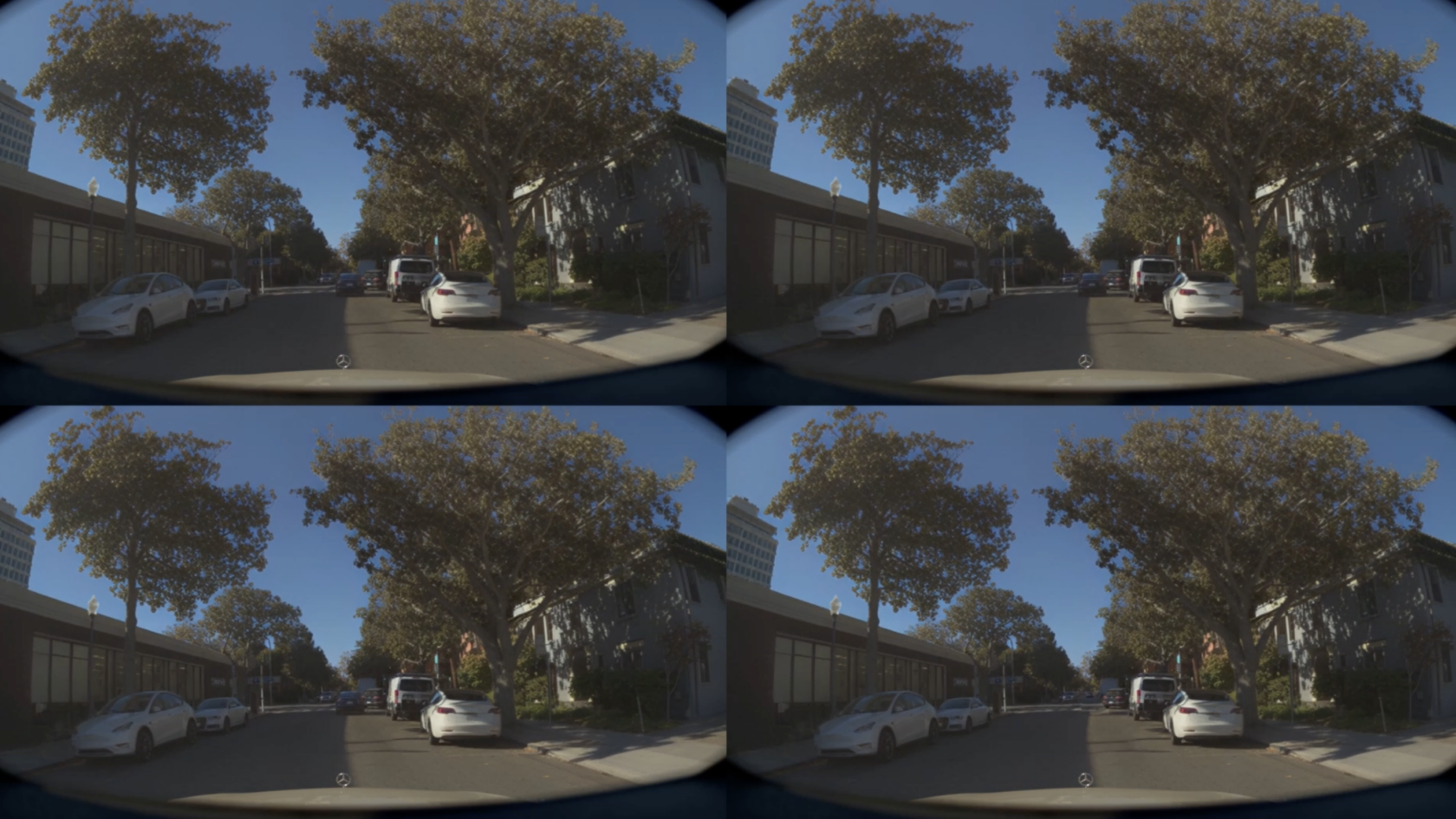
LCDrive is a different kind of physical-AI story. It replaces text chain-of-thought with compact latent representations, alternating between candidate actions and predicted future world states. NVIDIA says it achieves comparable trajectory quality to text-based reasoning while using roughly half the tokens.
That matters because autonomous driving is not a chatbot benchmark. Runtime reasoning has a hardware bill. Text reasoning is attractive because humans can inspect it, but embedded AV systems operate under tight latency, power, and safety constraints. If a model spends too much time narrating its reasoning in tokens, that cost shows up as delayed action, heavier compute, or reduced deployment feasibility.
The tradeoff is not free. Latent reasoning is harder to inspect than text. For safety cases, debugging, and regulator-facing analysis, teams still need evidence of why a system behaved the way it did. The right architecture may be split: efficient latent reasoning in the control loop, plus separate logging, replay, counterfactual analysis, and explanation layers outside the real-time path.
That distinction matters beyond AV. Many agentic systems are currently overusing language as the universal coordination format because it is convenient for developers and legible to humans. Physical systems will force a correction. Some decisions need to be inspectable. Some need to be fast. The mistake is pretending one representation should do both jobs equally well.
NitroGen is not a general game-playing agent. That is why it is interesting.
NitroGen is the weirdest project in the roundup, and probably the easiest to overstate. It is a vision-action foundation model trained on 40,000 hours of gameplay across more than 1,000 games. The public model card describes a roughly 493-million-parameter architecture using SigLip2 plus a Diffusion Matching Transformer, with 256x256 RGB inputs and gamepad actions as outputs: two continuous joystick vectors plus 17 binary buttons.
The dataset composition is unusually concrete. NitroGen includes 846 games with more than one hour of data, 91 games with more than 100 hours, and 15 games over 1,000 hours. Action-RPGs account for 34.9% of hours, platformers 18.4%, and action-adventure 9.2%. Its action-extraction pipeline reports joystick R² of 0.84 and button-frame accuracy of 0.96. In held-out game fine-tuning, NitroGen reports an average 10% relative improvement in task-completion rate, with up to 52% relative improvement in a low-data 30-hour regime.
That is a strong data-engineering story, not proof of a general gaming agent. The README is admirably blunt: the current model sees only the last frame, cannot plan over long horizons, cannot play games end-to-end, does not self-improve over time, and cannot play completely unseen games. Good. That honesty makes the work easier to place. NitroGen is a fast-reacting sensory-action pretraining base. It is not a magic gamer with a Twitch schedule.
The clever part is the supervision source. Games provide embodied environments with dense visual feedback, goals, failures, and interaction diversity. Internet gameplay videos, especially those with controller overlays or recoverable input signals, are a cheap source of noisy action labels. That is the pattern builders should copy: find the equivalent of controller overlays in your own domain.
For robotics, that might be teleoperation logs, machine-cycle traces, operator joystick streams, CAD-to-motion planning artifacts, or simulation rollouts with structured failure labels. For industrial automation, it might be PLC histories and camera feeds. For UI agents, it might be screen recordings with event logs. The model architecture matters, but the moat is often the action trace.
The practitioner read: stop worshipping demos, start auditing data loops
The useful takeaway from GraspGen-X, LCDrive, and NitroGen is not “NVIDIA solved embodiment.” It did not. A zero-shot grasping result still needs messy-object validation, sensor-noise tests, recovery behavior, and motion-planning integration. Latent AV reasoning still needs safety evidence. Gameplay pretraining still needs long-horizon planning, memory, and adaptation before it becomes agency.
But the direction is right. Physical AI will be won less by single heroic models and more by scalable ways to generate, mine, validate, and replay action-labeled data. GraspGen-X simulates grasp diversity. LCDrive compresses reasoning into a form more suitable for runtime. NitroGen mines internet-scale behavior traces. Each is a different answer to the same bottleneck: embodied intelligence needs examples of action in context, and those examples are expensive unless you get clever about where they come from.
Engineers evaluating this work should ask boring questions. What is the failure distribution? Which objects, grippers, lighting conditions, road scenes, games, controllers, or embodiments are underrepresented? Can the model expose uncertainty? Can failures be replayed? Does the synthetic data improve real outcomes, or merely benchmark performance? How does the system recover when the first action is wrong?
That last question is where the industry usually cheats. Physical systems cannot just retry forever. A failed grasp moves the object. A bad trajectory changes the road scene. A wrong button press in a game changes the state. Embodiment makes errors stateful. That is why scalable action data is necessary but not sufficient. The deployment loop still needs observability, safety boundaries, and recovery policies.
LGTM verdict: this roundup is worth reading because it is not one more “robot foundation model” press release pretending bigger means solved. It shows NVIDIA pushing on the less glamorous leverage points: gripper representations, hardware-aware reasoning, and mined behavior traces. None of these make robots graceful yet. They make the training loop less starved, and that is where real progress usually starts.
Sources: NVIDIA Blog, GraspGen-X project, NitroGen project, NitroGen model card